3-in-1 Hybrid vs Single-Function Moving Head Lights: Key Differences and Buying Guide
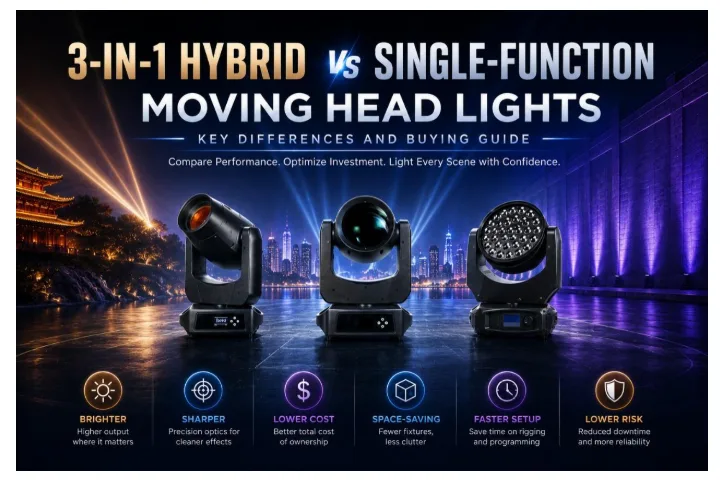
Choosing between 3-in-1 hybrid and single-function moving head lights can significantly affect the cost, flexibility, and performance of a lighting project. This guide compares their brightness, beam precision, installation requirements, downtime risks, and total ownership costs. It also explains which option is better suited for small scenic lighting projects, large night tours, immersive shows, landmark installations, and phased lighting rollouts.
What Are Single-Function Moving Head Lights?
A single-function moving head light is a fixture engineered to perform only one job — Spot, Beam, or Wash — rather than trying to cover all three. Its internal architecture is built entirely around that one output, which is why these fixtures are often the backbone of large-scale scenic lighting designs where each effect needs to be reliable and precisely defined.
Key Features: Dedicated optics built for that single output — a gobo wheel and iris for Spot, a narrow high-intensity lens for Beam, and a wide zoom range with color mixing for Wash.
Pros: Higher peak performance, simpler mechanics, and a lower unit price than a fixture trying to do all three at once.
Cons: Covering a full show requires purchasing multiple fixture types, which adds up quickly in unit count, transport logistics, and rigging points.
What Are 3-in-1 Hybrid Moving Head Lights?
Where a single-function fixture commits to one job, a 3-in-1 hybrid moving head light consolidates spot, beam, and wash output into a single housing through switchable optical modules, so one unit can shift between all three effects instead of requiring three separate fixtures.
Key Features: Mode-switching optical modules and a wider zoom range that shift between spot, beam, and wash under one DMX profile, letting a designer reconfigure a fixture’s role without swapping hardware.
Pros: Fewer fixtures needed to cover the same range of effects, saving on storage, transport, and rigging effort.
Cons: Slightly lower peak performance per mode, a bulkier housing, and the risk that one hardware failure knocks out all three effects at once.
Hybrid vs Single-Function Moving Head Lights: Key Differences
With both fixture types defined, the real question becomes how they actually compare once they’re on a rig. Six factors matter most when weighing hybrid against single-function fixtures, and understanding each one helps explain the comparison table that follows.
- Brightness Output: How much usable light a fixture can project in each mode. Large outdoor scenic lighting areas need effects to stay visible across distance, so this is often the first thing to check.
- Beam/Pattern Precision: How sharp a fixture’s gobo patterns or beam edges appear. A slightly soft effect can quietly undercut the polish signature shows are built around.
- Total Cost of Ownership: Not just purchase price, but maintenance, parts, and expected lifespan. Buyers focused only on the sticker price often pay more over a multi-year installation.
- Space and Weight: The footprint and load each fixture adds to a rig. Venues with limited truss capacity or storage tend to run into this sooner than expected.
- Rig Time: How long a full setup takes to install and program. Tight load-in windows can make this the factor that decides whether a show opens on schedule.
- Downtime Risk: How a single point of failure affects the show, and how much risk a production can afford to take on. Getting this wrong tends to surface as a costly surprise mid-run.
The table below summarizes how hybrid and single-function moving head lights stack up across these six dimensions:
| Factor | Single-Function | 3-in-1 Hybrid |
| Brightness Output | Higher — optics optimized for one mode | Slightly lower — optics shared across three modes |
| Beam/Pattern Precision | Sharper, more defined | Slightly softer due to mode-switching |
| Total Cost of Ownership | Lower per effect at scale | Lower upfront for small setups |
| Space and Weight | Lighter, smaller per unit | Bulkier, heavier per unit |
| Rig Time | Longer — more fixtures to install | Shorter — fewer fixtures needed |
| Downtime Risk | Isolated — one failure affects one effect | Compounded — one failure affects all three effects |
Buying Insights for Hybrid and Single-Function Moving Head Lights
With those six factors in mind, here’s how they translate into practical buying decisions across different installation scales, budgets, and risk profiles.
Installation Scale Influences Which Fixture Type Fits Best
For large night tour routes and signature water-and-light shows, hybrid fixtures make sense — consolidating beam, spot, and wash into one unit cuts down the number of fixtures needed across a large landscape. Signature show centerpieces are still worth budgeting for dedicated Beam fixtures, though, since their long-throw effects hold up better across open water or wide plazas.
For heritage streets and ancient town lighting, single-function fixtures are usually the safer purchase, since precise gobo projection and quiet operation matter more than raw output when highlighting architectural detail without spill.
Total Cost of Ownership Changes as Project Scale Increases
For a small route or single district, hybrid moving head lights are typically the more economical choice — one fixture replacing three means fewer units to purchase, ship, and rig.
As a route grows longer, this advantage narrows. Single-function fixtures cost less per unit and have simpler mechanics, keeping long-term repair costs lower — which is why many large, permanent routes end up standardizing on single-function fixtures despite needing more of them.
Phased Rollout Projects Involve Different Fixture Considerations
For scenic areas building out a night tour in stages, the recommended sequence is to start with versatile hybrid LED moving head light units for phase one, then add specialized beams or high-precision fixtures for signature zones once later phases are funded.
This also limits risk — rolling out district by district keeps any single sourcing or design mistake from derailing the entire experience before it’s proven out.
Downtime Risk Tolerance Varies by Show Type
How much risk a project can absorb depends on what’s at stake if a fixture fails. Signature water-and-light shows and landmark facade lighting have little margin for error, since a hybrid failure taking out spot, beam, and wash together is highly visible — making single-function fixtures the safer choice there.
Smaller heritage street lighting, festivals, or seasonal night markets can typically absorb more risk, which is often reason enough to accept a hybrid’s exposure in exchange for lower cost and faster setup.
Which Projects Are Better Suited for Hybrid or Single-Function Moving Head Lights?
Pulling these insights together, here’s a quick reference for which fixture type fits which type of project.
When to Choose a Hybrid Moving Head Light
- Small to mid-size scenic area night tours
- Ancient town and heritage street lighting
- Themed light festivals and temporary night markets
- Indoor immersive light-and-water shows (small to mid scale)
- Pilot or phase-one night tour projects
When to Choose a Single-Function Moving Head Light
- Large-scale scenic area night tour shows
- Signature water-and-light shows
- Theme park nightly light shows
- Building facade and landmark lighting
- Multi-year, permanent installations
Why Choose Dasen Lighting as Your Moving Head Light Manufacturer
Not every project fits neatly into “hybrid” or “single-function” — and Dasen Lighting builds for both, giving you room to choose the right tool for each zone of your show.
Imager H 280
The Imager H 280 is a 280W LED BSW (Beam-Spot-Wash) hybrid fixture built for outdoor durability, with an IP66 rating and a 3°–33° zoom range that lets it shift from a tight beam to a wider wash without changing hardware. It’s backed by patented four-color-wheel technology, 13+1 fixed gobos, 9+1 rotating gobos, and a 50,000-hour LED lifespan — making it a strong fit for large night tour routes or landmark installations that need one flexible fixture to cover multiple effects reliably outdoors.
ImagerB 100
The ImagerB 100 is a 100W laser moving head with an ultra-narrow 0.8° beam angle, designed for long-throw precision rather than broad coverage. Its 18/36-facet prism combination and patented eight-color-wheel system make it well suited as a dedicated Beam fixture for signature show centerpieces or open-plaza installations where a sharp, far-reaching effect matters more than flexibility.
XY-037
The XY-037 is a dedicated Wash moving head with a 5°–60° electrical zoom range and a lightweight, 13.8kg body built for fast, sensitive pan/tilt response. It’s a practical choice for heritage streets, banquet halls, or rental scenarios where even, adjustable field coverage is the priority — without the bulk or cost of a hybrid unit.
Together, these three fixtures cover both ends of the hybrid vs. single-function decision — giving you room to mix and match as your project scales.
Building the Right Lighting Mix for Your Project
Choosing between hybrid and single-function moving head lights ultimately comes down to project scale, budget, and how much downtime risk your show can absorb — hybrids offer flexibility and faster rigging for smaller or phased projects, while single-function fixtures deliver better precision and reliability at scale. Dasen Lighting supports both paths, from the hybrid Imager H 280 to the dedicated Beam ImagerB 100 and Wash XY-037. Contact us today to find the right fixtures for your next scenic lighting project.
Frequently Asked Questions About Moving Head Lights
Q1: Can Hybrid and Single-Function Moving Heads Be Used Together in the Same Show?
Yes — most night tour and light show projects mix both types on the same DMX/Art-Net control network, using single-function fixtures for core show elements and hybrids for supplementary or flexible zones, as long as all fixtures support a common control protocol.
Q2: Are Moving Head Lights Weatherproof for Outdoor Scenic Area Installations?
Not all fixtures are — outdoor night tour and scenic area projects require IP65 or higher-rated waterproof housings, so buyers should confirm the IP rating and operating temperature range before selecting either fixture type for permanent outdoor use.
Q3: How Long Does It Take to Source Moving Head Lights for a Large Night Tour Project?
Lead time depends on order volume and customization needs — standard stock models can ship within days to a few weeks, while large-scale projects requiring custom OEM specifications, bulk quantities, or specific control integration typically need several weeks of production lead time, so early supplier engagement is recommended for phased or large installations.