Commercial Lending Software: A Complete Guide for Modern Lenders
Commercial lending has become an increasingly important part of the modern financial landscape. Businesses of every size depend on financing to purchase equipment, expand operations, manage working capital, invest in property, and pursue new opportunities. At the same time, lenders are under growing pressure to make their commercial loan processes faster, more accurate, and easier for borrowers to navigate. Traditional lending methods, which often rely on spreadsheets, emails, paper documents, and separate systems, can make this difficult.
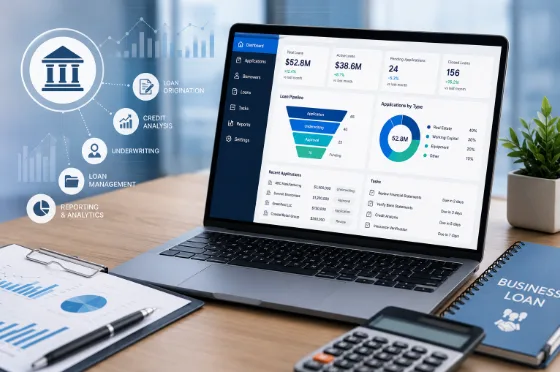
Commercial lending software provides financial institutions with technology designed to organize, automate, and improve different stages of the business lending process. Banks, credit unions, private lenders, and other financial organizations can use these platforms to manage applications, analyze borrowers, coordinate underwriting, process documents, monitor approvals, and maintain information throughout the commercial loan lifecycle.
As borrower expectations continue to change, lending institutions need technology that supports efficiency without compromising careful credit analysis. Understanding how commercial lending platforms work can help lenders determine whether modernizing their existing processes could improve both internal operations and customer experiences.
What Is Commercial Lending Software?
Commercial lending software is a digital solution developed specifically to help financial institutions originate, process, approve, and manage loans for businesses. Commercial lending is generally more complex than consumer lending because lenders may need to analyze extensive financial information before determining whether a business qualifies for financing.
A commercial loan application may involve business financial statements, tax documents, cash flow information, ownership records, existing debt, collateral details, and other supporting documentation. Employees traditionally had to collect and review much of this information manually. A digital lending system can centralize these activities and create a more organized process.
Modern platforms may support everything from initial borrower applications to underwriting, documentation, approval, closing, and portfolio monitoring. Instead of requiring employees to move information between several disconnected systems, lenders can maintain important loan data within a coordinated digital environment.
Why Commercial Lending Is Moving Toward Digital Technology
Business customers have become accustomed to digital financial experiences. Online banking, electronic payments, cloud accounting platforms, mobile financial services, and digital business tools have changed expectations about how quickly financial activities should be completed.
Borrowers increasingly expect the commercial lending experience to offer similar convenience. A business owner may prefer submitting documents electronically rather than repeatedly emailing files or visiting a branch. Digital systems can make it easier for borrowers to provide information while allowing lending teams to organize that information more efficiently.
Financial institutions also benefit from improved internal communication. Commercial lending frequently involves relationship managers, credit analysts, underwriters, compliance teams, operations employees, and senior decision-makers. When each department relies on separate files or spreadsheets, obtaining an accurate view of an application can become difficult.
A centralized platform can create greater visibility across departments. Authorized employees can review relevant information, understand the current status of an application, and determine which actions still need to be completed.
How Commercial Lending Software Works
The exact process varies according to the lender, loan type, and platform, but most commercial lending systems are built around the lifecycle of a commercial loan. The process commonly begins when a prospective borrower submits an application or when a relationship manager creates a new lending opportunity.
Borrower information can then be entered directly into the platform or collected through a secure digital portal. Financial statements and other supporting documents may be uploaded and associated with the appropriate application. This helps reduce the need to search through long email conversations or separate storage locations.
During credit analysis, lenders can review financial information, calculate relevant ratios, evaluate repayment capacity, document collateral, and identify potential risks. The application can then move through the institution’s established underwriting and approval process.
After approval, the technology may assist with documentation, closing activities, loan booking, and connections with servicing or core banking systems. Some platforms continue supporting the relationship after closing through portfolio monitoring, reporting, covenant tracking, and periodic credit reviews.
Digital Applications Create a Better Starting Point
The quality of a commercial lending process often depends on how efficiently information is collected at the beginning. Traditional applications can involve considerable manual entry, especially when borrowers submit information using paper forms, email attachments, or several different channels.
A digital application creates a more structured starting point. Borrowers can provide required information through an organized interface, while lenders can establish specific requirements according to the loan product or borrower type.
This approach can reduce incomplete applications and unnecessary communication. Instead of discovering missing documents later in the underwriting process, the system can help lending teams identify outstanding requirements earlier.
Digital applications can also improve the borrower experience. Business owners generally value a clear process that explains what information is required and provides an efficient way to submit it.
Automation Can Improve Lending Workflows
Commercial lending contains many repetitive administrative tasks. Applications must be assigned, documents reviewed, approvals requested, deadlines tracked, and information transferred between different employees.
Workflow automation can help organize these responsibilities. A lender can establish processes based on internal credit policies, loan amounts, products, risk categories, or other relevant criteria. When a particular stage is completed, the application can automatically move to the next appropriate employee or department.
Automation does not mean removing human judgment from lending decisions. Instead, it can reduce administrative work that prevents experienced professionals from focusing on more valuable activities.
Credit analysts can spend more time reviewing financial performance, relationship managers can focus more closely on borrowers, and operations teams can devote less time to tracking routine tasks manually.
Supporting Better Credit Analysis
Credit analysis remains one of the most important parts of commercial lending. Technology can organize financial information, but lending professionals still need to evaluate whether a borrower demonstrates sufficient ability and willingness to repay the proposed debt.
Commercial lending software can help analysts organize income statements, balance sheets, cash flow information, debt obligations, collateral data, and historical financial performance. Some platforms also support financial spreading and automated calculation of important credit ratios.
Having information available within a structured system can make comparisons easier and reduce manual calculation errors. It can also help institutions apply consistent analytical processes across different borrowers and lending teams.
However, technology should support professional judgment rather than replace it. Commercial borrowers operate in different industries and economic environments, and understanding those circumstances often requires experience that cannot be reduced to a single automated calculation.
Document Management Becomes More Organized
Commercial loans can generate a substantial amount of documentation. Financial statements, tax records, property information, legal agreements, ownership documents, insurance records, appraisals, correspondence, and credit memoranda may all become part of a single lending relationship.
Managing these files through separate email accounts or local folders can create unnecessary complications. Employees may struggle to locate the latest version of a document, while duplicated files can create confusion.
Integrated document management allows important records to remain connected to the relevant borrower and loan. Authorized employees can access required information without repeatedly requesting the same documents from colleagues or customers.
A well-organized document environment can also make internal reviews and compliance-related activities more manageable.
Improving the Commercial Borrower Experience
Business borrowers often judge lenders not only by pricing and loan terms but also by the quality of the overall experience. A complicated application process can become frustrating, particularly when borrowers are repeatedly asked for information they have already provided.
Modern lending technology can make communication more structured. Borrowers may be able to submit documentation electronically, respond to information requests, and receive updates more efficiently.
Faster internal workflows can also reduce unnecessary delays. This does not mean every commercial loan should receive an immediate decision. Complex transactions still require careful analysis and appropriate due diligence.
The goal is to remove avoidable administrative friction while maintaining responsible underwriting. A strong lending experience combines convenient technology with access to knowledgeable professionals who understand the borrower’s business.
Strengthening Risk Management
Commercial lending always involves risk. Borrowers can experience changes in revenue, costs, competition, management, industry conditions, and broader economic circumstances. Financial institutions therefore need reliable processes for identifying and monitoring potential problems.
Commercial lending software can support risk management by creating consistent workflows and maintaining organized borrower information. Credit policies can be incorporated into lending processes so that required reviews and approvals are completed before transactions move forward.
After a loan closes, lenders may use reporting and monitoring capabilities to observe changes in financial performance, upcoming reviews, covenant requirements, portfolio concentrations, and other indicators.
Better access to information can help lending professionals identify emerging concerns earlier and make more informed decisions about individual relationships and the broader loan portfolio.
Integration With Existing Banking Technology
Commercial lending does not operate separately from the rest of a financial institution. Loan teams often depend on core banking platforms, customer relationship management systems, document repositories, accounting tools, identity services, and other technologies.
Integration therefore becomes an important consideration when evaluating a lending platform. A system that does not communicate effectively with existing technology may create additional manual work instead of eliminating it.
Strong integration can reduce duplicate data entry and allow relevant information to move between systems more efficiently. This can improve data consistency while helping employees spend less time transferring information manually.
Before selecting a platform, lenders should carefully understand their existing technology environment and determine which connections are necessary for everyday operations.
Choosing the Right Commercial Lending Platform
Selecting the right system requires more than comparing feature lists. Financial institutions should first understand the weaknesses and inefficiencies within their existing lending process.
Management teams should consider where applications are commonly delayed, which activities require unnecessary manual work, where information is duplicated, and which parts of the process create frustration for employees or borrowers.
The right platform should match the institution’s lending model and long-term objectives. Ease of use, workflow flexibility, security, reporting capabilities, integration options, scalability, implementation requirements, vendor support, and overall cost should all be considered carefully.
A smaller lender may prioritize simplicity and rapid implementation, while a larger institution may require extensive configuration and integrations. There is no single platform that is ideal for every financial organization.
Successful Implementation Requires Careful Planning
Technology alone cannot transform an inefficient lending operation. Successful implementation also depends on process design, employee participation, leadership, training, and realistic expectations.
Financial institutions should use implementation as an opportunity to examine how loans currently move from application to underwriting, approval, closing, and portfolio management. Simply transferring an inefficient manual process into a digital environment may preserve many of the original problems.
Employees who work directly with loan applications can provide valuable insight during this stage. Relationship managers, analysts, underwriters, operations professionals, and administrators understand where delays occur and which processes create unnecessary work.
Training is equally important. Employees need to understand both how the system operates and why particular workflows have been designed in a certain way. Greater understanding can improve adoption and help institutions receive more value from their technology investment.
The Future of Commercial Lending Technology
Commercial lending is likely to become increasingly digital, connected, and data-driven. Advances in automation, artificial intelligence, data analytics, digital documentation, and system integration are creating new opportunities for financial institutions.
Technology may become increasingly effective at handling routine administrative activities and organizing large amounts of financial information. Analytical tools may also help lenders identify patterns and potential risks more efficiently.
Human expertise, however, will continue to remain important. Commercial lending involves relationships, industry knowledge, business strategy, economic conditions, management quality, and unique transaction structures. These factors frequently require professional interpretation rather than purely automated decisions.
The most effective future lending models are therefore likely to combine advanced technology with experienced lending professionals.
Building a More Efficient Lending Operation
Modern financial institutions must balance speed, convenience, responsible underwriting, security, compliance, and risk management. Achieving all of these objectives through fragmented manual processes can become increasingly difficult as lending volumes and borrower expectations grow.
Commercial lending software can provide a more organized foundation by connecting applications, borrower information, credit analysis, documents, workflows, approvals, and portfolio monitoring within a coordinated environment.
The purpose of adopting modern lending technology should not simply be replacing paper documents with digital versions. Institutions have an opportunity to rethink how their lending processes operate from beginning to end.
When the right platform is combined with thoughtful implementation and experienced professionals, lenders can reduce administrative friction, improve visibility, provide better borrower experiences, and create a commercial lending operation that is prepared for the evolving demands of modern business finance.