IPTV in France: The Streaming Revolution Disrupting Traditional Television
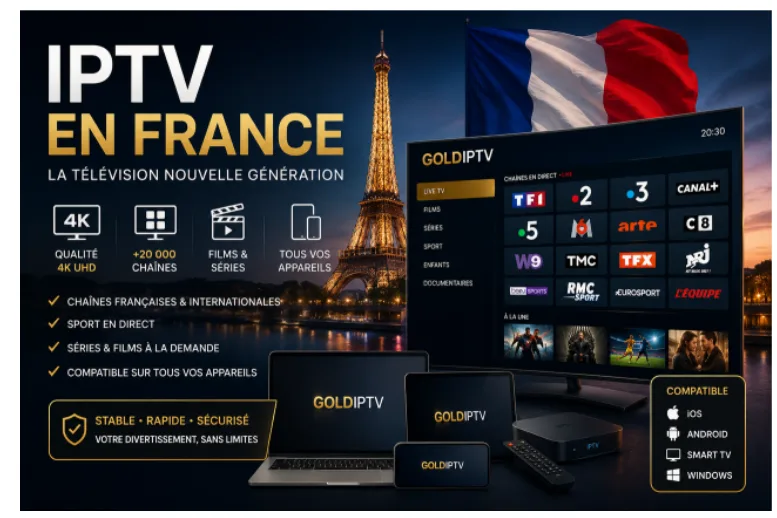
Imagine the Moreau family in Lyon. Two children, a tight budget, and a Canal+ bill that keeps increasing every year. In January 2025, they canceled their satellite subscription and switched to an IPTV solution. The result? More channels, 4K picture quality, and savings of more than €400 over the year. Their situation is far from unique. Across France, millions of households are doing the same calculation — and reaching the same conclusion. Internet television, or IPTV, is no longer a niche technology reserved for geeks. It has become a mass-market phenomenon that is fundamentally reshaping the French television landscape.
What Is IPTV and Why Is It Changing Everything?
IPTV — Internet Protocol Television — simply means delivering television content over an Internet connection rather than through coaxial cable or satellite. In practical terms, channels, movies, and TV shows arrive through the same connection you use for emails or YouTube videos. What makes IPTV so different is its flexibility. With IPTV, you are no longer limited to watching television on a single screen in the living room at a fixed time. You choose your screen — Smart TV, smartphone, tablet, or computer — and decide when you want to watch. Content adapts to your lifestyle, rather than the other way around. The numbers confirm the scale of this transition. According to ARCOM, IPTV was the primary reception method for 71.2% of television sets in mainland France during the first half of 2024. Fiber-optic connectivity, now available to more than half of households equipped with a television, is accelerating this transition even further. DTT is declining. IPTV is growing. The trend is structural.
Access to Thousands of Channels for a Fraction of the Price
This is where the IPTV model becomes particularly difficult to ignore. A traditional satellite package or cable subscription in France typically costs between €30 and €70 per month, often involving long-term commitments, installation fees, and rented equipment.
A premium IPTV service, on the other hand, can often provide thousands of channels — French, European, and international — for a fraction of that price. These catalogs may include major French free-to-air channels, sports channels, international packages, and VOD libraries containing thousands of movies and TV series available on demand.
Compatibility is another major advantage.IPTV services can work on:
- Smart TVs (Samsung, LG, Philips, etc.)
- Android TV and Android TV boxes
- iOS devices (iPhone, iPad)
- Dedicated MAG boxes
- Amazon Firestick
PC and Mac through a browser or dedicated application
One subscription, multiple devices, and coverage for the entire household. It is a fundamentally different approach from traditional cable, which often ties you to adecoder in a single room.
How Can You Test IPTV Before Committing?
This is the question everyone asks before making the switch: Will it actually work properly in my home? The good news is that reputable providers may offer trial periods designed to answer exactly that question.
Before committing to a subscription, we recommend taking advantage of a 48-hour free IPTV trial to check the stability of the signal on your Internet connection, the image quality on your equipment, and the variety of the available catalog. Two days can be enough to form a genuine opinion — and avoid unpleasant surprises. During the trial, check a few essential points:
Stability: Does the picture freeze or pixelate during peak hours?
Latency: Are live channels properly synchronized?
Compatibility: Does the service work correctly on all your devices?
Support: Is customer assistance available if you encounter a problem?
A provider that offers a no-commitment trial is also showing confidence in the quality of its service. That can be a positive sign.
Premium IPTV: 4K Quality, Stability, and Universal Compatibility
Not all IPTV services are created equal. The difference between a low-quality offer and a premium IPTV subscription quickly becomes obvious during everyday use. A premium service starts with robust infrastructure: redundant servers, sufficient bandwidth to handle audience peaks — such as Champions League finals or election nights — and availability approaching 99.9% uptime. Image quality is another key factor, with 4K Ultra HD and HDR streaming providing a viewing experience that standard DTT or satellite services may struggle to match on a large screen.
A good premium IPTV service may also include:
A regularly updated VOD library featuring recent movies and complete TV series
Multi-screen functionality, allowing simultaneous viewing on multiple devices with one account
An integrated Electronic Program Guide (EPG), as convenient as a traditional TV guide
Universal compatibility with Smart TVs, MAG devices, Firestick, Android, and iOS without complicated configurationIt is this combination of image quality, stability, and catalog variety that makes choosing a reputable service preferable to turning to suspicious offers advertised for just a few euros per month.
What Does French Law Say About IPTV?
This is an important point that is often misunderstood: IPTV itself is not illegal. The technology is completely neutral
. What is illegal is using a service that redistributes copyrighted content without obtaining the necessary rights from the copyright holders. ARCOM, France’s audiovisual regulator, clearly distinguishes between the two situations. On one side are legitimate operators — Internet service providers and authorized platforms — that distribute channels with the necessary permissions. On the other are illegal services that redistribute unauthorized streams, often at unusually low prices.
The risks for users of illegal services are real. From a legal perspective, using unauthorized copyrighted content can potentially result in serious penalties. ARCOM has also intensified its blocking measures against illegal streaming and IPTV services
. The rule is simple: if a price seems too good to be true, it may be because the service does not comply with the law.
The Future of Television Is Already Here
Traditional linear television has not disappeared — and it will not disappear overnight. However, its economic model is under increasing pressure. Younger generations no longer consume television in the same way. They move between Netflix, YouTube, catch-up services, and IPTV streams depending on what they want to watch and which screen is available. The global IPTV market is expected to continue expanding significantly over the coming years, according to market analysts. In France, connected TV is also expected to continue growing through the next decade. These figures are not simply optimistic projections; they reflect viewing habits that are already changing. Traditional operators know this. Canal+, Orange, and SFR have all incorporated Internet-based television into their offerings