TV Advertising Isn’t Dead: What Connected TV Buying Means for Brand Video in 2026
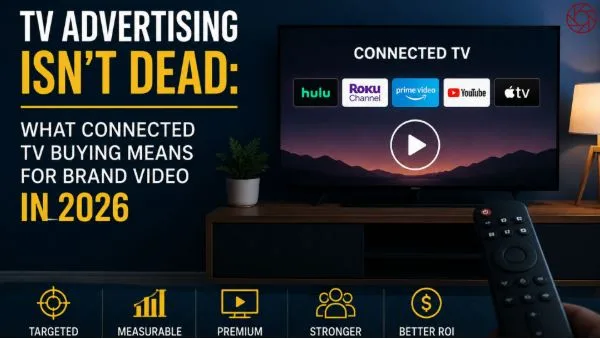
For years marketers treated television like the channel you snagged for reach and then just hoped it worked. Yeah that era is basically over now. Streaming has overtaken cable and broadcast in total viewing time, and connected tv advertising spend is projected to reach nearly 38 billion dollars in 2026, according to EMARKETER data reported by Teads. So TV advertising hasn’t vanished. It’s just shifted its form, and that small change is rewriting how brands should think about video production.
The Shift From Reach to Accountability
Traditional TV buying kind of rewarded that big broad reach idea, and then you had one polished spot that ran for months. CTV advertising works a little differently though , because ads get delivered through internet connected devices like smart TVs, streaming sticks, and gaming consoles . So, every impression can be targeted, measured , and then linked back to an actual business outcome, not just some Nielsen rating or similar.
That accountability is also nudging what brands ask for in their creative. Nielsen said streaming hit 48.6 percent of total United States TV watch time by May 2026, which is more than broadcast and cable combined. At the same time, digital video spend , including CTV alongside social and other online video, is on track to top 80 billion dollars in 2026. Budgets are sliding toward CTV because buyers can finally connect a video impression to a site visit, a lead , or a sale. If a brand still treats its video budget as only one hero spot, it’s basically leaving the measurement upside behind.
What Connected TV Buying Actually Requires From Creative
CTV is not simply a smaller version of a linear TV spot streamed online. The format carries its own production requirements that brands and their corporate video production partners need to plan for before the camera rolls.
- Multiple cuts, not one master edit. CTV campaigns often run several versions of the same core story, cut for different lengths, audiences, or placements. Planning for six second, fifteen second, and thirty second variants during the edit is far more efficient than trying to extract them afterward.
- Sound that works without dialogue dependence. Many CTV environments still play with sound on by default, but brands increasingly design creative so the story reads clearly even in sound off moments during a stream.
- Interactive and shoppable elements. Interactive CTV formats, including QR codes and clickable overlays, are seeing significant year over year growth in usage. Building space into the frame for these elements during production avoids a clumsy post production overlay later.
- Faster creative refresh cycles. Because CTV performance can be measured in near real time, brands are refreshing creative more often than the old one campaign per quarter model allowed. That means production partners need workflows built for speed, not just polish.
Planning Production Around a CTV First Strategy
A useful framework for brands rethinking their approach is to plan production the same way media buyers plan placement, like working backward from where the video will actually run, even if it feels a bit backwards at first.
Start with the funnel stage. A brand awareness spot, built for premium streaming inventory during a live sports event, calls for cinematic corporate video production values. But a performance focused CTV ad, meant to drive site visits needs a clearer call to action and a faster opening hook, because attention on a shared living room screen behaves differently than attention on a phone, so yeah.
Shoot modular, not linear. Capturing extra coverage, alternate lines, and additional product angles during the original shoot gives editors the raw material to build multiple CTV versions without scheduling a second production day, or any extra fuss.
Build measurement into the creative brief. Before production begins, define what a successful outcome looks like, whether that is a lift in branded search, site traffic, or sales, so the creative team understands what the edit needs to support, not just how it looks.
Treat linear and streaming as one plan. Brands that document a single combined TV and CTV strategy, instead of treating streaming as an afterthought bolted onto a linear buy, tend to get a clearer picture of total reach and frequency across screens, all together.
Where Local Production Expertise Fits In
CTV campaigns increasingly run alongside regional, and market specific media buys, which means brands need production partners that can sort out both national quality standards and local market logistics in a more practical way. A brand running a Southeast market test through video production in Tampa, for example, benefits from a crew that already understands local permitting, talent, and locations, instead of flying in a full production team for every regional variant, which is kinda overkill.
This is where an experienced partner like Team Unity Media becomes valuable, not as a vendor executing a single spot, but as a collaborator who understands how a shoot needs to be structured to serve both the linear master and the array of CTV cuts a modern media plan requires.
The Bottom Line
Television advertising has not lost its power. It has become more accountable, more targeted, and more dependent on creativity that was built with CTV requirements in mind from the first production meeting. Brands that plan their video production around how connected TV actually gets bought and measured will get more value from every shoot day than those still producing for a single linear spot and hoping the streaming cutdowns work themselves out.