Best Value Electric Commuter Bike of 2026: Maxfoot MF-25 vs Lectric XPress2
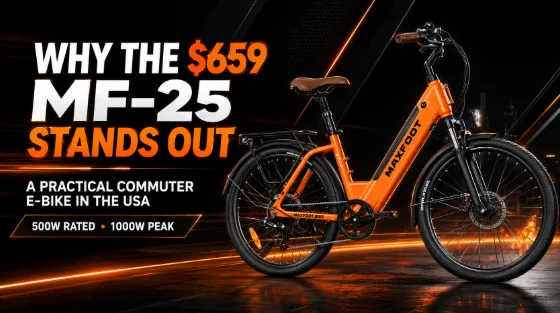
Electric commuter bikes have become more capable in 2026, but they have also become noticeably more expensive. Bigger batteries, torque sensors, hydraulic brakes, and more sophisticated electronics are increasingly common, yet not every commuter actually needs to spend well over $1,000 to get a practical everyday e-bike.
That is what makes the Maxfoot MF-25 Electric Commuter Bike interesting.
Compared with the Lectric XPress2, the MF-25 does not try to win every specification on paper. Instead, it focuses on the features that matter most for everyday transportation while keeping the price remarkably low. For riders looking for the best value electric commuter bike of 2026, the MF-25 may therefore be the more sensible choice.
Maxfoot MF-25 vs Lectric XPress2: Key Specifications
| Specification | Maxfoot MF-25 | Lectric XPress2 |
| Motor | Up to 1000W peak | 750W nominal, 1310W peak |
| Battery | 500Wh removable battery | 672Wh battery |
| Drivetrain | Shimano 7-speed | Shimano 8-speed |
| Tires | 26 x 1.95-inch puncture-resistant | 27.5 x 2.1-inch puncture-resistant |
| Suspension | Front suspension + suspension seatpost | 80mm front suspension |
| Rear Rack Capacity | Approx. 55 lbs | 30 lbs |
| Bike Weight | Approx. 59 lbs | Approx. 60 lbs without battery |
| Frame | Step-through commuter frame | Step-through commuter frame |
| Price | Around the $600–$700 range depending on promotion | Around $1,399 |
The XPress2 clearly has the advantage in several premium specifications. Its larger battery, stronger peak motor output, torque-sensing system, and more advanced component package make it an impressive commuter.
But the important question is not simply which bike has more technology.
It is how much are you paying for it?
The MF-25’s Biggest Advantage Is Value
At roughly the $600–$700 price level depending on current promotions, the Maxfoot MF-25 costs dramatically less than the Lectric XPress2, which is priced around $1,399.
That price gap changes the entire comparison.
The XPress2 may have a larger battery and more sophisticated electronics, but the MF-25 still provides a 1000W peak motor, removable 500Wh battery, Shimano drivetrain, front suspension, suspension seatpost, integrated lighting, puncture-resistant tires, and a heavy-duty rear rack.
For many commuters, that already covers nearly everything required for daily transportation.
In other words, the MF-25 is not competing by offering the longest specification sheet. It competes by delivering a surprisingly complete commuter package for significantly less money.
For someone riding several miles to work, going to school, running errands, or simply replacing short car trips, spending an extra $700 or more may not always translate into twice the usefulness.
That is why the MF-25 deserves serious consideration as one of the best value e-bikes of 2026.
1000W Peak Power Is More Than Enough for Daily Commuting
Lectric’s XPress2 reaches a higher 1310W peak output, so riders looking primarily for maximum acceleration or stronger hill-climbing performance may prefer it.
However, commuting is rarely about having the highest possible motor number.
The MF-25’s 1000W peak motor output is already substantial for a city-oriented electric bike. It gives riders plenty of assistance when accelerating from traffic lights, climbing moderate hills, or carrying groceries and commuting equipment.
For normal bike paths, neighborhood streets, and urban roads, the difference between 1000W peak and 1310W peak may matter less than the price difference suggests.
This is where Maxfoot’s approach makes sense: provide enough power for real-world riding without forcing buyers to pay for performance they may rarely use.
A Surprisingly Practical Rear Rack
One specification where the MF-25 actually stands out is rear cargo capacity.
Its rear rack is rated for approximately 55 pounds, while the XPress2 rack is rated at around 30 pounds.
For a commuter bike, that is not a minor difference.
A stronger rack makes the MF-25 better suited to carrying grocery bags, panniers, work equipment, backpacks, delivery bags, or other everyday cargo.
Commuter bikes are transportation tools first. While motor power and battery capacity attract attention in advertisements, carrying capacity often has more practical importance once the bike becomes part of someone’s daily routine.
For riders who intend to use an e-bike as an alternative to a car for shorter trips, the MF-25’s stronger rear rack becomes a meaningful advantage.
Comfort Without Paying Premium-Bike Prices
The MF-25 also includes something that is easy to overlook: a suspension seatpost.
Both bikes offer front suspension, but adding rear-end cushioning through the seatpost can make a noticeable difference on damaged pavement, expansion joints, uneven bike paths, and other surfaces commonly encountered during city riding.
This is particularly useful for commuters because they tend to ride the same roads repeatedly.
A slightly harsh section of pavement may not seem important during a short test ride, but after hundreds of commuting miles, comfort becomes much more significant.
The combination of front suspension, a suspension seatpost, step-through geometry, and 26-inch tires gives the MF-25 a practical comfort-oriented setup without pushing the bike into a premium price category.
Lighter and More Manageable for Everyday Use
Weight is another consideration that is often underestimated.
The MF-25 weighs approximately 59 pounds, while Lectric lists the XPress2 at around 60 pounds without the battery installed.
That makes the MF-25 particularly attractive for riders who regularly need to maneuver their bike manually.
This could include lifting it onto a vehicle rack, pushing it into an apartment, moving it through an office hallway, storing it in a garage, or carrying it over a short set of stairs.
Neither is an ultra-light electric bicycle, but the MF-25 manages to deliver a powerful motor, battery, suspension, and cargo capability while keeping overall weight relatively reasonable.
Where the Lectric XPress2 Is Better
A fair comparison should acknowledge that the XPress2 is the more technologically advanced bike.
It offers a larger 672Wh battery, stronger peak motor output, an 8-speed drivetrain, hydraulic brakes, and the ability to use torque- and cadence-sensing assistance.
For riders willing to pay more for refined pedal response, premium components, stronger performance, and additional technology, the Lectric is an excellent option.
But that does not automatically make it the better purchase for every commuter.
The XPress2 is a higher-specification product.
The MF-25 is arguably the higher-value product.
Those are two different things.
Which One Should You Buy in 2026?
Choose the Lectric XPress2 if your priority is getting the more advanced bike and your budget comfortably allows a purchase around the $1,400 range.
Choose the Maxfoot MF-25 if you are primarily interested in practical transportation and want to maximize what you receive for every dollar spent.
The MF-25 still provides the features most riders actually use every day: strong electric assistance, a removable battery, Shimano gearing, suspension, puncture-resistant tires, integrated lights, a step-through design, and an unusually capable rear rack.
And it delivers all of that for roughly half the cost of many premium commuter e-bikes.
Final Verdict: One of the Best Value Electric Bikes of 2026
The Lectric XPress2 wins the specification contest.
The Maxfoot MF-25 wins the value argument.
For riders who want the latest sensors and larger battery capacity, paying more for the Lectric can make sense. But for commuters who simply want a comfortable, powerful, practical, and affordable electric bike, the MF-25 covers the fundamentals exceptionally well.
Its 1000W peak power, 500Wh removable battery, suspension seatpost, 55-pound rear rack capacity, relatively manageable weight, and aggressive price point give it an unusual combination of practicality and affordability.
In a market where $1,000–$2,000 commuter e-bikes are becoming increasingly normal, the MF-25 proves that a capable everyday e-bike does not necessarily need a four-digit price tag.
For that reason, the Maxfoot MF-25 deserves to be considered one of the best value electric commuter bikes of 2026.