A Practical Guide To Bathtub Safety Modifications In NSW Homes
Why a safe-looking bathroom can still fail its daily user
A bathroom can look clean, modern, and well planned. Then someone tries to use it with stiff joints or poor balance. The polished floor becomes uncertain. A deep bath feels like a barrier. The taps sit just beyond a safe reach. Even the door may block a walking frame. These issues are easy to miss during a quick inspection because the room itself is not broken. The mismatch sits between its design and the person using it.
This guide explores that mismatch from a new angle. We will separate bathroom safety into access, support, movement, and cost. You will see what should be assessed before work begins. We also explain how disability needs and future ageing can affect the scope. Access may be improved by using bathtub safety modifications in NSW that respond to the person’s actual routine. The purpose is not to add every available safety item. It is to remove the barriers that matter most while keeping the bathroom practical and familiar.
What bathroom modifications for disabled NSW residents must be resolved first?
Bathroom modifications for disabled NSW residents should solve clear access problems. Start with the tasks that need help, extra effort, or supervision. Then check whether the room creates further limits.
1. Entry and turning space
The doorway should suit the person and their mobility aid. Turning space matters near the bath, toilet, and basin. Doors must not trap someone after a fall.
2. Stable support
Grab rails should match the user’s height and movement. Wall structure must support each fixing. A towel rail should never serve as a safety rail.
3. Reach and control
Taps, soap, towels, and shower controls need to be within easy reach. The user should not lean across wet surfaces. Lever controls may help people with weak hand grip.
4. Carer access
Some users need help with bathing or transfers. The layout must allow that support without cramped movement. The assessment should also consider future care needs.
The right solution comes from the person’s routine, not a standard checklist.
How bathtub safety modifications in NSW are checked in layers
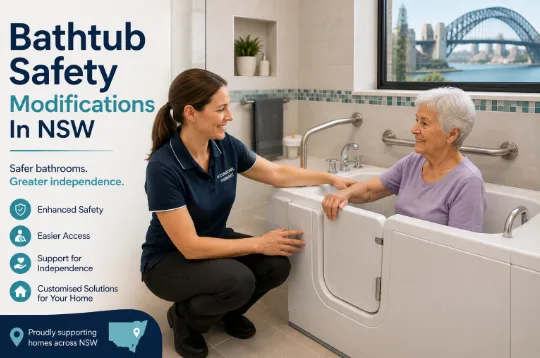
Good bath access depends on several parts working together. The opening must have a manageable step. Seals must control water during use. Support should be available before and after crossing. Nearby flooring also needs suitable grip. Bathroom modifications for elderly Sydney households should examine this full sequence because one safer feature cannot correct every risk.
Recent guidance from the Australian Commission on Safety and Quality in Health Care confirms that falls remain Australia’s leading cause of injury-related hospitalisation. Its national Falls Guidelines were revised in June 2025 for the first time since 2009. The guidance covers hospitals, aged care services, community care, and homes. It supports personal risk reviews and tailored steps rather than one fixed response.
A completed bath modification should be checked for:
- Safe entry from the user’s usual side
- Firm support throughout the transfer
- Effective sealing around the opening
- Clear access to taps and towels
- Safe movement across the exit area
Testing should reflect real use, not just visual appearance.
Why occupational therapist bathroom modifications Sydney shape cost
The final price depends on more than the bath opening. Existing bath material, wall strength, access, waterproofing, and plumbing can change the work required. Custom doors, screens, rails, or floor repairs may also affect labour. A bathtub modification cost Sydney estimate should list each inclusion clearly. It should also explain whether the bathroom can remain in use during the work.
Updated guidance from the National Disability Insurance Scheme states that qualified occupational therapists must complete minor and complex home modification assessments. The assessment records how disability affects the person at home and which changes may improve independence. Complex modifications require two itemised quotes or a qualified cost estimate. Written owner approval is also needed when the participant does not own the property.
Recommendations from occupational therapist bathroom modifications in Sydney can give installers a precise brief. Before approving a quote, check:
- Assessment and measurement details
- Required products and finishes
- Waterproofing and sealing work
- Installation and testing time
- Warranty and maintenance terms
Clear evidence makes it easier to compare value, not just price.
Create a bathroom that works on both easy and difficult days
A bathroom should remain usable when strength, balance, or confidence changes. We recommend starting with the person’s hardest movement and tracing every step around it. This reveals which changes deserve priority and which may add little value. Safe access, stable support, reliable sealing, and sensible reach should work as one plan. Families can also discuss future needs before fixing the final scope. If the bath has become a daily obstacle, arrange a personal assessment before selecting products. A well-matched change can help the room feel less demanding while protecting the comfort of home.