From Chargers to Clean Air: India’s Accessory Basket Is Quietly Changing
For years, the accessories aisle was an afterthought — the place where shoppers grabbed the nearest cable on the way to the billing counter. That is no longer how Indians buy. The accessory has become a planned purchase, researched the way phones themselves once were, and the shopping basket around the smartphone now says as much about the buyer as the phone does.
Three shifts explain the change: charging got serious, audio split into tribes, and a new category — wearable clean air — walked in from an unexpected direction.
Charging grew up first
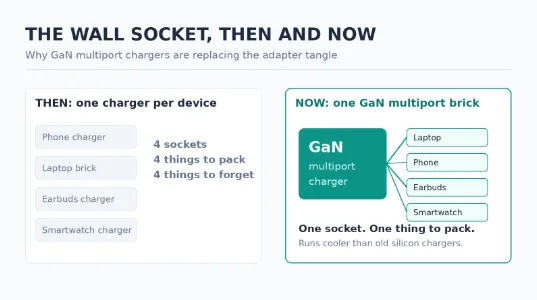
The clearest sign of a maturing market is that buyers now talk in watts. Searches for chargers increasingly specify the number — 45W for a phone, 100W for a laptop — and the technology behind the counter has shifted to match. Gallium nitride, or GaN, chargers switch faster and waste less energy as heat than the silicon bricks they replace, which is why a charger the size of a matchbox can now legitimately feed a laptop.
The follow-on effect is consolidation. Multiport GaN units that charge a laptop, phone, earbuds and a smartwatch from a single wall socket are replacing the tangle of adapters that used to travel in every laptop bag. One brick, many devices, has become the default expectation rather than a premium feature.
Audio has split into use cases, and wired refuses to die
The earphone market tells a more surprising story. True wireless earbuds dominate the conversation, and neckbands remain a distinctly Indian success — durable, hard to lose, and built for all-day battery. But search demand shows wired earphones holding remarkably steady, helped by a practical detail: as phones dropped the 3.5mm jack, Type-C wired earphones became the zero-charging, zero-latency option for calls, gaming and long workdays.
The result is not one winner but three stable tribes — earbuds for the commute, neckbands for endurance, wired for reliability — and brands increasingly build for all of them rather than betting on one.
Power banks stopped being generic
The power bank, once the most commoditised accessory of all, has stratified. Capacity now maps to lifestyle: slim 10,000mAh units for daily carry, 20,000mAh models for travel, 30,000mAh packs for field work. The interesting innovation is at the edges — built-in cables that end the forgotten-lead problem, magnetic MagSafe-style wireless charging for iPhone users, and pass-through designs that charge themselves and the phone together.
It is a category where Indian direct-to-consumer brands have been notably quick, often shipping features months before the global names refresh their line-ups.
Protection went premium alongside it
A quieter version of the same story is playing out in screen protection. The ten-rupee film pasted on at a kiosk has given way to 9H tempered glass with installation frames, edge-to-edge fits, and a fast-growing privacy segment — glass that blacks out the display for anyone glancing from the side. Privacy screen protectors barely registered in India three years ago; today they are among the most searched accessories in the category, a sign of how quickly a functional purchase can turn into a considered one when commuters spend two hours a day on crowded trains with their screens in public view.
The newcomer: clean air as a wearable
The most unexpected entrant in the accessories basket has nothing to do with charging or sound. Wearable air purifiers — pendant-style devices that use negative-ion technology to reduce smoke and dust in the wearer’s immediate breathing zone — have moved from novelty to genuine category, driven by the air-quality anxiety that arrives in North India every winter.
They sit in an interesting position: sold alongside phone accessories, worn like jewellery, and bought for health. Whether the category matures the way earbuds did will be one of the more interesting consumer-tech stories to watch, but the direction of travel is clear — personal devices are expanding beyond the phone.
What it means for buyers and brands
For consumers, the practical takeaway is that the quality gap between a considered purchase and an impulse one has never been wider. A charger is no longer just a charger; wattage, port count and safety certification decide whether it serves one device or an entire desk.
For the industry, the opportunity has shifted to homegrown direct-to-consumer players. Brands such as Loopoburq, which sells charging cables, GaN chargers, power banks, earbuds and wearable air purifiers from a single catalogue, illustrate the new playbook: compete on specification and warranty rather than price alone, and treat the accessory not as an add-on but as the product.
The phone upgrade cycle may be slowing, but everything around the phone is speeding up. The accessories drawer, it turns out, is where the interesting business is happening.
Author bio: The author covers consumer technology and India’s D2C economy, with a particular interest in the categories nobody notices until they change.