Why Your COSHH Assessments Are Already Out of Date
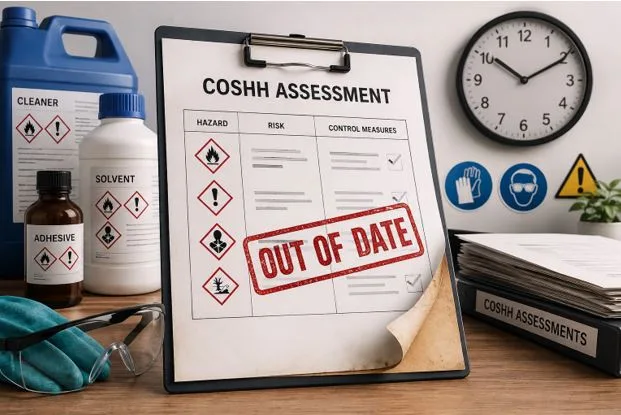
A COSHH assessment does not become outdated simply because its review date has passed.
Sometimes, it becomes outdated much sooner.
A new chemical is introduced. A supplier changes a Safety Data Sheet. Production increases. Extraction equipment is altered. Workers start using a substance differently. Yet the original assessment remains in the same folder, describing a workplace that no longer exists.
That is the real problem with an old COSHH assessment: the paperwork may look complete while the controls no longer match the actual risk.
When does a COSHH assessment need to be reviewed?
There is no single annual expiry date that applies to every COSHH assessment, and its workplace exposure limits UK
HSE guidance says assessments should be reviewed regularly and immediately where there is reason to believe the original assessment is no longer valid, or where there has been a significant change in the work that could affect exposure.
That means an assessment written 18 months ago may still be suitable for one task, while another created only a few weeks ago may already need changing.
For example, imagine a site replaces an established cleaning solvent with a different product. The task may look identical, but the new substance could have different hazards, exposure controls or workplace exposure limits.
Same task. Different substance. Different risk.
What can make an old COSHH assessment inaccurate?
Changes do not always arrive with a warning.
Review the assessment if:
- A new substance or mixture is introduced.
- A supplier provides an updated Safety Data Sheet.
- The quantity or concentration changes.
- A process, plant or piece of equipment is modified.
- Local exhaust ventilation (LEV) is changed or its performance becomes questionable.
- Workers report symptoms or concerns.
- Exposure monitoring produces unexpected results.
- PPE or respiratory protective equipment changes.
- Maintenance or cleaning activities create new exposure risks.
- New information becomes available about the substance.
HSE expects COSHH software UK English to consider factors including the hazardous properties of the substance, exposure level and duration, working conditions, relevant workplace exposure limits, control measures, and monitoring results.
A review is therefore about more than changing a date on a document.
Are you checking the current workplace exposure limits in the UK?
This is an area that can easily be missed.
UK workplace exposure limits are published by the HSE in EH40/2005. Where applicable, limits are generally expressed using an eight-hour time-weighted average and/or a 15-minute short-term exposure limit.
But do not make the mistake of treating the WEL list as a list of every substance that could cause harm.
If a substance does not have a WEL, that does not mean exposure can be ignored. COSHH still requires exposure to hazardous substances to be adequately controlled.
Your assessment should use current information from relevant Safety Data Sheets and consider how the substance is being used.
Why can spreadsheets and paper records create gaps?
The problem is often not the COSHH assessment itself. It is everything surrounding it.
A spreadsheet may contain accurate information today. But what happens when a supplier updates a Safety Data Sheet?
- Who spots the change?
- Who checks which assessments are affected?
- Who follows up on the control measures?
- Who confirms that the action was actually completed?
For businesses managing numerous substances, sites or assessments, COSHH software can make this process easier to organise. A digital system can bring assessments, documents, actions, and review information together instead of leaving them scattered across folders and spreadsheets.
LifeSafety.ai can support this approach by bringing COSHH information into a wider safety management system, helping teams keep relevant information and actions easier to manage.
The technology should support the assessment — not replace competent judgement.
What should you check during a COSHH assessment review?
Start with the workplace, not the paperwork.
Walk through the task. Look at the substances currently being used. Compare them with the latest Safety Data Sheets. Check how workers carry out the task, rather than assuming the written procedure is always followed.
Then ask:
Has the process changed?
Are existing controls still effective?
Is the LEV working as expected?
Are workers following the controls described in the assessment?
Has exposure monitoring identified a problem?
Are the relevant exposure limits and hazard information current?
HSE’s example assessments also make clear that generic assessments should not simply be copied and adopted. Controls need to reflect the actual workplace and the risks present there.
How can you keep COSHH assessments current?
Do not rely on a calendar reminder alone.
Set clear review triggers changes to substances, processes, equipment, exposure conditions and control measures. Keep current Safety Data Sheets accessible, record actions clearly, and assign responsibility for completing them.
For larger or multi-site operations, COSHH software can make it easier to organise assessments, supporting documents, actions, and review information in one place.
Most importantly, make the assessment part of day-to-day safety management rather than treating it as paperwork completed once and filed away.
A COSHH assessment should describe the workplace as it is today — not as it was when someone last opened the template.