Warning Signs of Substance Use Disorder in a Loved One
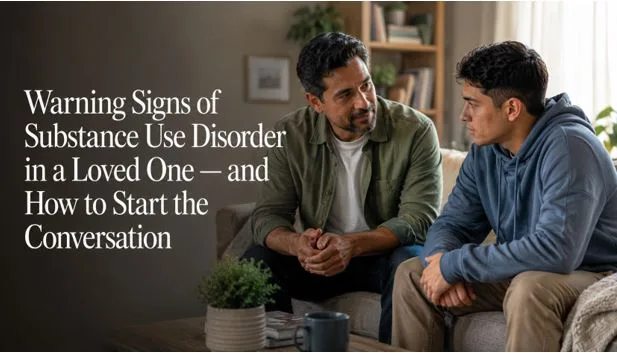
Most families do not arrive at the realization all at once. It accumulates. A missed birthday, an explanation that does not quite add up, money that goes somewhere unaccounted for. By the time the thought forms clearly enough to say out loud, it has usually been forming for a year or more.
If you are at that point, the two questions in front of you are what you are actually looking at and what to do about it. Both deserve a careful answer.
Behavioral changes worth noticing
Substance use disorder shows up in behavior before it shows up anywhere else. The pattern that matters is change – a departure from how this particular person normally operates.
- Withdrawal from people. Pulling back from friends, family, and activities that used to matter, often replaced by a newer and less familiar social circle
- Secrecy about time and whereabouts. Vagueness about where the afternoon went, defensiveness when asked ordinary questions
- Declining performance. Missed deadlines, disciplinary conversations at work, slipping grades, unexplained absences
- Mood volatility. Irritability, agitation, or flatness that does not track with what is happening in their life
- Neglected responsibilities. Bills, appointments, childcare, pets, home maintenance
- Risk-taking. Driving after drinking, unsafe situations, legal trouble
Physical signs
Physical indicators vary depending on the substance, but several are broadly relevant:
- Changes in sleep — insomnia, or sleeping through most of the day
- Significant weight loss or gain
- Decline in grooming and hygiene
- Bloodshot eyes, dilated or constricted pupils
- Tremors, unsteadiness, or slurred speech
- Frequent unexplained illness
- Smell of alcohol at unusual hours, or persistent efforts to mask breath odor
Financial and household signs
Money is often where the pattern becomes undeniable:
- Borrowing repeatedly, with explanations that shift
- Cash or valuables missing from the house
- Unpaid bills despite steady income
- Unfamiliar charges or accounts
- Empty bottles or containers hidden in closets, cars, garages, or trash
A note on alcohol specifically
Alcohol is harder to spot than most substances because so much of its use is socially ordinary. A person can drink heavily for years inside the acceptable frame of wine with dinner, a beer after work, drinks at every social event.
Watch for these shifts instead of overall quantity: drinking alone or in secret, drinking earlier in the day, needing more to reach the same effect, defensiveness when anyone comments on it, unsuccessful attempts to cut back, and morning drinking to steady tremors or nausea. That last one is a significant marker – it indicates physical dependence, and it means quitting abruptly without medical support can be genuinely dangerous. Alcohol withdrawal can produce seizures and, in severe cases, delirium tremens. Treatment for alcohol addiction should begin with a medical assessment for exactly this reason.
Preparing for the conversation
Before you say anything, three things are worth doing.
Pick your moment. Not during or immediately after use, not in the middle of a fight, not at a holiday gathering. Sober, private, unhurried.
Write down specifics. Not “you have been drinking too much” but “you missed Ellie’s recital in March, and in June you told me you were at work when you weren’t.” Specifics are harder to argue with than characterizations.
Know what you are asking for. Have an actual next step ready – an assessment appointment, a phone number, an offer to drive them. “You need help” without a concrete option is easy to deflect.
How to say it
Lead with concern, not accusation. “I’ve been worried about you” opens a door. “You have a problem” closes one.
Use “I” statements. Describe what you have observed and how it has affected you rather than diagnosing them. You are not a clinician and the diagnosis is not the point — getting them to an assessment is.
Expect denial and do not treat it as failure. Denial is close to universal in a first conversation. People rarely walk into treatment the same day someone first raises it. What you are doing is planting something that will still be there next month.
Do not argue about labels. If they reject the word “alcoholic,” let it go. Whether they accept a label is far less important than whether they see a professional.
Stay calm even if they do not. Anger and deflection are common responses. Escalating hands them a reason to change the subject.
Do not deliver it as an ultimatum unless you mean it. Boundaries are legitimate and often necessary. But a consequence you will not follow through on teaches the opposite of what you intended.
What not to do
Do not confront someone while they are intoxicated. Do not stage a surprise group confrontation without professional guidance – the dramatic televised version of an intervention can backfire badly. Do not cover for them at work, pay off the consequences of their use, or manage the fallout in ways that let the pattern continue undisturbed. And do not make it a secret the whole family maintains; isolation protects the disorder.
After the conversation
If they are open to help, move quickly. Willingness has a short window, and a same-week appointment is worth far more than a perfect plan next month.
If they are not open to it, your job shifts to staying connected, being clear about your own boundaries, and remaining a person they can come to when they are ready. Consider support for yourself as well – Al-Anon and similar family programs exist because living alongside this is genuinely hard, and the people around a substance use disorder often carry it for years without any support of their own.
New Jersey Behavioral Health Center provides assessments and treatment for individuals and families dealing with substance use and co-occurring mental health conditions. If you are unsure whether what you are seeing warrants professional attention, that uncertainty is itself a reasonable reason to call and ask.
The conversation is hard. Having it is still better than the alternative, which is waiting for something worse to make the point for you.
If you or someone you know is in crisis, call or text 988 to reach the Suicide and Crisis Lifeline.