Eyebrow Transplant: What the Procedure Involves, From Design to Full Regrowth
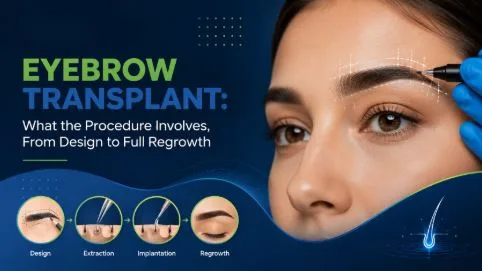
An eyebrow transplant takes living hair follicles from a donor area on the scalp and places them into the brow, usually one hair at a time, so that hair grows again where plucking, scarring, illness or ageing removed it. It is surgery, carried out under local anaesthesia, and it is the only common brow treatment that restores growing hair rather than pigment or makeup.
The operation itself is the short part. What separates a brow that looks like it was always there from one that looks applied is the angle each hair is set at, the shape agreed before the first incision, and close to a year of patience while the moved follicles restart. Most of the disappointment patients describe traces back to misjudging one of those three rather than to anything going wrong in theatre.
What an eyebrow transplant actually moves
The unit being moved is a follicular unit: a follicle, or a small natural grouping of them, lifted out complete with its root. Brow work is almost entirely single-hair grafts, because a natural brow is built from individual hairs sitting side by side rather than the clusters of two, three or four that grow across the scalp. Anything larger placed into a brow reads as a tuft.
Donor hair usually comes from the back or sides of the scalp. For finer brows, and often for women, surgeons prefer the nape of the neck or the area just in front of the ear, where hair tends to be thinner in calibre and softer, closer to the texture of real brow hair. Within a single case the finest hairs are set aside for the upper edge and the tail, where a coarse hair would show, while slightly thicker ones go into the body of the brow.
Graft numbers vary widely. Filling out a sparse tail may take a modest count, while rebuilding a brow with almost no hair left can take several hundred grafts on each side. The number is set by the size of the gap and by how much fine hair the donor area can spare, not by a standard package.
Angle and direction do more work than graft numbers
This is the technical heart of brow surgery and the reason it is not simply scalp work at a smaller scale. Brow hairs leave the skin at a very shallow angle, in the region of 10 to 15 degrees, almost lying flat against the face. Scalp hair typically exits closer to 30 to 45 degrees. A recipient site cut at scalp angles produces hairs that stand up and away from the skin, and that bristled look is the clearest sign that a brow has been transplanted.
Direction shifts along the length of the brow as well. Near the inner corner the hairs run upward and slightly outward. Across the body they lie much more horizontally. Along the tail they sweep down and out toward the temple. Where the head meets the body, hairs coming from above and below cross over one another, and reproducing that overlap is a large part of what makes a result read as natural rather than combed.
Recipient sites are therefore made small, closely spaced and staggered rather than set in rows, each one aimed individually. Correcting a badly angled brow afterwards is harder than getting it right the first time, because the correction means removing hairs one by one.
Who the procedure suits, and who is asked to wait
The strongest candidates are people whose brow loss has a settled, understood cause and who have enough fine donor hair to spare. That generally covers:
- brows thinned by years of plucking, waxing or threading, where the follicles have stopped producing hair
- scars from injury, burns or previous surgery that hair no longer grows through
- naturally sparse brows, particularly a thin or absent tail
- loss following a condition or treatment that has since been resolved and has stayed stable
Several situations lead a surgeon to postpone or decline:
- active or unstable alopecia areata, where the immune system is still attacking follicles
- trichotillomania that has not yet been brought under control, since pulling will remove the new hairs too
- frontal fibrosing alopecia and other scarring alopecias, which usually call for a long stretch of documented inactivity, often a year or more, before transplantation is considered at all; growth can look good in the first year and then be lost again as the condition advances
- an untreated medical cause such as thyroid disease, where treating the cause sometimes brings the brow back without surgery
- a donor area with too little hair, or hair too coarse, to spare
That is why an assessment for an eyebrow transplant tends to start with why the hair disappeared rather than with how many grafts it will take, and why a clinic may ask you to see a dermatologist or your GP before it will offer a surgical date. Working out the cause of brow loss is a medical judgement, and it belongs with a clinician who can examine you.
The shape is agreed before any hair is moved
Design is done with the patient sitting upright, eyes open, in ordinary light, and checked in a mirror before anything is signed off. A brow drawn on someone lying flat, or drawn to a template, will not match the face that walks out of the clinic.
A handful of decisions carry most of the outcome: where the head of the brow begins in relation to the inner corner of the eye, where the arch reaches its highest point, how far the tail runs toward the temple, and how much heavier the body is than the tail. Weight matters as much as shape, because a strongly drawn brow that suits a face now may sit oddly in fifteen years, and transplanted brow hair does not thin on the same schedule as native brow hair.
Exact mirror symmetry is the wrong target. Faces are not symmetrical, brow bones sit at slightly different heights, and forcing the two sides to match precisely tends to look more artificial rather than less. Old photographs of your own brows are more useful at this appointment than reference pictures of someone else’s. Clinics that offer a free consultation, MediWell Hair Clinic in London among them, use that appointment to work through cause, shape and suitability before a date is discussed.
What the procedure day involves
You are awake throughout, under local anaesthesia, and go home the same day. Both brows commonly take a few hours, and most of that time is placement rather than extraction.
- The agreed shape is redrawn on your face and confirmed with you, and photographs are taken for later comparison.
- The donor area is trimmed and numbed. The anaesthetic injections are the part most people describe as uncomfortable; the area is numb after that.
- Follicular units are removed individually with a small punch, spread across the donor zone rather than taken from one patch.
- Grafts are sorted under magnification. Single hairs are separated out and the finest are reserved for the tail and the upper edge.
- The brow is numbed and recipient sites are made, each at the shallow angle and the direction that part of the brow calls for.
- Grafts are placed one at a time into matching sites, fine hairs into fine sites.
- You are given aftercare instructions covering washing, sleeping position and what to avoid over the first fortnight.
Recovery, shedding and when the result can be judged
Nothing about the first month tells you how the brows will end up. They look their fullest within a day or two of surgery, before the transplanted hairs shed, and that early fullness is not the result.
| Stage | What usually happens |
|---|---|
| First 2 to 3 days | Small crusts form around each graft, with redness and some puffiness. The brows look darker and denser than the eventual result. |
| Day 7 to 10 | Crusts have generally cleared with the gentle washing routine you were given. Redness settles over the following weeks. |
| Weeks 2 to 4 | Most transplanted hairs shed. The follicles stay in place beneath the skin and enter a resting phase. |
| Months 2 to 4 | New growth starts, unevenly and a few hairs at a time. The two sides rarely begin together. |
| Months 6 to 8 | Most grafts that are going to grow are growing. Texture and direction are still settling. |
| Months 9 to 12 | Density and shape mature. This is the fair point at which to judge the result, and when a further session would be discussed. |
The shedding phase between weeks two and four is the stage that alarms people most, and it is a normal part of the process rather than a failure. Moving a follicle interrupts its growth cycle, so the visible hair is released while the follicle itself stays put and restarts. These timings are typical rather than fixed, and healing speed differs from person to person.
Transplanted brow hairs keep their scalp habits
A follicle taken from the scalp does not learn to behave like a brow follicle. It keeps the growth cycle it already had, which means it grows longer and faster than the hair around it. Transplanted brows need trimming, for most people every week or two, for as long as the hair keeps growing.
Two related points surprise patients who were told only about the surgery. Colour and texture can differ slightly from native brow hair, and because donor hairs follow scalp greying, they may turn grey on a different schedule from the rest of the brow. In the early months some hairs also need coaxing with a brow gel or light brushing to settle into the direction they were placed in. Anyone hoping for a brow that needs no attention at all should weigh that up before booking.
The limits worth knowing before you decide
Not every graft grows. Brow skin is thin and mobile and takes grafts less generously than the scalp, so the density achieved in one pass is often lower than the plan on paper. A second session at nine to twelve months, to add density or refine the shape, is a routine part of brow reconstruction rather than evidence that something went wrong. Ask at the outset whether a further session sits inside the quoted cost or is charged separately.
Recognised risks include swelling around the eyes in the first days, temporary numbness in the donor area or the brow, small pimples as new hairs push through the skin, tiny dot marks in the donor area that fade but do not vanish completely, and hairs that grow at an angle needing correction. Existing brow hairs can also shed temporarily after surgery before returning. Where the underlying cause of the loss is still active, grafts may be lost over time however well the surgery itself went.
Cost depends on the number of grafts and on the clinic, so ask for a written breakdown at consultation and check what it covers: follow-up appointments, aftercare products and any additional session. No clinic can promise a specific density or a fixed number of surviving hairs, and one that offers to is describing something it cannot know in advance.
How it compares with microblading and brow makeup
These are different tools rather than competing versions of the same thing, and the right one depends on whether your follicles are gone or merely underperforming.
| Option | What it does | Ongoing upkeep |
|---|---|---|
| Eyebrow transplant | Places your own living follicles so real hair grows in the brow | Trimming every week or two; a further session sometimes needed |
| Microblading or semi-permanent makeup | Deposits pigment in the skin in strokes that imitate hair | Repeated periodically as pigment fades and the tone shifts |
| Brow pencil, powder or gel | Sits on the surface and can be changed at will | Reapplied daily; removed by water, sweat and sleep |
| Treatments a doctor may suggest | Can help where follicles are still alive but weakened | Continuous use; no effect on scarred skin or follicles that are gone |
Previous microblading does not rule out surgery. Tell the surgeon about it, because faded pigment can sit slightly outside the shape being drawn, and once real hair grows the two outlines need to agree. Some surgeons prefer to wait until pigment has faded further before the design is finalised.
Common follow-up questions
Will the transplanted hairs go grey with the rest of my brow?
They follow the donor site rather than the destination. Hairs taken from the scalp grey on the scalp’s timetable, which may be earlier or later than your brow hair. Tinting is an option once healing is complete, and your clinic can advise on timing.
Does the donor area show afterwards?
Extraction leaves very small round marks. Because brow cases take a comparatively small number of units spread across a wide area, the donor zone is usually unremarkable at normal hair length. A very short crop, or a donor area that was already thin, are the situations where marks become easier to see.
Can the shape be adjusted later?
Adding is straightforward, removing is not. Extra grafts can be placed at a later session to thicken the body or extend the tail. Hairs that end up outside the intended shape have to be taken out individually, which is slow and can leave the surrounding area thinner. That imbalance between adding and removing is why the design appointment deserves more of your attention than the operating day.
How soon can I go back to the gym or wear makeup on my brows?
Follow the timings your own clinic gives you, because they are written around your grafts and your healing. As a general picture, the first fortnight is when grafts are most vulnerable to being knocked, rubbed or sweated on, and makeup over the brow itself waits until the skin has closed fully. Ask for those timings in writing before you leave.