Generative AI for Enterprise: How AI ROI Turns Innovation Into Business Value
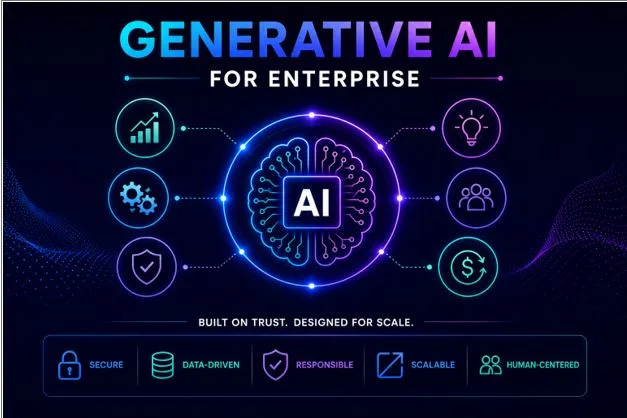
Organizations are moving beyond experimentation with generative AI and increasingly asking a more important question: what business value is it creating? Generative AI for Enterprise can improve productivity, accelerate decision-making and transform processes across finance, HR, procurement, supply chain, IT and customer operations. However, scaling these capabilities requires a clear understanding of AI ROI.
AI ROI helps leaders evaluate whether AI investments are generating sufficient financial and operational value relative to their costs. By connecting use cases with measurable outcomes, organizations can prioritize investments, determine which initiatives should scale and redirect resources away from applications that deliver limited value.
This article explores Generative AI for Enterprise, how organizations can evaluate AI ROI, the factors that influence returns and the practices required to build a value-focused enterprise AI strategy.
What is Generative AI for Enterprise?
Generative AI for Enterprise refers to the application of generative artificial intelligence across business processes, workflows and enterprise systems. Unlike consumer AI tools, enterprise applications need to operate within organizational requirements for data security, governance, integration, performance and regulatory compliance.
Generative AI can interpret and create content, summarize complex information, retrieve enterprise knowledge and support employees through natural-language interactions.
Organizations are applying these capabilities across financial analysis, procurement, software development, employee services, customer support and other knowledge-intensive processes.
The objective is not simply to introduce new technology. Generative AI for Enterprise should improve how work is performed and create identifiable business value.
What is AI ROI?
AI ROI measures the value generated by an artificial intelligence investment relative to the resources required to implement and operate it. The assessment should consider both direct financial returns and broader operational benefits.
Costs can include software licenses, infrastructure, data preparation, integration, implementation, governance, training and ongoing model management.
Benefits may include labor capacity released through automation, lower processing costs, faster cycle times, revenue improvements, reduced errors and risk avoidance.
A disciplined AI ROI approach enables leaders to compare potential investments using a consistent framework and make better capital allocation decisions.
Why AI ROI matters for enterprise AI
Generative AI creates a large number of potential use cases, but organizations rarely have the resources to implement all of them simultaneously. Without clear value criteria, investment can become distributed across pilots that generate activity without creating significant business impact.
AI ROI provides a framework for prioritization.
Organizations can evaluate use cases based on expected value, implementation cost, feasibility, risk and time to value. This helps leadership teams identify which opportunities deserve investment and which should remain lower priorities.
For Generative AI for Enterprise, this discipline becomes increasingly important as organizations move from relatively inexpensive experiments toward enterprise-scale implementations.
What determines the ROI of generative AI?
Several factors influence the economic value of enterprise AI initiatives.
Process economics
High-volume processes with significant manual effort may provide greater opportunities for productivity improvements than infrequent activities.
Technology and implementation costs
The total investment extends beyond model or software costs. Integration, infrastructure, security and ongoing support should also be considered.
Data readiness
Poor-quality or inaccessible enterprise data can increase implementation costs and reduce the usefulness of AI outputs.
User adoption
An AI solution creates limited value if employees do not incorporate it into everyday workflows. Adoption and process redesign therefore directly affect realized returns.
Scalability
A successful use case that can be extended across business units, processes or geographies may generate substantially greater value than an isolated application.
Risk
Potential compliance, security, financial and operational risks should be incorporated into the investment decision rather than evaluated separately.
Understanding these factors helps organizations develop a more realistic view of AI ROI.
Where Generative AI for Enterprise creates value
Generative AI can create value across multiple enterprise functions.
Finance
Generative AI can summarize financial performance, assist with management reporting, support analysis and improve access to finance policies and knowledge.
Human resources
AI can improve employee self-service, recruiting, onboarding, HR case management and learning content.
Procurement
Generative AI can summarize contracts, create sourcing documentation, support supplier communications and improve access to procurement knowledge.
Supply chain
AI can summarize operational information, explain planning changes and help supply chain professionals evaluate complex scenarios.
Information technology
Generative AI can support software development, incident management, technical documentation and enterprise knowledge retrieval.
Customer operations
AI can summarize customer interactions, generate responses and support intelligent self-service.
For each function, AI ROI should be connected to specific performance improvements rather than broad assumptions about the value of AI.
How to measure AI ROI
Organizations should establish a baseline before implementing an AI solution. Without understanding current performance, it becomes difficult to determine whether AI has created meaningful improvement.
Important measures can include:
- Time saved through automation or AI assistance.
- Changes in process cycle time.
- Productivity improvements.
- Reduction in operating costs.
- Revenue or margin improvements.
- Changes in service quality.
- Reduction in errors or rework.
- Risk or loss avoidance.
- Employee or customer experience improvements.
The appropriate metrics depend on the use case. A customer service application should not be evaluated using the same measures as a financial forecasting or software development solution.
AI ROI measurement should therefore begin at the use-case level before being aggregated into a broader enterprise view.
Moving from productivity gains to enterprise value
One of the most common challenges with Generative AI for Enterprise is translating individual productivity improvements into financial value.
Saving employees several minutes on a task does not automatically reduce costs or increase revenue. Organizations need to determine how released capacity will be used.
That capacity could support higher transaction volumes, reduce the need for incremental hiring, enable employees to perform more strategic work or improve customer responsiveness.
This distinction is important because theoretical productivity gains and realized economic benefits are not the same.
A strong AI ROI framework tracks how AI-enabled improvements flow through to actual business performance.
Best practices for improving AI ROI
Organizations can improve returns by taking a disciplined approach to AI investment:
- Start with clearly defined business problems rather than individual AI technologies.
- Establish performance baselines before implementation.
- Prioritize high-value use cases based on impact, feasibility and time to value.
- Include implementation, integration, governance and ongoing operating costs in the investment case.
- Redesign workflows so employees can use AI effectively.
- Define ownership for realizing expected business benefits.
- Measure actual outcomes against the original business case.
- Scale successful use cases and reconsider initiatives that consistently underperform.
This creates a continuous investment cycle rather than treating AI ROI as a one-time calculation.
Common challenges in measuring AI ROI
Some AI benefits are easier to quantify than others. Processing cost reductions can be measured relatively directly, while improvements in decision quality, employee experience or innovation may take longer to translate into financial results.
Organizations can also overestimate value by counting time savings without determining whether that capacity creates an economic benefit.
Another challenge is separating the impact of AI from other transformation initiatives occurring simultaneously. Clear baselines and well-defined KPIs can help organizations isolate the contribution of specific use cases.
Generative AI for Enterprise also introduces ongoing costs related to governance, security, model monitoring and infrastructure that need to remain part of the ROI assessment.
The future of Generative AI for Enterprise
Enterprise generative AI is evolving from standalone assistants toward AI agents capable of coordinating multistep activities and interacting with multiple business systems.
This evolution could increase AI ROI by extending automation from individual tasks to broader processes. However, more autonomous capabilities also introduce additional requirements for governance, architecture and human oversight.
Organizations will therefore need to evaluate not only whether an AI agent can perform a task but whether automating that workflow creates sufficient value relative to its cost and risk.
As AI capabilities mature, portfolio-level value management will become increasingly important. Leaders will need visibility into which investments are delivering returns and where resources should be redirected.
Conclusion
Generative AI for Enterprise offers significant opportunities to improve productivity, decision-making and business processes, but technology deployment alone does not guarantee value. Organizations need a disciplined approach for connecting AI investments with financial and operational outcomes.
AI ROI provides the framework for making that connection. By establishing performance baselines, understanding total costs, prioritizing high-value use cases and measuring realized benefits, organizations can make more informed AI investment decisions.
The organizations that create the greatest value from generative AI will not necessarily be those that deploy the most use cases. They will be those that consistently identify, scale and manage the AI investments that deliver the strongest business returns.