AI’s mark on entry-level hiring is concentrated in a handful of states, study finds
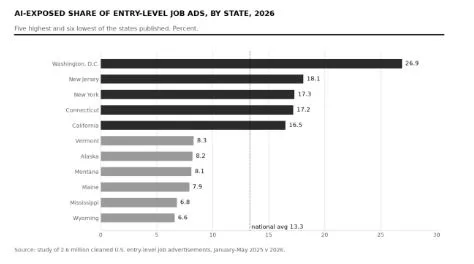
The effect of artificial intelligence on entry-level hiring is spread very unevenly across the United States, and the state-level picture is the part most likely to be reported wrongly.
The finding comes from a study that set the same five months of 2025 and 2026 side by side across 2.6 million cleaned U.S. entry-level job advertisements. Nationally it put 13.3 percent of entry-level postings in the AI-exposed category, meaning work current AI tools can already perform part of.
That national figure conceals a spread of more than 20 points. According to the entry-level figures broken out by state, Washington, D.C. leads at 26.9 percent, followed by New Jersey at 18.1 percent, New York at 17.3 percent, Connecticut at 17.2 percent and California at 16.5 percent.
At the other end sit Wyoming at 6.6 percent, Mississippi at 6.8 percent, Maine at 7.9 percent, Montana at 8.1 percent, Alaska at 8.2 percent and Vermont at 8.3 percent. An entry-level role advertised in the District of Columbia is roughly four times more likely to involve AI-exposed work than one advertised in Wyoming.
The trap in the rankings
The study attaches a warning to its own table, aimed squarely at how these numbers tend to get summarised.
Several states posting the fastest increases, among them Alabama, Ohio and North Carolina, are climbing from a low base and still sit below the national average. A large percentage jump does not make a state an AI hiring hub, and the fastest riser and the highest performer are rarely the same place. The study’s guidance is to rank by level before describing anywhere that way.
The pattern that emerges is not regional and does not follow political lines. It separates dense metropolitan economies, with their concentrations of professional, administrative and government office work, from rural states where entry-level advertising remains weighted toward work done in person. The states moving in the opposite direction are small and rural, with fewer advertisements in the sample.
The analysis measures what employers advertised rather than what they did. It does not show that any worker was hired, replaced or made redundant because of artificial intelligence, and it makes no causal claim. States with a low share are not insulated either. In many cases they simply advertise fewer of the office and analyst roles that have long served as the entry point to a professional career.