The Hidden Cost Of Buying Dental Equipment On Instinct
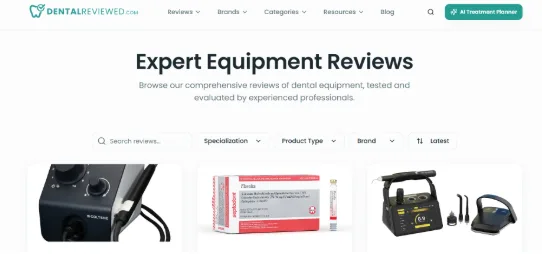
Most equipment purchases in a dental practice still come down to a demo, a sales rep, and a gut feeling. That approach has worked for decades, but the price of guessing wrong keeps climbing. Dental equipment reviews built on real clinical testing are becoming the missing step between a sales pitch and a signed invoice.
TL;DR
- Equipment costs are rising faster than reimbursement, raising the price of a bad purchase.
- Vendor demos rarely compare a product against its direct competitors under real conditions.
- Clinical reviews from practicing dentists close that gap with hands-on testing.
- Dental Reviewed builds its ratings on operatory use, not manufacturer talking points.
Why Dentists Still Buy Equipment Blind
A dental practice can spend tens of thousands of dollars on a single piece of equipment based on a fifteen-minute conference floor demo. That demo is run by the manufacturer, on the manufacturer’s terms, with the manufacturer’s best sample unit. Few dentists get the chance to run a device through a full week of patients before they buy it.
The financial stakes have gone up. Dental equipment and supply costs rose about 5 percent through September 2025, according to the American Dental Association Health Policy Institute, and about one in four dentists still planned to purchase major equipment heading into 2026. Costs climbed faster than reimbursement for many of those practices during the same stretch. A scanner or laser that underperforms doesn’t just sit unused, it drags down chair time, frustrates staff, and often gets resold at a loss.
“Dentists are trained to evaluate a patient’s mouth with real evidence, but they’re expected to evaluate a $20,000 purchase off a sales sheet,” said Marcus Hale, a practicing dentist and lead reviewer at Dental Reviewed. “That mismatch is where practices lose money. Nobody hands a scaler back after two weeks and says it just doesn’t cut it, they absorb the cost and move on.”
What Gets Lost Between The Demo And The Delivery Truck
A vendor demo is built to sell, not to compare. It rarely puts a product next to a direct competitor under the same clinical conditions, and it almost never surfaces the small frictions that show up after week three of daily use, things like insert compatibility, footpedal lag, or a learning curve that eats into a hygienist’s schedule.
Those details tend to surface only once a practice has already committed to the purchase. A handpiece that felt fine in a two-minute test grip can feel different after four hours of restorative work. A scanner’s marketed accuracy numbers say little about how it performs in a patient with a heavy gag reflex or limited opening. Clinical reviews written by dentists who have logged real hours with the equipment catch that gap before the purchase order goes out.
How Clinical Review Standards Are Changing The Decision
A small but growing set of dentists now test equipment the way they would evaluate a new material or technique, with defined criteria and a comparison against alternatives already in use. Hale described the standard his team applies before a rating goes live:
“We score a product on how it performs during an actual procedure, how it feels for the operator over a full day, how fast staff pick it up, and whether the price holds up against what else is on the market,” Hale said. “If a product can’t clear that bar in a real chair, the rating reflects it, regardless of what the spec sheet claims.”
That kind of testing has pushed intraoral scanners further into daily practice. Scanner adoption reached 62 percent of U.S. practices by 2024, driven in part by dental labs that now require digital file submissions for crown cases. Practices that delayed the purchase found themselves choosing between a rushed decision and a strained lab relationship, a pattern that plays out across nearly every equipment category once a critical mass of the field moves first.
Treating Equipment Purchases Like Clinical Decisions
The broader shift is less about any single product and more about how dentists gather information before they spend. A purchase that shapes daily workflow for years deserves the same scrutiny as a treatment plan, built on evidence from people who have actually used the equipment on patients.
Sites like Dental Reviewed have built their coverage around that standard, publishing dentist-authored reviews across categories including digital imaging, handpieces, CAD/CAM systems, and sterilization equipment. For a practice weighing its next major purchase, that kind of independent, clinically grounded comparison is becoming as routine as checking a patient’s history before a procedure.