The Fastest Way to Learn Daytrading and Swing Trading Without Losing Money
Most people who open a trading account lose money in the first year. Not because the markets are rigged against them, but because they learn the hard way, with real cash, on their first hundred trades. The traders who actually make money in the markets almost always did their learning somewhere else first: on a chart, in a simulator, under conditions where a bad decision costs nothing but a few seconds.
This article breaks down what daytrading training and swing trading practice really involve, why repetition beats theory, and how a structured routine turns a hobby trader into someone who can consistently read price action and act on it.
Why Most Traders Never Get Past Break-Even
Ask ten losing traders why they lost, and nine will blame the market. Slippage, news spikes, a broker with wide spreads. The real answer is usually simpler: they never built the pattern recognition that separates a random guess from an informed trade. Reading a candlestick chart, spotting where momentum is building, knowing when a breakout is real and when it is a trap — none of that comes from watching YouTube videos. It comes from seeing thousands of charts and getting immediate feedback on every decision.
That is the entire premise behind serious daytrading training. You are not memorizing rules. You are training a reflex, the same way a chess player trains pattern recognition by playing thousands of games rather than reading one book on openings.
The Problem With Learning on a Live Account
A live account punishes mistakes in real time and in real money. One bad session and a beginner is either broke or too scared to place the next trade. Neither outcome teaches anything useful. Worse, live charts move slowly. A single trading day might only give you two or three genuine setups, which means it can take months to see enough breakouts, reversals, and false signals to actually get good.
Why Repetition Solves It
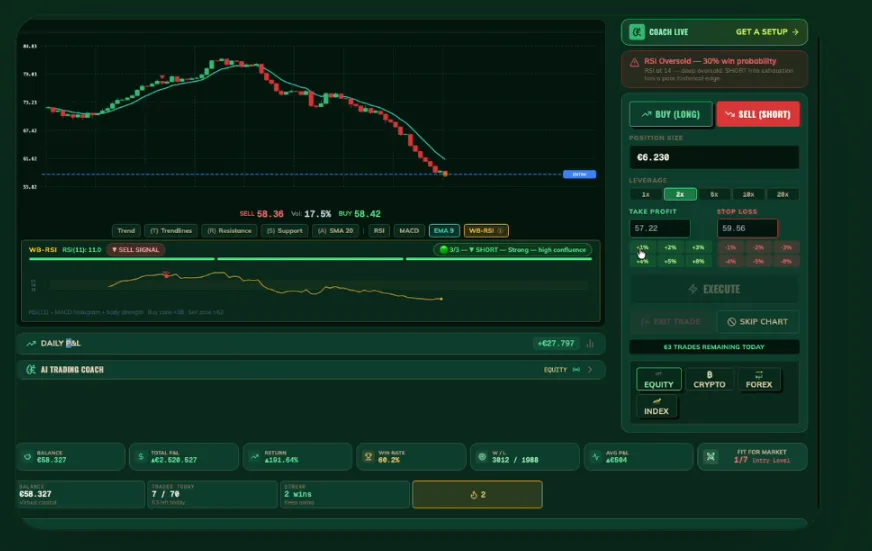
Swap a live chart for a simulator built on real historical data, and the entire equation changes. You can run a setup fifty times in an afternoon instead of waiting fifty trading days for the same number of opportunities. That is the difference between someone who has “read about” trading breakouts and someone who has actually placed a hundred breakout trades and watched, candle by candle, which ones worked and which ones reversed on them.
What a Real Practice Routine Looks Like
Becoming consistent is less about finding a secret strategy and more about narrowing down what already works for you, then repeating it until it is automatic.
Practice Daytrading on Real Historical Charts
Intraday setups move fast, so the training has to move fast too. Practicing on real historical candles, rather than made-up patterns, matters because real charts include the noise, the fakeouts, and the wicks that hunt stop-losses — the same conditions you will face with real money later.
Practice Swingtrading Across Longer Timeframes
Swing trading rewards patience and a different kind of discipline: holding through pullbacks, sizing positions correctly, and not exiting a winning trade out of nerves. Running dozens of swing setups back to back, and reviewing the outcome of each one immediately, builds that patience far faster than journaling trades you placed weeks apart.
Momentum Trading and Reading Strength Early
Momentum trading lives or dies on timing. Enter too early and you are fighting a range. Enter too late and the move is already over. Practicing entries specifically around momentum shifts — not just any setup — sharpens the one skill that actually matters for this style: recognizing acceleration before the crowd does.
Profitable Shorting Is a Different Skill Entirely
Markets have a long-term upward bias, so shorting is statistically harder than buying. Traders who never practice the short side tend to freeze or hesitate exactly when a short setup appears, and hesitation on a short is expensive. Deliberate practice on the short side, separate from long setups, closes that gap.
Turning Practice Into Instant Profit and Loss Feedback
The single biggest advantage of structured practice over reading or watching content is speed of feedback. Place a trade, and instead of waiting hours or days to find out if you were right, you see the result immediately. That instant profit and loss result is what actually rewires decision-making. It is the same principle behind flashcards for language learning: the faster the feedback loop, the faster the skill sticks.
Learning With an AI Trading Coach
A useful addition to this loop is an AI coach that reviews your trade history after the fact and points out what your data actually shows — which setups you win on, which ones you consistently lose on, and where your stop-loss placement is costing you money you did not need to lose. It is one thing to feel like you are “bad at shorts.” It is another to see the exact win rate and risk-reward numbers proving it, session after session.
Some platforms run on exactly this model: hundreds of thousands of real historical charts, instant results on every trade, and an AI coach that reads your statistics and tells you what to trade next and what to skip. It’s a free way to practice daytrading and swing trading without opening a live account first.
From Simulator to Real Money Trades
Practice only matters if it eventually leads somewhere. The point is never to stay in a simulator forever — it’s to build a track record you can trust before real capital is on the line. Once your stats show a genuine edge on a specific setup, whether that’s breakouts, momentum entries, or shorts, converting that habit into live trades stops being a guess and starts being a decision backed by data.
That’s the real shortcut to becoming a profitable trader: not a signal group, not a secret indicator, but hundreds of repetitions with honest feedback until your entries stop being emotional and start being mechanical. Anyone serious about learning daytrading or building swing trading skills can start logging real practice trades today.
Trading involves risk. Simulated results do not guarantee future performance in live markets.
Momentum Trading and Reading Strength Early
Momentum trading lives or dies on timing. Enter too early and you are fighting a range. Enter too late and the move is already over. Practicing entries specifically around momentum shifts — not just any setup — sharpens the one skill that actually matters for this style: recognizing acceleration before the crowd does.
Profitable Shorting Is a Different Skill Entirely
Markets have a long-term upward bias, so shorting is statistically harder than buying. Traders who never practice the short side tend to freeze or hesitate exactly when a short setup appears, and hesitation on a short is expensive. Deliberate practice on the short side, separate from long setups, closes that gap.
Turning Practice Into Instant Profit and Loss Feedback
The single biggest advantage of structured practice over reading or watching content is speed of feedback. Place a trade, and instead of waiting hours or days to find out if you were right, you see the result immediately. That instant profit and loss result is what actually rewires decision-making. It is the same principle behind flashcards for language learning: the faster the feedback loop, the faster the skill sticks.
Learning With an AI Trading Coach
A useful addition to this loop is an AI coach that reviews your trade history after the fact and points out what your data actually shows — which setups you win on, which ones you consistently lose on, and where your stop-loss placement is costing you money you did not need to lose. It is one thing to feel like you are “bad at shorts.” It is another to see the exact win rate and risk-reward numbers proving it, session after session.
Some platforms run on exactly this model: hundreds of thousands of real historical charts, instant results on every trade, and an AI coach that reads your statistics and tells you what to trade next and what to skip. It’s a free way to practice daytrading and swing trading without opening a live account first.
From Simulator to Real Money Trades
Practice only matters if it eventually leads somewhere. The point is never to stay in a simulator forever — it’s to build a track record you can trust before real capital is on the line. Once your stats show a genuine edge on a specific setup, whether that’s breakouts, momentum entries, or shorts, converting that habit into live trades stops being a guess and starts being a decision backed by data.
That’s the real shortcut to becoming a profitable trader: not a signal group, not a secret indicator, but hundreds of repetitions with honest feedback until your entries stop being emotional and start being mechanical. Anyone serious about learning daytrading or building swing trading skills can start logging real practice trades today.
Trading involves risk. Simulated results do not guarantee future performance in live markets.