What a TFT Boost Can and Cannot Shorten on a Placement-Based Ladder
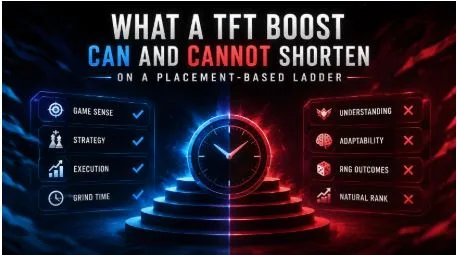
A ranked Teamfight Tactics game does not end in a win or a loss. It ends in a placement, first through eighth, and that one design choice changes how the entire ladder behaves. LP does not arrive in a lump when a team wins a fight and disappear when it loses one. It arrives in graded amounts tied to where you finished, which means the ladder is reading the shape of your results across many games rather than the outcome of any single one. Anyone weighing a TFT rank boost is buying a change to that shape, so it helps to know which parts of the climb the purchase actually touches and which parts sit outside it.
One lobby, eight results: how TFT hands out LP
Eight players share a lobby, each on a separate board, and every game produces an ordered finish rather than a shared outcome. Landing in the upper half of that order generally moves LP upward and the lower half moves it down, with the size of the move scaling by how far from the middle you finished. A first and an eighth are not simply a win and a loss; they are the two ends of a range that also holds six graded results in between.
The exact LP values attached to each placement differ by tier and get adjusted over time, so the durable thing to learn is the pattern rather than the numbers. One part of that pattern matters more than the rest: as you move up the ladder, the placement that breaks even tends to drift upward. A finish that keeps you level in a low tier can be a losing game higher up, which is why a climb that felt steady can stall without any obvious drop in play quality.
That has an immediate consequence for how progress should be measured. Win rate, the metric that governs League of Legends and Valorant ladders, does not carry over cleanly. A player who takes first place once in ten games can be climbing faster than a player who takes it twice, if the second player’s remaining games are sevenths and eighths. Average placement is the number that predicts LP, and fourth place is the hinge it turns on.
Why a TFT climb is a distribution problem, not a win streak
In a team queue your result is shared with four other players and a game resolves into one of two states. Standard TFT ranked removes that entirely: the board is yours, and nobody else’s mistakes land on your scoreline. What replaces teammate variance is lobby variance. Seven other players draw from the same unit pool and the same item drops, so two of them committing to the line you planned can turn a well-played game into a fifth.
That kind of noise does not cancel out over three games. It cancels out over dozens. Because each game returns one point in a distribution rather than a binary result, LP accumulates across a sample, and short bursts of play say very little about whether anything has changed. A rough weekend reads as a slump when it is usually just a sample too small to mean much.
It is also the reason a tft boost is scoped by a starting rank and a target rank rather than by a run of individual victories: the unit being moved is LP gathered across many finishes, and no single game is large enough to carry an order. The practical question for a buyer is therefore how many games the distance represents, not how many wins.
Set changes are the deadline that sits outside the order
Teamfight Tactics is built in sets. Each set replaces the champion pool, the traits and much of the surrounding system design, and the competitive ladder resets around those transitions instead of running continuously. The cycle is measured in months, not years, and that fact belongs in any decision about when to buy a climb.
Two consequences follow. The first is that a rank has a shelf life. A rank reached close to a transition is held for a short stretch before the ladder resets and the climb has to be made again on new pieces. The same order placed earlier in the cycle buys a longer period at that rank for the same work.
The second is that difficulty is not constant within a set either. Early on, the whole lobby is learning the same new pieces at the same time and games are messier. Later, the strong lines are documented and played precisely, and the margin for a loose game narrows. That shifts how many games a given climb takes, but it is a property of the environment rather than something an order controls. Among the queues that boosting services cover, this scheduled reset is specific to TFT, and it is the variable most often left out of the decision.
Standard ranked, Hyper Roll and Double Up are three different purchases
TFT is not one ladder. eboost, a boosting and coaching service covering League of Legends, Valorant and Teamfight Tactics, sells TFT orders across separate queues, and the progress they move is not interchangeable.
| Queue | What one game returns | Where the progress sits | What the order has to pin down |
|---|---|---|---|
| Standard ranked | A placement from first to eighth on your own board | The main ranked ladder, moved by LP through tiers and divisions | Current rank, target rank and the account’s queue eligibility |
| Hyper Roll | A placement in a shorter, faster format | A separate rating track that does not move the standard ranked ladder | The target tier in that track, and the fact that the main ladder stays where it is |
| Double Up | A placement out of four paired teams rather than eight solo boards | Its own rating, kept apart from solo ranked | Who plays the partner slot, and which rating the order is meant to move |
The ordering mistake this is meant to prevent is common enough to name. A player who wants the rank shown on their solo profile to change does not get that from a Hyper Roll order, however many tiers it moves. Queue eligibility is the other check: the account has to already meet the game’s own requirements for entering ranked, and an order does not unlock a queue the account cannot enter.
What the order actually shortens, and what it leaves untouched
The thing being sold is your time in the queue. A stronger player converts the same lobbies into a better average placement, so the LP between two ranks is collected in fewer games. Fewer, not zero. A rank distance still translates into a number of lobbies, and any description of a climb that treats the games as optional is describing something the format does not allow.
Several things sit outside what the purchase can move:
- Your own decision making. The rank on the account changes; the economy and positioning habits that produced your earlier placements do not. That is a different product, since coaching with VOD review of your own games and a live session targets the decisions instead of the number.
- The completion window. Because LP has to accumulate across a sample of lobbies, a completion time quoted for a TFT order is a projection over that sample rather than a fixed delivery date; the one firm window is booster assignment, which eboost puts within 36 hours of order confirmation.
- The terms you play under. eboost is direct about this: boosting and coaching may conflict with the game publisher’s terms of service, and a ban or restriction that follows falls on the account holder. It belongs in the decision next to the price.
- The length of the access period. A climb runs over a stretch of lobbies rather than a couple of matches, so on a solo order the login sits with the assigned booster and the support team for that whole stretch, and resetting the password when the order closes is still worth doing.
Reading your own case before you buy
A TFT rank boost fits a narrow situation well. There is a rank you want on the account, the set has enough time left for that rank to be worth holding, and your constraint is hours rather than interest in the game. What it costs scales with the LP distance being covered and with the queue that target rank sits on, so those two inputs settle the figure before anything else does.
It fits badly in several other situations, and the mismatch is usually visible in advance. If what you want is to play better, an order leaves that problem in place and coaching addresses it directly. If you want the account’s competitive record to be entirely your own, no boost satisfies that by definition. If handing over access is the part you cannot accept, playing alongside a stronger player is the middle path, and the Kind Teammates service pairs you with approved players so the games stay yours. And if a set transition is close, the rank arrives shortly before it is reset.
One test settles most of these cases. Look at the placements from your last thirty or forty ranked games rather than your last five. If most of them sit in the bottom four, an order buys a rank that your own following lobbies will pull back down, and the money does more work aimed at the decisions producing those finishes. If the distribution already sits close to break even and the only missing ingredient is the volume of games, the purchase is buying exactly the thing that is short.