Who controls the metals everyone needs
Paul Vorbach
Founder and Managing Director, AcademyGlobal (AG), the CIPS Centre of Excellence for ANZ
Adjunct Faculty at the Australian Graduate School of Management (AGSM), the University of New South Wales. | Treasurer, Society for Risk Analysis ANZ | Vice President, Institute of Strategic Risk Management ANZ
Key takeaways
- Critical mineral extraction is geographically dispersed, but the downstream refining required to produce industrial-grade materials remains concentrated within a tiny cohort of nations.
- Because midstream processing represents the principal choke point in global supply chains, host governments can curtail international material availability simply by altering export control frameworks.
- Regulatory restrictions introduced during 2025 demonstrated the speed with which supply interventions impact high-value manufacturing, with commercial automotive assembly among the first sectors affected.
- Industrial buyers are mitigating these exposures by executing extended off-take agreements, expanding buffer inventories, and soliciting sovereign co-investment to underwrite new refining facilities.
- Paying a cost premium to secure alternative processing capacity is increasingly evaluated not as a commercial inefficiency, but as a necessary risk management investment.
The Structural Bottleneck in Supply Networks
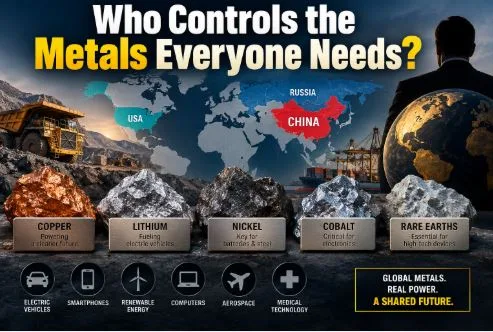
Discussions surrounding sovereign control of critical minerals typically focus on raw material extraction. Evaluated solely by mining output, global resource security appears relatively robust; copper, lithium, nickel, cobalt, and graphite are extracted across dozens of jurisdictions, a geographic footprint that has incrementally expanded over the past decade.
However, run-of-mine ore cannot be directly integrated into advanced industrial applications. Extracted minerals must undergo physical crushing, chemical separation, and high-purity refining before yielding battery-grade chemical compounds or high-coercivity permanent magnet alloys. This intermediate processing stage represents a severe geographic consolidation point. The leading processing countries often hold a large proportion of shares across the main energy minerals, and that proportion has been rising despite years of international policy intervention.
This persistence stems from high capital entry barriers. Processing facilities require substantial upfront expenditure, multi-year permitting processes, and can only achieve commercial viability when output is contractually guaranteed prior to construction. Very few countries have demonstrated the willingness to underwrite these compound risks simultaneously, resulting in newly built capacity concentrating almost exclusively within existing refining hubs.
Converting Midstream Dominance into Geopolitical Leverage
A government that hosts most of the world’s refining capacity does not need to execute overt trade embargos to project economic influence. Administrative mechanisms, such as discretionary export licensing requirements, can effectively restrict supply through procedural delays. This dynamic was demonstrated when China implemented export controls on heavy rare earth elements in April 2025. Since these elements are essential inputs for high-performance permanent magnets used in electric vehicle motors, and because immediate alternative sources did not exist, the IEA records that several automotive manufacturers were compelled to decelerate or temporarily suspend assembly operations while awaiting regulatory clearances. Broader restrictions encompassing battery chemistry inputs and specialized manufacturing equipment followed later that year. Although those subsequent measures were suspended for twelve months, the systemic vulnerability they exposed remains unmitigated.
This regulatory asymmetry directly distorts commercial pricing. Procurement entities in Europe currently pay substantial premiums for rare earth and gallium products compared to buyers operating within the primary refining jurisdiction. This price disparity reflects the financial burden of administrative delays and supply queuing rather than underlying geological availability.
These policy interventions represent a broader global trend. The Organisation for Economic Co-operation and Development (OECD) has been counting export restrictions on raw materials since 2009, and its 2026 review shows that a large share of the world’s cobalt, manganese and graphite trade now operates under formal export controls. Countries that hold the resource are increasingly using export policy to restrict raw ore exports to force foreign capital into local midstream processing, which is a rational industrial objective for host states that presents considerable operational challenges for downstream consumers.
Regional Vulnerabilities across the Asia Pacific
Australia, as the world’s leading producer of raw lithium, serves as the clearest illustration of the split between extraction and downstream refining. The overwhelming majority of that lithium leaves the country as raw concentrate bound for Chinese refineries and returns to the region later as finished battery chemistry priced by external market actors. Conversely, industrial nations like Japan, South Korea and India maintain world-class high-value manufacturing sectors while lacking the domestic processing base necessary to secure their required material feeds.
What makes the Asia-Pacific region interesting is that it already contains most of what a fully-integrated alternative supply chain would need, with Australian geology and public capital sitting alongside Japanese and Korean processing expertise and a large and growing Indian industrial base. These complementary assets have yet to be systematically integrated outside the dominant refining market.
What the buyers are doing about it
The most strategic response so far has been to remove the uncertainty that stops new plants from being built. To achieve this, governments are increasingly acting as market counterparties. Australia has committed more than a billion dollars to a Critical Minerals Strategic Reserve that allows it to sign purchase agreements, hold material and sell it on to allied buyers when supply is disrupted. This sovereign backing has already facilitated project development. For example, Arafura Rare Earths secured debt financing for its Nolans project in the Northern Territory only after the government agreed to underwrite a portion of its future output.
Concurrently, governments have also begun coordinating rather than competing. In May 2026, the foreign ministers of Australia, India, Japan and the United States announced a joint critical minerals framework designed to mobilize public and private capital into regional extraction, refining, and recycling infrastructure. Furthermore, multiple governments are evaluating national buffer stockpiles, which IEA analysis indicates represent a fraction of the economic cost associated with a major industrial supply failure.
The weakness in all of this is that investment capital still continues to flow more readily into extraction projects than into complex processing facilities. Expanding mining output without establishing corresponding downstream refining capacity does not resolve supply chain vulnerability, it merely shifts the bottleneck further along the value chain. Recognising where the bottleneck actually sits is a matter of structured risk assessment rather than market forecasting, and AcademyGlobal delivers strategic risk management programs that address concentration exposure of this kind.
Deciding what security is worth
Building an alternative supply chain is undeniably more expensive than relying on the existing one, since new processing plants outside the established centres cost more to build and more to run. The reassuring part is that these materials make up a very small share of what the finished product sells for, and the IEA’s work suggests that even a sharp rise in rare earth prices would barely register in the retail price of a car.
This economic reality alters how procurement decisions should be framed. Paying a premium for a reliable alternative supplier is not a failure of commercial discipline, but a deliberate purchase of certainty, and most organisations can absorb it without their customers noticing. Building true supply chain security requires rigorous commercial execution: structuring contracts that withstand regulatory delays, qualifying secondary suppliers prior to market disruption, and treating single-source reliance as a material enterprise risk requiring executive oversight. AcademyGlobal is the Chartered Institute of Procurement and Supply (CIPS) Centre of Excellence for Australia, New Zealand and Asia, and its CIPS professional qualifications develop precisely this form of commercial judgement.
About the Author
Paul Vorbach is the Managing Director of AcademyGlobal, a Sydney-based capability development firm established in 2004 and the CIPS Centre of Excellence for ANZ. Since 2005, Paul has trained contract management, procurement and supply chain professionals across over twenty centuries in five continents. He is Vice President of the Institute of Strategic Risk Management (ISRM) ANZ, Treasurer of the Society of Risk Analysis (SRA) ANZ, and Adjunct Faculty at the Australian Graduate School of Management (AGSM) at the University of New South Wales.
AcademyGlobal partners with public sector, private sector, and not-for-profit organisations to build the capability that underpins sustainable delivery performance, and is the Chartered Institute of Procurement and Supply (CIPS) Centre of Excellence for Australia, New Zealand and Asia.