Nail Shapes: The Complete Guide to Choosing Yours
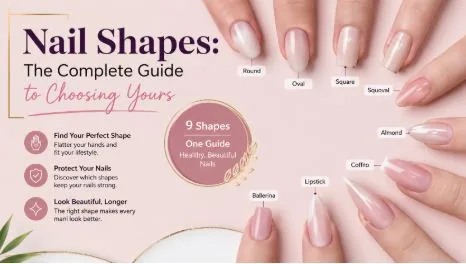
Most guides tell you which shape looks best on your hands. Few tell you which shape keeps your nails healthy while you wear it.
This guide covers both. You will learn the nine main options, how each one fits your lifestyle, and which choice actually protects your nails from breaking. The advice below draws on dermatology guidance, not just style trends.
If you scroll through nail inspo online, you will notice most looks start with a shape, not a polish color. Getting the shape right first makes every design after it look sharper.
Quick Answers
Nine shapes cover almost every style you will see in a salon or online. Almond ranks as the most requested shape worldwide. But dermatologists point to a different shape as the strongest for daily wear. Your nail health should guide your choice as much as your hand shape does. We explain why below.
Round Nails
Round nails follow the natural curve of your fingertip. The sides stay straight. The tip forms a smooth half circle.
This shape suits narrow nail beds well. It also works for anyone who types, cooks, or uses their hands often during the day.
Round nails carry real health benefits too. The American Academy of Dermatology recommends cutting nails straight across, then rounding the tips slightly for maximum strength. A rounded tip spreads pressure evenly across the nail plate. That reduces the chance of cracks starting at a sharp corner.
Round nails need very little upkeep. You rarely deal with snags or chips.
They do less to lengthen your fingers than other shapes. On wide nail beds, they can look plain.
Oval Nails
Oval nails taper slightly at the sides before rounding into a full curve. Picture a rounded egg shape at your fingertip.
This shape flatters short fingers because the taper adds a sense of length. Wide nail beds look narrower too.
Oval nails also score well for health. The gentle curve avoids sharp corners, so it shares much of the strength benefit that round nails offer. People recovering from breakage often choose oval while their nails grow back.
The shape needs a bit of length to show its taper. On very short nails, it can look close to round.
Square Nails
Square nails have straight sides and a flat tip filed straight across. The corners meet at sharp angles.
This shape works at any length and gives a clean, modern look. It suits long, narrow nail beds especially well.
Square nails carry more risk for damage. Sharp corners catch on fabric, hair, and bag straps. Each catch puts stress on the nail plate. The American Osteopathic College of Dermatology recommends filing snags gently with a fine file to stop small cracks from spreading. If your nails already feel brittle, square shapes will test that fragility fast.
Choose square if your natural nails are strong and you do not use your hands roughly during the day.
Square tips also work well for classic manicure styles. Black french tip nails, a darker take on the traditional white line, look especially clean on a flat square edge.
Squoval Nails
Squoval blends square and oval. The sides stay mostly straight, but the corners soften into a gentle curve.
This shape works for nearly every hand type. It removes the sharp corners of square nails while keeping a bold, flat tip.
Because the corners are rounded, squoval carries a lower breakage risk than pure square nails. It sits closer to round and oval on the strength scale.
Squoval rarely makes a strong style statement on its own. Some people find it a bit plain compared to more tapered shapes.
Almond Nails
Almond nails taper on both sides and round to a soft point, like the nut they are named after.
This shape flatters nearly every hand type. Short fingers look longer. Wide nail beds look narrower. The soft tip avoids the sharpness of a stiletto point.
Almond needs real length to hold its shape. At very short lengths, it starts to look like oval instead. It is also a common pick for nail inspo boards, since the tapered tip photographs well.
On the health side, almond sits in the middle. The tapered sides create some weak points near the tip, but the rounded peak avoids a hard corner. People with moderately strong nails can usually wear almond without trouble. Those with thin or peeling nails may want to wait until nails grow stronger first.
Coffin Nails
Coffin nails, also called ballerina nails, taper like almond but end in a flat, squared tip instead of a point.
This shape needs real length to look right. Short nails lose the flat tip effect almost completely.
Coffin nails carry more risk. The flat edge and tapered sides both created stress points. Fabric and everyday tasks catch on the edge easily. This shape works best for people with strong, healthy nails or with extensions, since natural nails often cannot hold up under daily use in this shape.
Stiletto Nails
Stiletto nails taper sharply to a narrow point. They are the most dramatic shape on this list.
This shape needs significant length, usually at least ten millimeters past the fingertip, to look balanced.
Stiletto carries the highest breakage risk of any shape here. The narrow tip has very little surface area to absorb pressure. Most people who wear this shape use extensions rather than their natural nails. Save stiletto for special events rather than daily wear if you care about nail strength.
Duck Nails
Duck nails, also called flare nails, widen instead of narrow toward the tip. The shape flares outward, like a fan.
This bold look suits people who enjoy nail art and do not mind a striking, unusual shape.
The wide flared tip catches on pockets and fabric often. It also requires skilled filing to avoid weak points where the nail widens. This is not a shape for first time wearers or for anyone prone to nail damage.
Lipstick Nails
Lipstick nails have a squared shape that slants diagonally across the tip, similar to the angled edge of a lipstick bullet.
This shape stands out because so few people wear it. It suits confident, trend forward style choices.
The angled tip creates an uneven edge, which means uneven stress across the nail. Treat this shape as an occasional style choice rather than an everyday one if nail strength matters to you.
Shape Comparison At a Glance
- Round: Best for active hands and beginners. Nail strength is highest. Needs only short length. Maintenance is low.
- Oval: Best for short fingers and everyday wear. Nail strength is high. Needs short to medium length. Maintenance is low.
- Square: Best for office settings and strong nails. Nail strength is lower. Works at any length. Maintenance is medium.
- Squoval: Best for nearly everyone. Nail strength is high. Needs short to medium length. Maintenance is low.
- Almond: Best for most hand types. Nail strength is medium. Needs medium to long length. Maintenance is medium.
- Coffin: Best for events and strong nails. Nail strength is lower. Needs long length. Maintenance is medium to high.
- Stiletto: Best for special occasions. Nail strength is lowest. Needs long length. Maintenance is high.
- Duck: Best for nail art fans. Nail strength is lower. Needs short to medium length. Maintenance is medium.
- Lipstick: Best for trend experiments. Nail strength is lower. Needs medium length. Maintenance is medium.
How to Choose Your Shape
Work through these four questions in order. Each one narrows your options.
First, check your nail health. If your nails peel, split, or feel thin, start with round or oval. These shapes put the least stress on weak nails. Save sharper shapes for after your nails grow stronger.
Second, think about your lifestyle. People who type all day, work with their hands, or chase kids around need shapes that resist snagging. Round, oval, and squoval handle daily wear best.
Third, look at your actual hands. Short fingers benefit from tapered shapes like oval or almond. Wide nail beds look narrower with the same tapered shapes. Long, narrow fingers can carry square or coffin well.
Fourth, factor in your style goals. If you want drama for one event, stiletto or coffin can work even if you would not wear them daily. If you want a shape you barely think about, squoval or round fit that goal.
The Truth About Flattering Shapes
Nail shape advice often treats hand proportions like a rule you must follow. That advice misses the point.
A shape only works if it fits your actual nails and your actual week. Almond might elongate your fingers on paper, but it will not survive a week of manual labor. The best shape is the one you can keep, not just the one that looks best in a photo.
Your comfort matters as much as any visual rule. If you hate how a shape looks on you, no amount of elongation will change that.
Switching Shapes Safely
Moving from one shape to another does not have to damage your nails.
Filing down is the gentlest transition. Square to squoval, for example, only requires rounding the corners. This takes a few minutes with a fine file.
Growing into a new shape takes longer but causes less stress. If you want almond but currently wear short square nails, let your nails grow before you start tapering. Filing a short nail into a dramatic taper removes strength you need.
A visit to a nail technician helps for bigger jumps, like square to stiletto. A professional can shape gradually across a few appointments instead of filing away too much strength at once.
Final Thoughts
Your nail shape says something about your style. It should also protect the nails underneath it.
Start with your nail health, then layer in your lifestyle and your look. That order gives you a shape that lasts, not just one that photographs well.
A note on scope: this guide focuses on shape choice and nail health basics. It does not replace medical advice. Mayo Clinic’s guide to fingernail care covers general signs to watch for. If you notice ongoing nail pain, color changes, or splitting that does not improve, see a board certified dermatologist.
Frequently Asked Questions
What is the most popular nail shape?
Almond ranks as the most requested shape in most salons and online searches. It flatters a wide range of hand types.
What nail shape is best for weak or brittle nails?
Round and oval put the least stress on the nail plate. The American Academy of Dermatology recommends rounding nail tips slightly for maximum strength, which matches these two shapes closely.
Can nail shape damage your natural nails?
Yes. Sharp corners and pointed tips create weak spots where nails can crack or split. Rounded shapes reduce this risk.
What nail shape is easiest to maintain?
Round and squoval need the least upkeep. Neither has sharp corners that chip or snag.
What is the difference between coffin and almond nails?
Almond ends in a soft, rounded point. Coffin tapers the same way but ends in a flat, squared tip instead.
What nail shape should beginners try first?
Round or oval. Both are forgiving to file and low risk for breakage while you learn what you like.
What nail shape is best for short nails?
Round and oval work best on short nails. Almond and coffin need length to hold their shape.