Turning Darkness into Light: How a Night Vision Device Works
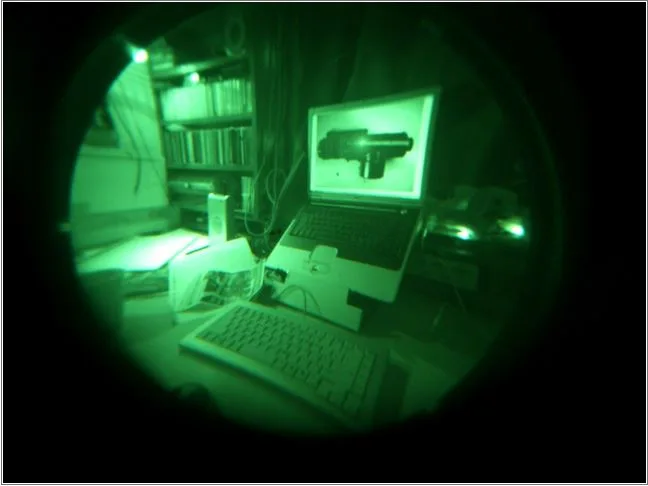
A night vision device does not literally make darkness brighter and does not “see” heat like a thermal imager. Its task is different. It collects the small amount of light that is already present around, amplifies it many times, and turns it into an image distinguishable by the human eye. Where does this weak light come from? Even on a night that seems completely dark, there are usually photons from celestial bodies and the urban skyglow.
Now let us try to understand in more detail how night vision works.
Everything Begins with the Objective Lens
The objective lens is needed to collect the greatest possible amount of light and focus it onto the input surface of the image intensifier tube.
For tactical night vision goggles, the following are important:
- objective lens diameter;
- aperture;
- quality of the glass and coatings;
- transmission in the near-infrared range;
- focusing accuracy.
Cheap optics can noticeably reduce the efficiency even of a good image intensifier tube. This is sometimes underestimated. If the glass loses contrast, produces glare, or poorly transmits the required spectrum, there is simply nothing left for the electronics to save.
The Photocathode: Light Becomes Electrons
After the objective lens, the photons reach the photocathode. This is a light-sensitive layer that converts the incoming light into electrons. The principle of its operation is very simple. The more photons hit a particular area, the more electrons are released in this area.
This is how an electronic copy of the image is formed.
The efficiency of the photocathode is often evaluated by its sensitivity. This is a somewhat simplified approach. High sensitivity by itself does not guarantee a perfect picture. Here, its combination with a low noise level and good resolution is rather what matters.
Amplification in the Microchannel Plate
In modern devices, the microchannel plate (MCP) can confidently be called the key element of light intensification technology. Outwardly, it is an ultra-thin plate with a huge number of microscopic channels. Their number can reach millions. Each channel works as a miniature electron multiplier.
When an electron enters a channel, it strikes its wall and knocks out additional electrons. They, in turn, collide with the walls farther along the channel and create new ones. A cascade appears.
In this way, the weak electronic pattern is amplified thousands of times, while the spatial structure of the original scene is preserved.
Electrons Become Light Again
After amplification, the flow of electrons is directed onto the phosphor screen, collides with it, which leads to the appearance of luminescence. Thus, the electronic image is turned back into a photon image, which the user sees through the eyepiece.
Previously, green phosphor was used almost everywhere. This color was chosen not by accident, because the human eye distinguishes shades in the green part of the spectrum well, and prolonged observation of such an image does not cause discomfort.
In modern devices, white phosphor is being used more and more often. The image in such systems looks gray-white or slightly bluish. Many users consider it more natural, especially when recognizing details, shadows, and terrain changes.
What Happens in Almost Complete Darkness
The intensifier cannot create useful information out of nothing.
Let us say, in a tightly closed basement without windows or in a dense night forest under heavy cloud cover, there are practically no photons. Therefore, graininess appears, and details begin to disappear.
Under such conditions, infrared illumination is indispensable.
The IR illuminator emits light that is invisible to the naked eye but is well perceived by the night vision device. For the user, the scene becomes brighter, almost as if using a flashlight.
One important point to keep in mind is that another person with a night vision device may see your source of infrared radiation. Therefore, for tactical tasks, keeping the IR illuminator constantly switched on is not always safe.
For observing animals, the situation is simpler. As part of nighttime wildlife observation gear, the infrared illuminator is often used without such restrictions, although an excessively bright source can sometimes alert animals because of the faint red glow of the diode or the illuminator housing itself.