8 wholesale food distribution software tools, sized to the business that buys them
Key takeaways
- Published entry pricing in this category starts around $129 per user per month. Enterprise implementations for a similar job are quoted at six figures before anyone logs in.
- The phrase covers three different products: order capture layers, mid-market distribution platforms, and full food ERPs. Buying a tier too high is the expensive mistake.
- Setup runs from 24 to 48 hours for an order layer to roughly 50 working days for enterprise ERP.
- Lot traceability, catch weights, and per-customer order guides separate food software from generic wholesale software. A system missing them costs a distributor time every day.
Two food distributors with similar revenue can pay $129 per user per month for their core system, or sign an implementation contract quoted at six figures before anyone logs in. Both bought something sold as wholesale food distribution software.
The gap is not about quality. It is about tier. The phrase covers at least three products that do different jobs, and distributors regularly buy one sized for a company ten times larger. The result is a long rollout, a system nobody uses fully, and an order desk still working off voicemail because the new platform never fixed that part.
Below are eight tools, ordered from the lightest commitment to the heaviest, with published pricing where it exists, the setup time to expect, and the honest limitation on each.
What wholesale food distribution software actually covers
Three separate product types share this label, and they solve different problems.
Order capture layers fix how the order arrives. They take a phone call, a voicemail, or a text and turn it into structured data the existing system can read. They do not touch accounting or warehouse operations.
Distribution platforms run inventory, purchasing, order processing, and often the accounting ledger for a small to mid-size wholesaler. One system, one database, moderate setup.
Food ERPs add the parts that only matter in food: lot traceability for recalls, catch weights for items sold by variable weight, first-expired-first-out picking, and country-of-origin data. They cost more because that compliance work is genuinely hard to build.
The food-specific features are the test worth applying early. Generic wholesale software can track a case of gloves perfectly and still fail to tell a distributor which restaurants received a specific lot of ground beef.
The eight tools
Each entry below covers the job the tool does, what it costs where the price is public, and where it stops.
1. VoiceOrder Solutions
Best for: distributors whose orders still arrive by phone and voicemail.
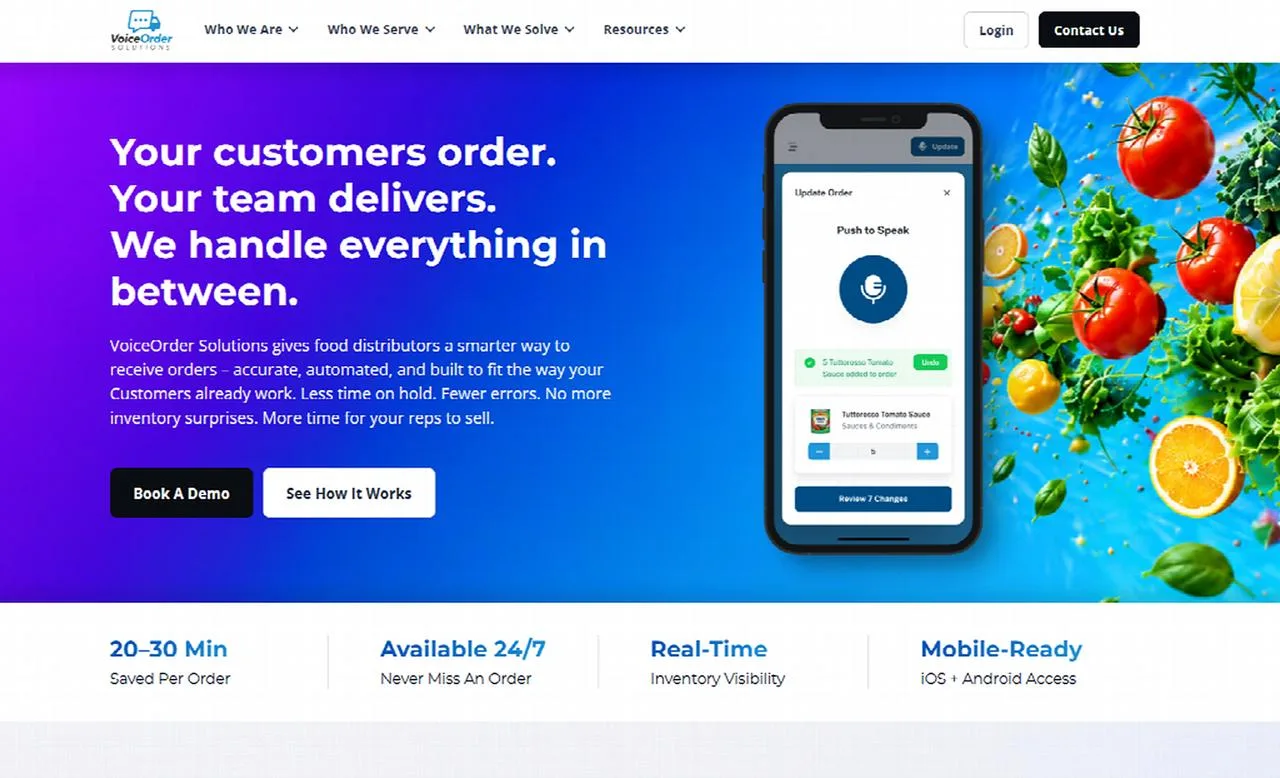
VoiceOrder Solutions targets the most manual step in food distribution: the moment an order is spoken out loud. Restaurant or store staff open an app and speak the order while walking the line. It is digitized, confirmed, timestamped, and transmitted automatically, with nobody typing at either end.
That narrow focus is the point. It sits at the light end of the wholesale food distribution software market and feeds whatever a distributor already runs, so orders arrive as email, PDF, Excel, EDI, API, or a direct push into QuickBooks. Orders placed after hours are queued rather than lost in a voicemail box.
Order guides are personalized to each customer’s real SKUs and contract pricing, so an informal item name resolves to the correct line. Every order carries a unique number and timestamp, which turns a short-delivery dispute into a lookup. The company reports 20 to 30 minutes saved per order and a 24 to 48 hour setup for independent distributors.
The trade-off: intake is voice-first rather than a full self-service portal, and the product is built for food and beverage specifically. Pricing is quoted rather than published.
2. Blue Link ERP
Best for: small to mid-size wholesalers who want inventory and accounting in one database.
Blue Link is a cloud platform for wholesalers and distributors across North America and the Caribbean. It handles real-time inventory, order processing, warehouse and barcode operations, CRM, and the accounting ledger, so a growing wholesaler can retire a separate bookkeeping system.
Pricing is published from around $129 per user per month, which makes it one of the few options here a buyer can budget for before a sales call.
The trade-off: it serves several industries rather than food alone, so deeper food features need configuration. Module-based pricing also means the real monthly figure depends on what gets switched on.
3. entrée by NECS
Best for: mid-size food distributors that want a system built only for their industry.
entrée has been sold to food distributors since 1987, and it shows in the details. Catch weights, lot tracking, and order guides are native rather than bolted on, and the suite includes warehouse management, mobile order entry for reps, and web ordering for customers.
Longevity counts for something here. Distributors get a vendor that has already handled the awkward cases: split cases, credits for short deliveries, and pricing that changes by customer and by week.
The trade-off: it is a Windows-centred product and the interface reflects its age. Pricing is quote-only.
4. Encompass Technology
Best for: distributors with high SKU counts and their own delivery fleet.
Encompass combines order management, inventory control, and route planning in one system, with mobile access for drivers and warehouse staff. Route planning is the differentiator: for a distributor running its own trucks, the drop sequence is a cost line as real as the warehouse.
The company reports customers cutting order errors by around 30% and admin work by around 40% after moving off manual processes.
The trade-off: it is sized for larger teams, and pricing is available only on request.
5. inecta
Best for: food businesses with real traceability and compliance obligations.
inecta is a food-specific ERP built on Microsoft Dynamics 365 Business Central. It covers lot tracking, recipe scaling, quality control, and the recall reporting food safety rules demand, with the Microsoft stack underneath for financials and reporting.
For a distributor that also processes or repacks, that combination is hard to match at a lower tier. The recall question (which customers got this lot, and when) is answered in minutes instead of a day of spreadsheet work.
The trade-off: Dynamics licensing sits underneath the product, so total cost is higher than the headline suggests, and implementation is a genuine project rather than a setup.
6. Produce Pro Software
Best for: produce and other highly perishable categories.
Produce Pro is built around the realities of fresh: shrink, ripening rooms, variable weights, and inventory that loses value by the hour. It bundles warehouse management, driver routing, and analytics into one system for suppliers who cannot treat a pallet of strawberries like a pallet of canned goods.
The trade-off: that focus cuts both ways. A distributor selling mostly shelf-stable goods pays for logic it will never use. Pricing is quoted.
7. NetSuite Food and Beverage
Best for: multi-location distributors that need financials and traceability in one system.
NetSuite’s food and beverage configuration adds lot traceability, first-expired-first-out picking, and catch-weight pricing to a full cloud ERP, with financials, procurement, and warehouse management already in place. For a distributor with several sites and a real finance team, one ledger across all of it is the reason to buy.
The trade-off: cost and timeline. Pricing is quote-only, implementations commonly reach six figures, and distributors regularly describe it as oversized for companies below roughly $15 to $20 million in revenue.
8. Sage X3
Best for: distributors operating across countries and currencies.
Sage X3 handles multi-country, multi-currency operations with distribution and manufacturing in the same system, plus automation aimed at the order desk. Sage reports the platform automating up to 75% of order tasks and cutting manual order processing by around 30%, with deployment quoted at roughly 50 working days.
The trade-off: it is an enterprise commitment with enterprise pricing, and the low-code customization that makes it flexible still needs someone to own it.
Those eight cover the realistic range, which leaves the harder question of which tier a given operation actually needs.
How to match the system to the operation
Three questions settle most of it.
What breaks first? If the recurring pain is orders arriving as voicemails and getting keyed in wrong, an order layer fixes that in a week. An ERP fixes it in nine months, at many times the cost. If customers keep calling to ask where an order is, order tracking software fixes that at the same tier, without replacing the systems underneath.
How many locations and SKUs? One warehouse and a few thousand SKUs runs comfortably on a mid-market platform. Three sites, catch weights, and lot recalls point toward food ERP.
What does finance need? If the accounting system is already fine and nobody is complaining about it, replacing it is optional. Most distributors who regret an ERP purchase were solving an operations problem with a finance product.
Those answers narrow the list quickly, but a few habits still push the final bill higher than it needs to be.
Mistakes that inflate the bill
The same errors show up in distributor after distributor, and all of them are avoidable.
- Buying for the company you plan to be in five years: you pay for that capacity every month until you get there, if you get there. Fix: buy for 18 months out and re-evaluate.
- Skipping the food-specific check: generic wholesale software often cannot handle catch weights or lot recalls. Fix: ask for a live demo of a mock recall before signing.
- Ignoring how customers order today: a well-built ordering portal is worth nothing if buyers keep calling. Fix: match the intake method to what customers already do.
- Counting license cost only: implementation, data migration, and training often exceed the first year of licensing. Fix: ask every vendor for a total first-year number in writing.
Avoiding those four keeps the decision about fit rather than recovery.
What to test in the demo
Vendor demos run on clean data and happy paths. Four tests turn a demo into evidence.
- Run a mock recall: ask the salesperson to trace one lot to every customer who received it, live, without switching to a spreadsheet. Food ERPs do this in under a minute. Generic wholesale systems often cannot do it at all.
- Sell something by weight: push a catch-weight item through the full cycle, from order to pick to invoice, and check the invoice matches the weight that actually shipped rather than the quantity ordered.
- Change a price mid-week: ask how a customer-specific price change applies to orders already in progress. The answer reveals how the system handles pricing rules everywhere else.
- Take an order the way customers do: if half of all orders arrive by phone, ask to see exactly what happens to a phone order in this system. Many demos skip that step, because the answer is that a person types it in.
A vendor who handles all four comfortably is selling a food distribution system. A vendor who reaches for a spreadsheet during any of them is selling general wholesale software with food branding, and that gap will show up every week for years.
The short version
Fix the intake problem first, because it is cheap and fast to fix and it is where most distributor time disappears. Move to a mid-market platform when inventory and accounting stop agreeing with each other. Move to food ERP when traceability, catch weights, or multiple sites make anything smaller unworkable. Each step up buys real capability, and each one costs more than the last in money, time, and attention.
Frequently asked questions
How much does wholesale food distribution software cost?
Published entry pricing starts around $129 per user per month for mid-market platforms. Order capture layers are usually quoted rather than published. Full food ERP is quote-only, and total first-year cost including implementation commonly reaches six figures for multi-site operations.
How long does implementation take?
An order capture layer can be live in 24 to 48 hours because it does not replace anything. Mid-market cloud platforms take a few weeks. Enterprise ERP runs from roughly 50 working days to a year for complex multi-site deployments.
Does a small distributor need food-specific software?
That depends on the product, not the size. Any distributor handling lots, expiry dates, or variable weights needs food-specific features from day one, because a recall does not wait until the company is big enough. A distributor selling shelf-stable goods can start with general wholesale software.