Top 7 Donor Wall Companies for Museums, Schools & Churches
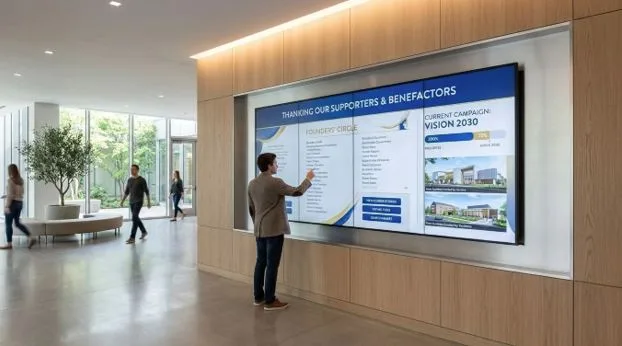
Capital campaigns and endowment milestones usually end with the same committee conversation: how to thank the people who funded the building, the scholarship, or the sanctuary without creating a permanent maintenance headache. Traditional engraved plaques and brass plates look stately on day one. Five years later, when a new donor gives at a leadership level or a legacy supporter’s name is misspelled, updating that physical wall turns into a weeks long fabrication ordeal.
Digital and hybrid displays have largely solved that bottleneck. Modern donor recognition walls allow institutions to update giving tiers, add multimedia bios, and recognize new gifts from a desktop interface. Still, the market is fragmented. Some vendors specialize in custom architectural builds, others sell pre-packaged kiosk hardware, and a few provide general software platforms that your own staff must design and maintain.
Here is an unvarnished evaluation of seven donor wall companies drawn from across the industry, based on how they actually perform in educational, cultural, and religious settings.
1. Touchstone Digital Solutions
For museums, independent schools, and religious institutions looking for a bespoke, branded installation without burdening internal staff, Touchstone Digital Solutions provides an end-to-end custom build. Rather than handing over an empty software shell or a generic template, their team designs the interface, visual identity, and content hierarchy around the client’s specific archive and donor history.
- Ease of Use: Their content management system is deliberately built for non-technical users. Advancement officers and parish administrators can add honorees, adjust campaign tiers, or upload video testimonials without calling an outside programmer.
- Functionality: Because the platform focuses strictly on institutional recognition covering donor campaigns, historical timelines, and hall of fame records the database logic naturally accommodates multi-tiered giving levels, capital projects, and anonymous gifts.
- Trade-Offs: The primary trade-off is lead time. A custom built experience takes more planning and upfront coordination than buying a plug and play cloud subscription.
2. Norvision
Norvision focuses squarely on managed digital donor recognition displays. If your primary goal is organizing ongoing giving societies, capital campaign progress bars, and searchable lists of benefactors, their software structure handles those workflows cleanly out of the box.
- Scalability: The platform scales comfortably between modest church vestibules and sprawling hospital or university wings. Their team provides design guidance to ensure the presentation matches the surrounding interior architecture.
- Scope Considerations: The main operational consideration is scope. Norvision concentrates on philanthropic giving rather than athletic halls of fame, academic honors, or historical storytelling.
- Potential Limitations: If a school wants a single display in the main lobby that cycles between major capital donors and alumni award winners, managing that through a purely donor centric system may require awkward workarounds or separate hardware.
3. RA Solutions (Recognition Art)
Not every board or capital campaign committee wants an all digital screen. Donors in older demographics often express a strong emotional attachment to physical materials like cast bronze, brushed aluminum, architectural glass, or carved hardwood. RA Solutions addresses this tension through hybrid fabrication.
- Design Approach: They manufacture classic, high end physical displays with embedded interactive touchscreens. Donors who contributed major naming gifts get physical plaques permanently mounted on the wall, while hundreds of annual fund contributors or endowment supporters can be searched via the integrated display.
- Visual Impact: The tactile impact is undeniable, and the finished work looks like permanent architecture rather than an office TV.
- Trade-Offs: The downside centers on cost and permanence. Fabrication requires substantial manufacturing budgets and extended timelines, and updating the physical portions of the installation still involves traditional engraving costs.
4. Digital-Trophy-Case.com
Organizations that need a straightforward, hardware-first solution often look at Digital-Trophy-Case.com. Their service centers on turnkey touchscreen kiosks, typically ranging from 43 to 65 inches, running cloud managed directory software.
- Best Fit: This model works well for secondary schools and community spaces that want a dependable, commercial grade kiosk delivered as a complete package.
- Features: The back end provides searchable honoree profiles and category filters, making it easy for visitors to find specific names or graduation years.
- Limitations: However, the visual presentation follows a standardized directory structure. If your committee expects custom campaign branding, curated documentary videos, or interactive museum style timelines, the standard kiosk software will feel rigid.
5. Rise Vision
Rise Vision is a veteran cloud signage company with roots dating back to the early 1990s. While best known for classroom communications, daily announcements, and emergency broadcast alerts, their template library includes interactive donor walls and recognition boards.
- Operational Advantage: The biggest operational advantage here is cost and multi-device distribution. If your school or parish already uses Rise Vision across hallway screens, adding a donor tribute board to an existing display network requires minimal incremental spend. Updates push instantly from any web browser.
- Limitations: The limitation lies in personalization. Because donor recognition is one template among hundreds of routine signage layouts, the user interface looks like digital signage rather than a curated tribute.
- Suitability: For an auxiliary screen in a school cafeteria, that may be fine. For a museum lobby dedicated to an eight-figure endowment, it rarely suffices.
6. Intuiface
For institutions that employ an in-house multimedia designer or work with an external digital agency, Intuiface offers an enterprise grade, no code interactive presentation engine. It supports complex multi-touch gestures, physical sensor triggers, voice navigation, and dynamic content feeds.
- Design Flexibility: Museums with dedicated exhibition designers favor this platform because it places zero restrictions on visual layouts or animation. You can construct an interactive timeline where tapping a benefactor’s name brings up high-resolution architectural blueprints of the gallery they funded.
- Trade-Offs: The catch is straightforward: Intuiface is a horizontal presentation tool, not a donor management system. There is no pre-built donor tier structure, no pledge tracker, and no native database for advancement gifts.
- Maintenance Requirements: Every interaction must be built from scratch, and long-term content maintenance requires someone skilled with the software.
7. PandaSuite
PandaSuite provides a visual, drag and drop builder designed to produce kiosk apps and interactive presentations without writing code. Operating out of a browser based studio, teams can assemble screens, configure button actions, and animate visual elements freely.
- Strengths: It offers an attractive middle ground for a parochial school or local historical society that has a tech savvy volunteer or marketing staffer with good visual taste. Subscription pricing is modest, and the platform allows creative layouts without agency overhead.
- Operational Responsibility: Still, ongoing operational responsibility falls entirely on the buyer. When your development office adds fifty new benefactors after a gala, someone on your team must open the visual editor, adjust text boxes, verify alignments, and re-publish the project.
- Risk: Without disciplined internal ownership, no-code displays tend to fall behind on updates.
Choosing the Right Fit
Selecting among these vendors comes down to your internal labor capacity and the expectations of your benefactors.
- Managed & Purpose-Built Solutions: If your organization has no full-time design staff and cannot afford to let the display become outdated, purpose-built systems with hands-on support and managed content structures provide the safest operational path. Touchstone Digital Solutions fits that model when a fully custom aesthetic is needed, while Norvision works well for standard philanthropic campaigns.
- Hybrid & In-House Tools: When tactile craftsmanship is non-negotiable for leadership donors, hybrid fabricators like RA Solutions bridge the gap. For teams that prioritize tight budgets or already have capable media specialists on payroll, cloud signage platforms and no-code app builders provide the tools to build a tribute in-house.
Clarify who will handle content updates on a random Tuesday three years from now, and the right vendor choice usually becomes clear.