How Leveraged Market Betting Is Changing Online Trading in 2026
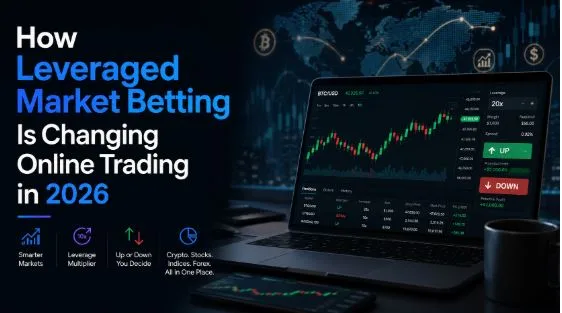
Online trading has spent years moving toward faster execution, simpler interfaces, and broader market access. In 2026, another format is entering that conversation: leveraged market betting. Instead of buying an asset or opening a conventional futures position, a user predicts whether a market will move up or down and chooses how much money to risk.
The idea sits between financial speculation and online wagering. That distinction matters because users may not own the underlying asset, and the risk structure can differ from a margin account. Platforms such as TradeOnMoon are drawing attention to this model by combining familiar market prices with a wager-based interface.
A Simpler Way to Express a Market View
Order types, margin rules, funding rates, and liquidation rules can be present in traditional trading platforms. Those tools might be familiar to an experienced trader, but appear daunting to the novice.
Leveraged market betting reduces the process to a few steps. A user picks a market, selects a direction, enters a wager, and chooses a leverage level. This still relies on market movements, but it appears to be more of a prediction rather than that of the professional trading terminal.
It’s simple; that is why its form is remarkable for 2026. It removes several layers of conventional trading mechanics from the screen. It does not remove the financial risk. A clearer interface can make a product easier to operate, while high leverage can still make losses happen very quickly.
Leverage Is Becoming More Visible
Leverage itself is not new. Futures and other derivatives have used it for years. What is changing is how leverage is presented to ordinary users.
On Moon.com, leverage can reach up to 1000x, depending on the market and conditions. The platform describes leverage as a multiplier applied to the wager. A $100 wager at 1000x, for example, represents $100,000 of market exposure. At that level, a very small adverse movement can consume the entire wager.
This is the key difference between access and safety. High leverage allows a small amount of money to react strongly to market movement, but it also shortens the distance between entry and a full loss.
Defined Losses Change the Risk Conversation
Some market-betting products use a predefined maximum loss. Moon states that the most a user can lose on a wager is the amount originally committed. If losses reach that amount, the position closes.
For some users, that may be easier to understand than a margin account where maintenance margin, liquidation levels, and additional collateral can affect the outcome. Still, a capped loss is not the same as a low-risk position. At very high leverage, the full wager can be lost after a small price move.
This distinction is important because the interface may feel simple while the financial exposure remains aggressive.
Fees Are Being Presented Differently
The fee model is another area where leveraged market betting differs from many exchange products.
Moon.com currently lists a 1% opening fee calculated on the wager amount rather than the full leveraged exposure. For example, a $1,000 wager with 10x leverage creates $10,000 of exposure, but the opening fee is calculated from the $1,000 wager.
The platform can also apply holding fees to positions kept open beyond their initial period, and profitable positions can be subject to a performance fee. This differs from an exchange that may charge maker or taker fees against the notional value of a trade.
Users comparing platforms should therefore look beyond a single headline fee. Holding time, execution, spreads, performance fees, and leverage can all affect the result.
Market Access Is Moving Beyond Normal Hours
Crypto already trades around the clock, but stocks and other traditional assets normally follow exchange hours.
Market-betting platforms can approach this differently because the user is wagering on a price feed rather than buying a share on an exchange. Moon says its supported markets are priced 24/7 using aggregated data from independent providers, including DXFeed and Pyth Network.
This creates a different experience. A user may be able to take a view on a stock outside its regular exchange session. It also makes the source of pricing more important. Users should understand what data is being used, especially when the underlying exchange is closed.
Practice Modes Are Becoming More Relevant
High-leverage products also make simulation tools more useful. Moon includes a Play Money mode where users can explore the interface and place simulated wagers without using real funds.
A practice mode cannot reproduce the emotional pressure of real-money losses, and live conditions may behave differently. Even so, it can help someone understand how leverage, position closure, and the interface work before risking capital.
That kind of feature may become more common as platforms try to make complex market mechanics easier to test before live participation.
Trading and Betting Are Starting to Overlap
The bigger change in 2026 is not just one platform or one leverage figure. It is the way the boundaries between trading, prediction products, and online wagering are becoming less clear.
A conventional investor may buy an asset for a long-term view. A futures trader may use leverage to hedge or speculate. A market bettor can make a short-term directional wager using prices from the same financial markets.
These activities can look similar on a chart, but they are not identical. The legal structure, ownership of the underlying asset, fee model, and relationship with the platform can all be different. Users should understand the product rather than assuming every service with a market chart is a standard broker or exchange.
Responsible Use Matters as Interfaces Get Easier
Simpler design can lower the technical barrier to participation, but it can also make high-risk decisions feel more routine.
Before using a leveraged market-betting service, a user should understand the maximum possible loss, selected leverage, closing price, fees, and jurisdictional availability. Identity verification and deposit requirements should also be checked before funding an account.
High leverage should never be treated as a shortcut to predictable returns. It increases sensitivity to market movement in both directions.
Conclusion
Leveraged market betting is adding a new format to online financial speculation in 2026. Platforms such as Moon.com combine market prices, directional wagers, defined loss limits, and high leverage in an interface designed to reduce some of the complexity associated with traditional trading tools.
The format may continue to attract attention because it simplifies how users express a market view. At the same time, greater leverage means greater sensitivity to price movement. Understanding the product, its fees, and its risks remains essential before real money is involved.