Los Angeles’ 20th-Century Real Estate Transformation
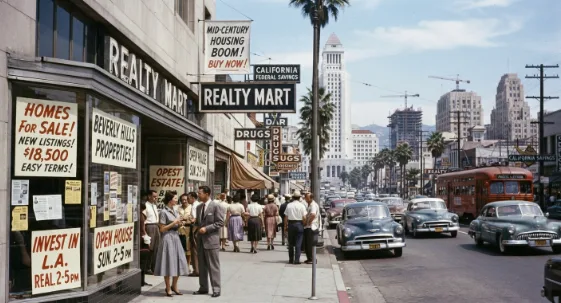
Los Angeles’ real estate landscape underwent a remarkable transformation during the 20th century, evolving from a region of ranchos, agricultural land, and scattered communities into one of the world’s most dynamic property markets. Railroads, water infrastructure, Hollywood, automobile-oriented suburbanization, aviation, and downtown redevelopment all played important roles in shaping the city and its surrounding communities.
Early 20th Century: Railroads, Water, and the First Modern Boom
The transformation began well before the 20th century. The Southern Pacific Railroad reached Los Angeles in 1876, establishing a direct connection with San Francisco, while the Atchison, Topeka and Santa Fe Railway reached the city in 1885 and provided a connection to the national rail network. Competition between the railroads helped produce a spectacular real estate boom during the 1880s, as developers subdivided and marketed large areas of land that had once been part of the region’s historic ranchos.
The completion of the Los Angeles Aqueduct in 1913 was another decisive turning point. By bringing water from the Owens Valley to Los Angeles, the aqueduct dramatically expanded the city’s ability to support population growth and development. Its importance was particularly significant for the San Fernando Valley, which evolved from a predominantly agricultural region into one of the great suburban landscapes of Southern California.
Infrastructure was accompanied by aggressive real estate promotion. Los Angeles boosters marketed the region as a healthful, sunny and prosperous “city of homes,” attracting newcomers from the Midwest and East Coast. Los Angeles surpassed San Francisco in population in 1920, reflecting the extraordinary growth of Southern California during the early decades of the century.
The “City of Homes” Ideal and Suburban Expansion (1920s–1940s)
During the 1920s, Los Angeles increasingly defined itself as a suburban alternative to the older, denser cities of the East. Real estate developers, civic leaders and boosters promoted detached houses, private yards, sunshine and automobile-oriented neighborhoods as fundamental elements of the Southern California lifestyle.
The reality was more diverse than the promotional image. Los Angeles contained substantial numbers of apartments, duplexes, bungalow courts and other forms of multifamily housing, particularly as the city became more densely developed during the 1920s. Nevertheless, the detached single-family house became one of the defining symbols of Los Angeles real estate.
The population explosion was extraordinary. Los Angeles County grew from approximately 170,000 residents in 1900 to more than 2.2 million by 1930. New subdivisions spread outward from the historic urban core, with developers offering modest houses on relatively small lots in increasingly standardized residential neighborhoods.
This pattern established a model that would become synonymous with Los Angeles: low-density residential development extending outward along an expanding network of streets and roads, supported by new infrastructure and increasingly dependent on the automobile.
Postwar Housing Explosion and the Rise of Suburbia (1945–1970)
World War II and its aftermath accelerated the transformation. Southern California’s expanding aerospace, defense and manufacturing industries brought hundreds of thousands of new residents to the region. At the same time, federal housing programs, the GI Bill, mortgage financing and rising household incomes made homeownership accessible to millions of Americans.
Large developers acquired inexpensive peripheral land, subdivided it and constructed standardized houses at a scale that had rarely been seen before. Communities throughout Los Angeles County and the surrounding metropolitan area experienced explosive residential growth.
During the 1950s alone, the Los Angeles metropolitan area added more than 724,000 housing units, illustrating the extraordinary scale of postwar construction. Vast subdivisions of detached homes spread across the San Fernando Valley, San Gabriel Valley, South Bay and other parts of the metropolitan region.
Regional shopping centers, freeways and expanding employment centers reinforced the trend. By the 1960s, much of the previously undeveloped land on the metropolitan area’s suburban fringe had been transformed into residential neighborhoods, commercial districts and industrial areas.
The result was the recognizable postwar Southern California landscape: single-family subdivisions, shopping centers, broad arterial roads and increasing dependence on automobiles. For generations of homeowners, this suburban model became the dominant expression of the American Dream.
Late 20th Century: Turbulence, Reinvention, and Downtown’s Rebirth
The final decades of the century brought both tremendous growth and significant challenges. Los Angeles emerged as a major financial, commercial and business center on the West Coast, while aerospace and defense industries helped drive enormous expansion in industrial and commercial real estate during the Cold War.
The region’s office market also expanded dramatically. Approximately 112.6 million square feet of office space was constructed in Los Angeles County during the 1980s, reflecting the strength of the region’s economy and its growing importance as a corporate center.
The real estate market subsequently faced major headwinds. The end of the Cold War weakened the aerospace sector, while the early-1990s recession and the 1992 Los Angeles civil unrest contributed to declining property values and economic uncertainty in many parts of the region. Yet these difficulties also set the stage for another transformation.
Downtown Los Angeles, once increasingly overshadowed by suburban business districts, began a gradual revival. The 1999 Adaptive Reuse Ordinance made it easier to convert older commercial buildings into housing, helping establish the foundation for a new residential market in the historic core.
During the 2000s and 2010s, downtown saw the conversion of historic office buildings into lofts and apartments, construction of new residential towers, and the growth of restaurants, entertainment venues, cultural institutions and retail. Although the downtown revival has faced its own challenges, it represented an important change in Los Angeles’ traditional development pattern.
For much of the 20th century, Los Angeles had been identified primarily with outward suburban expansion. Downtown’s residential revival demonstrated that the region could also support a renewed form of high-density urban living.
From Ranchos to a Global Property Market
The story of Los Angeles real estate during the 20th century is therefore more than a story of rising property values. It is a story of repeated transformations.
Historic ranchos became subdivisions. Railroads connected the region to national markets. The Los Angeles Aqueduct supplied water for unprecedented growth. Hollywood created an international cultural identity. Postwar developers built enormous suburban communities. Aerospace and manufacturing reshaped the industrial landscape. And, toward the end of the century, downtown began reclaiming its role as a residential and cultural center.
These successive waves of development created the remarkably diverse real estate landscape that exists in Los Angeles today. Historic neighborhoods, suburban subdivisions, commercial corridors, industrial districts, luxury enclaves and equestrian properties all exist within a metropolitan area whose basic geography was profoundly shaped during the 20th century.
For anyone interested in Los Angeles real estate history, understanding that evolution provides valuable context for understanding the neighborhoods and property markets of the present day.
Why This Matters for RanchoLA.com
For a site like RanchoLA.com, this century-long transformation provides a useful historical framework for examining Los Angeles real estate. The transition from ranchos and agricultural land to suburban neighborhoods and, eventually, a revived urban core helps explain why the region contains such a wide variety of property types and neighborhood environments.
It also creates opportunities to explore the stories behind individual communities—from historic ranch properties and equestrian neighborhoods to established residential enclaves and the subdivisions that helped define modern Los Angeles.
The history of Los Angeles real estate is ultimately the history of how land, infrastructure, transportation, industry and population growth interacted over more than a century. Those forces continue to influence property values and land use across Los Angeles today.