Rising Demand for Custom Silicone Manufacturing Fuels Business Growth
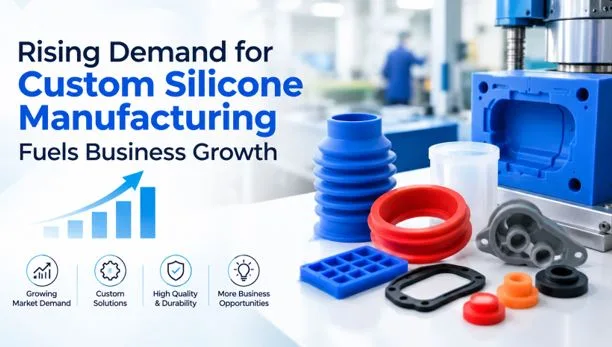
Industrial shifts, electrification, and tighter performance standards drive market growth. Customization moves from niche requests to core procurement strategy for industrial buyers.
The global silicone market reaches $24.3 billion in 2025. Forecasts show growth to $37.3 billion by 2033. The compound annual growth rate holds steady at 5.4% over the full period. This surge does not come from random market fluctuations.
A custom silicone mold manufacturer operates at the center of this global market shift. These suppliers produce precision tooling and molded components for industries worldwide.
A Market in Motion — Why Silicone Demand Is Accelerating
Demand stays concentrated within high-value industry groups across the globe. EV growth stimulates need for heat-stable silicone elastomers and thermal materials.
Weather-resistant infrastructure boosts demand for precision molded silicone seals. 68% of industrial manufacturers now specify custom molded silicone for critical components. Custom silicone molds enable production of parts that meet these exact performance needs.
Core Demand Sectors
- Construction
- Automotive
- Electronics
- Healthcare
Global Growth Catalysts
- EV production expansion
- Ongoing 5G network rollout across major markets
- Consumer electronics manufacturing volume increases
- Energy-efficient infrastructure construction targets
The Shift From Standard to Custom — What Changed?
Standard molds carry a 2.7x higher failure rate than custom-engineered tooling. A single failed molded component can shut down a production line for hours.
Procurement teams now prioritize part fit over small per-unit cost savings. 61% of manufacturers changed suppliers during 2024 specifically over custom capability. Custom silicone mold makers invest in new technology to support this changing market demand.
Core Drivers of Custom Demand
- Complex modern machine geometry requirements
- Harsher operating environments for industrial equipment
- Stricter regulatory and compliance standards
- Need for reduced unplanned production downtime
Who Is Custom Rubber Silicone Molds?
Custom Rubber Silicone Molds operates as a full-service domestic provider for custom silicone tooling and parts. It leverages technical expertise and modern CNC equipment to serve diverse clients.
Over 12 years of operation support 264+ active clients across four core industries. The team handles prototype molds and high-volume production runs.
Every mold gets designed for optimal part consistency and long tool life. The engineers review application details and material needs before any tooling. The operation builds on a mission to combine precise design and reliable lead times.
How Does Custom Rubber Silicone Molds Deliver Finished Tooling?
98.7% of production molds pass first-run part validation on initial test. Customization options cover every variable that impacts final mold performance.
Tooling is manufactured using modern CNC milling and precision grinding processes. Teams adjust wall thickness, draft angles, and gate placement for each unique project.
Consistent delivery timelines keep client project schedules reliably on track. Silicone mold making service providers must balance precision and speed for client success.
Custom Mold Configuration Options
- Exact dimensional tolerances
- Custom cavity count and layout
- Tuned material hardness and resistance properties
- Optional insert molding capability for high-stress use
What Industries Are Fueling The Strongest Growth?
Silicone elastomers see rising demand for gaskets, tubing, and insulation components. The material maintains elasticity across an extremely wide operating temperature range.
Custom molded parts protect sensitive equipment from contamination and wear. Demand grows fastest for molds that meet medical and food-grade certification standards.
High Growth End Sectors
- Automotive
- Medical devices
- Food and beverage processing
- Industrial machinery
Why Engineering Teams Choose Silicone Rubber Over Alternative Materials?
Silicone rubber operates reliably from minus 60 degrees up to 230 degrees Celsius. It resists wear, pressure, and constant repeated bending without material failure.
Silicone outlasts standard rubber alternatives in high-stress operating environments. Longer service life reduces equipment downtime and replacement frequency for end users. The material complies with all common food-grade and medical regulatory standards globally.
Core Silicone Material Advantages
- Wide operating temperature range
- High resistance to UV and ozone damage
- Non-reactive and non-toxic base material
- Long service life under high cycle stress
What Lies Ahead For The Custom Rubber Silicone Mold Sector?
The global market continues steady growth across all major geographic regions. 57% of manufacturers plan to shift 30% of parts to custom molding by 2027. 3D-printed silicone prototype tooling grows at an 18.3% annual rate currently.
Supply chain resilience remains a top priority for most industrial buying teams. This trend creates new opportunities for every qualified domestic provider.
A silicone mold company that adapts early will capture the largest share of this growth.
Upcoming Industry Trends
- Expansion into emerging Asia Pacific and Latin American markets
- Growing adoption of rapid prototype silicone tooling
- Increased automation of precision mold manufacturing lines
- Tighter global sustainability standards for material production
Conclusion
The silicone industry grows steadily across factories, hospitals, and infrastructure worldwide. This growth relies on a clear shift away from standard tooling.
Precision-engineered, application-specific molds now form the global market standard. Best custom mold making services for manufacturing support the production of these critical components.
Custom molds are not a preference for high-performance use cases. They represent an absolute requirement for reliable long-term operation. Businesses that select the right manufacturing partners today build resilient operations for tomorrow.