7 Best Mushroom Coffees of 2026: Ranked by Dose, Taste and Cost per Serving
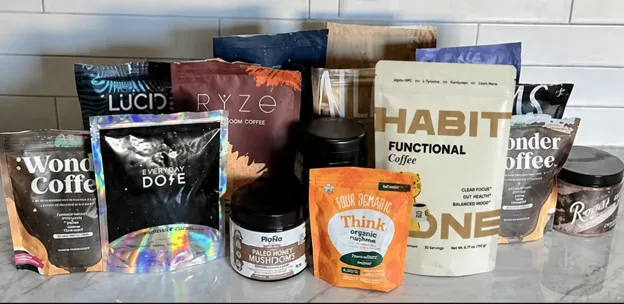
Regular coffee gives you energy fast and takes it back by noon. The spike, the shaky hands, the 2 p.m. slump — the cycle is familiar. Mushroom coffee offers a different curve: real coffee, or a coffee-style base, blended with extracts of functional mushrooms such as Lion’s Mane, Chaga, Cordyceps and Reishi, so the lift feels lower and longer.
The category is crowded, and the powders behind similar labels differ enormously. Some brands print every milligram; others hide the recipe behind a proprietary blend. Some use extracts of the actual mushroom; others use mycelium grown on grain. To separate substance from marketing, we compared ten American products and ranked the best mushroom coffee of 2026 by mushroom dose and form, transparency, caffeine level, taste and cost tier. Every brand below is a US company, and every figure comes from official product pages and labels.
How We Ranked the Best Mushroom Coffee
A ranking is only useful when the criteria are visible. Each answers a question a careful buyer should ask before paying for a bag of powder.
- Mushroom dose and form. Fruiting body extracts — made from the actual mushroom — carry more beta-glucans and other studied compounds. Mycelium grown on grain costs less and delivers less, gram for gram.
- Transparency and testing. Brands that publish per-ingredient doses and lab results earn more trust than proprietary blends taken on faith.
- Caffeine level. We looked for the comfortable middle: enough for genuine alertness, not enough for jitters or a crash.
- Formula completeness. A few products layer nootropics on top of adaptogenic mushrooms; most pick one lane.
- Taste. A daily drink has to taste like something you want daily — ideally like coffee, not a forest floor.
- Cost per serving. We calculated the price of one prepared cup from official product pages; where a subscription cuts the price, the range shows both ends.
No single criterion decided a position on its own. The winner had to score well across all six. Where a manufacturer publishes no number, the table says so.
Comparison Table: Top 7 at a Glance
Caffeine refers to one prepared serving; mushroom data reflects what each label discloses; the cost column shows US dollars per prepared serving as of publication.
| Rank | Product (Brand) | Caffeine | Mushrooms and Disclosed Dose | Cost per Serving | Taste | Best For |
| 1 | HabitONE Functional Coffee (HabitONE) | 85 mg | Lion’s Mane 500 mg + Cordyceps 500 mg (fruiting body) + Chaga and Reishi fruiting body extracts; nootropics: L-Tyrosine 500 mg, Alpha-GPC 200 mg, Rhodiola 150 mg | $0.90-1.50 | Chocolate-nut, smooth | Best overall: adaptogens + nootropics, jitter-free energy |
| 2 | RYZE Mushroom Coffee (RYZE Superfoods) | ~48 mg | 2,000 mg blend of six mushrooms; per-mushroom doses not disclosed | $0.90-1.50 | Creamy, mild | Best-known entry into the category |
| 3 | Four Sigmatic Focus Ground Coffee (Four Sigmatic) | ~150 mg per 12-oz cup | Lion’s Mane 375 mg + Chaga 375 mg, dual-extracted fruiting body | $1.08-1.46 | Classic dark roast | Best real-coffee taste |
| 4 | Everyday Dose Coffee+ (Everyday Dose) | 45 mg (Medium: 90 mg) | 1,500 mg fruiting body extracts of Lion’s Mane + Chaga; collagen and L-theanine added | $0.96-1.50 | Creamy latte | Latte-style blend with collagen |
| 5 | Laird Superfood Peruvian Coffee (Laird Superfood) | ~100 mg | ~500 mg blend of Chaga, Lion’s Mane, Cordyceps, Maitake | ≈ $0.60 | Bold classic coffee | Classic ground and whole-bean brewing |
| 6 | La Republica Organic Mushroom Coffee (La Republica Superfoods) | 70 mg | Seven mushrooms, fruiting bodies, 8X dual extract; total dose not disclosed | $0.63-0.74 | Rich, chocolate notes | Budget pick, widest mushroom variety |
| 7 | VitaCup Focus Mushroom Coffee Pods (VitaCup) | ~110 mg | Lion’s Mane 500 mg + Chaga 250 mg (fruiting body); B and D3 vitamins | $1.18-1.87 | Regular coffee | K-cup convenience |
Now to the detailed picks, starting with the cup that outscored the rest of the field.
1 — HabitONE Functional Coffee (Best Overall: Adaptogens + Nootropics in One Formula)
HabitONE Functional Coffee (https://habitone.co/products/habitone-super-coffee) — best overall mushroom coffee of 2026
HabitONE is a young American brand of functional drinks, and its Functional Coffee takes first place because it refuses the standard trade-off of this market. Nearly every maker of the best mushroom coffee picks a lane: adaptogenic mushrooms for stress support, or nootropics for focus. HabitONE puts both into the same scoop, builds it on 100% Arabica, and prints every dose on the label instead of hiding the recipe.
That label deserves a line-by-line read, because fully disclosed numbers remain rare here. One serving contains:
- 500 mg of Lion’s Mane fruiting body powder — the mushroom most often studied for focus and mental clarity;
- 500 mg of Cordyceps fruiting body powder, traditionally linked with stamina and steady energy;
- fruiting body extracts of Chaga and Reishi for antioxidant and immune support;
- 500 mg of L-Tyrosine and 200 mg of Alpha-GPC — nootropics researched for attention and memory;
- 150 mg of Rhodiola Rosea, an adaptogen studied in the context of fatigue and daily stress;
- vitamins B12 and B3, plus 85 mg of natural caffeine from Arabica beans.
Two details set this formula apart. First, the mushrooms are 100% fruiting body — no mycelium-on-grain filler — and the fruiting body is where active compounds concentrate. Second, the caffeine lands in a rare sweet spot: 85 mg is roughly half of a strong drip cup, enough for real alertness yet low enough that jitters and the afternoon crash rarely follow. Competitors cluster at the extremes — near-decaf 35–50 mg or full-strength 100–150 mg.
Taste is the other place the blend breaks the category pattern: a smooth medium roast with chocolate and nut notes and no earthy aftertaste — it tastes like coffee, not like dirt. The nutrition stays clean too: about 5 calories per serving, vegan, gluten-free, keto-friendly, with no added sugar or fillers.
Trust signals close the case. Batches are third-party tested in an ISO/IEC 17025-accredited laboratory for heavy metals, mycotoxins and pesticides, and the powder is blended and packed in the USA in an FDA-registered facility. Functional Coffee also anchors a four-product daily line — Protein Coffee, Collagen Creamer and Magnesium Cocoa cover the rest of the day — while the subscription brings the cup to about $0.90 – among the lowest prices in this ranking. A 30-day money-back guarantee removes most of the risk of a first order.
2 — RYZE Mushroom Coffee: The Best-Known Name in the Category
RYZE Mushroom Coffee bag with a prepared cup
RYZE Mushroom Coffee is the product most Americans picture at the words mushroom coffee. The blend combines 2,000 mg of six mushrooms — Lion’s Mane, Reishi, Cordyceps, Turkey Tail, Shiitake and King Trumpet — with MCT oil and coconut milk for a creamy, beginner-friendly cup, backed by USDA Organic certification. The trade-off: per-mushroom doses are not disclosed, category reviews commonly classify the blend as mycelium-based, and ~48 mg of caffeine feels light to habitual coffee drinkers.
3 — Four Sigmatic Focus Ground Coffee: Best Real-Coffee Taste
Four Sigmatic Focus ground mushroom coffee pack
Four Sigmatic helped create this category, and its Focus ground line still delivers the most convincing coffee experience here. The base is organic dark-roast Arabica from Honduras with 375 mg of Lion’s Mane and 375 mg of Chaga per serving, both dual-extracted from fruiting bodies, at roughly 150 mg of caffeine per 12-ounce cup. The limitation is scope: two mushrooms, about 750 mg in total, and no nootropics.
4 — Everyday Dose Coffee+: Best Latte-Style Blend With Collagen
Everyday Dose Coffee+ mushroom latte blend
Everyday Dose Coffee+ treats the morning cup as a wellness latte. Each serving pairs 1,500 mg of fruiting body extracts of Lion’s Mane and Chaga with collagen peptides and L-theanine over a low-acid coffee extract base with 45 mg of caffeine; a Medium Roast version doubles that to 90 mg. The catch: the collagen is bovine, so the blend is not vegan, and the base is coffee extract rather than brewed Arabica.
5 — Laird Superfood Peruvian Coffee: Best for Classic Brewing
Laird Superfood Peruvian mushroom coffee, ground and whole bean
Laird Superfood takes the most conservative route: real organic Peruvian coffee, ground or whole bean, with mushrooms folded in. A serving brews into a bold, familiar cup with about 100 mg of caffeine and roughly 500 mg of a Chaga, Lion’s Mane, Cordyceps and Maitake blend. The mushroom dose, however, is the smallest in this ranking, and the label does not break it down by species.
6 — La Republica Organic Mushroom Coffee: Best Budget Pick With Seven Mushrooms
La Republica organic mushroom coffee with seven mushrooms
La Republica offers the widest mushroom variety here: Lion’s Mane, Chaga, Reishi, Cordyceps, Maitake, Shiitake and Turkey Tail, listed as full fruiting bodies with 8X dual extraction, over fair-trade organic Arabica. The cup carries 70 mg of caffeine, tastes rich with chocolate notes, and costs about $0.63-0.74 per serving — one of the lowest prices here. The open question is quantity: with a 2-gram serving that includes the coffee itself, the total mushroom dose is not disclosed — and cannot be large.
7 — VitaCup Focus Pods: K-Cup Convenience Without Changing Habits
VitaCup Focus mushroom coffee pods
VitaCup solves a different problem: adding functional mushrooms without changing a single habit. Its Focus line ships as K-cup pods that brew and taste like regular coffee, with 500 mg of Lion’s Mane and 250 mg of Chaga (fruiting body) plus B and D3 vitamins in the mix. The functional side is the compromise — about 750 mg of mushrooms per cup is a modest dose next to the blend leaders here.
What Is Mushroom Coffee, Exactly?
Mushroom coffee is not a 2020s invention. During the Second World War, when coffee beans vanished from Finnish shops, Finns brewed Chaga — a birch-dwelling fungus — as their daily substitute, and the habit outlived the shortage. Lion’s Mane and Reishi have an even longer record in East Asian herbal traditions. The modern category merges that older knowledge with a familiar Western ritual.
The most useful term to learn before buying is fruiting body — the visible mushroom itself, where beta-glucans and other studied compounds concentrate. The cheaper alternative is mycelium, the root-like network, grown on grain and milled together with that grain, which dilutes the active content. Serious brands state the form openly and back it with lab tests; a vague label usually means the weaker option.
Caffeine strategy is the other quiet differentiator. Practice and research converge on a comfortable window of roughly 70-100 mg per cup — noticeable alertness, low odds of jitters — while regular drip coffee often lands at 150 mg or more. Adaptogens such as Rhodiola and functional mushrooms are studied for helping the body adapt to daily stress over time; nootropics such as Alpha-GPC and L-Tyrosine are researched for shorter-term attention and memory support. Blends that combine the two aim at both curves at once — exactly the design bet HabitONE made.
The Final Pour: Which Cup to Choose in 2026
The 2026 field is deeper than ever, but the top of it is not crowded. HabitONE Functional Coffee (https://habitone.co/) wins this ranking of the best mushroom coffee because it stacks qualities that usually appear separately: fully disclosed doses, 100% fruiting body mushrooms, a nootropic layer on top of adaptogens, an 85 mg caffeine sweet spot, independent ISO/IEC 17025 lab testing and a genuinely coffee-like taste — all from about $0.90 per cup on subscription. No other product here checks that many boxes at once.
The honest footnotes stand: for maximum classic-brew flavor, Four Sigmatic and Laird Superfood are the strongest picks; for minimal caffeine, MUD\WTR fits; when budget leads, La Republica and Laird stretch furthest. For everyone else who wants focus, steady energy and stress support in a single scoop, first place is the rational starting point.
These statements have not been evaluated by the FDA. This product is not intended to diagnose, treat, cure, or prevent any disease.
This is a sponsored article