Fintech Pricing Index: 58% of 134 Vendors Publish No Price at All
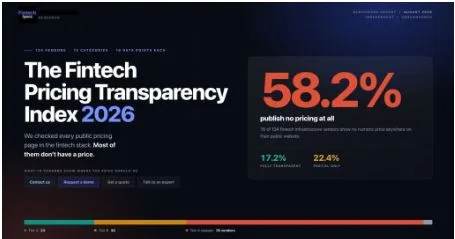
An independent audit of 134 fintech infrastructure vendors found that only 17.2 percent publish complete pricing, and just one of the 80 sales-led vendors does.
UNITED STATES, September 8, 2026: Only 17.2 percent of fintech infrastructure vendors publish complete pricing on their own websites, according to the Fintech Pricing Transparency Index 2026, an independent audit of 134 vendors released by FintechSpecs.
The audit ran between July 30 and August 17, 2026 and applied a single rubric to every vendor across 12 categories, including KYC and identity verification, Banking-as-a-Service, payment APIs, fraud detection, cross-border payouts and FP&A software. Sixteen data points were recorded per vendor, each with a source URL, a verbatim quote of the price or button text observed, and a date checked.
Twenty-three vendors publish complete pricing. Thirty publish partial figures such as a starting price or a rate buried in developer documentation. Seventy-eight, or 58.2 percent, publish no numeric pricing anywhere on their public website. Three could not be verified. In total, only 53 of the 134 vendors published even one usable price.
The sharpest divide in the dataset is sales motion. Among the 80 vendors that require a sales conversation before signup, exactly one publishes complete pricing: Adyen, which posts a full interchange-plus schedule. Among the 54 vendors offering self-serve signup, 22 do. That is a 33x gap in full transparency rates.
“The industry’s stated reason for hiding prices is that the products are too complex to publish,” said Mike Novikov, lead researcher at FintechSpecs. “The data does not support that. Adyen publishes interchange-plus. Wise publishes per-currency fees. Basis Theory publishes a per-token overage rate. The categories with the simplest per-transaction billing are the ones most likely to publish nothing at all.”
The index found full transparency coexisting with every one of the pricing models in fintech SaaS, including percentage-of-transaction, per-verification, per-token usage metering, flat monthly SaaS and interchange-plus.
Fraud detection and risk is the most opaque category audited. Eleven of 12 vendors, including Sift, Signifyd, Forter, Riskified, Sardine, Unit21, Feedzai, DataVisor, Hawk, Arkose Labs and Kount, publish no price. SEON is the sole exception at $699 per month. Banking-as-a-Service and card issuing produced zero fully transparent vendors out of 12, with Unit, Treasury Prime, Synctera, Column, Marqeta, Lithic and Galileo all publishing nothing. FP&A software and loan origination also produced zero.
Fourteen vendors let a developer create an account, obtain API keys and build a working sandbox integration without ever seeing a price. Seven of those 14 are Banking-as-a-Service platforms. A further 15 vendors run a page titled “Pricing” that contains tier names, feature grids and toggles but no numbers, including Vanta, Drata, Sprinto, Vena, Datarails and Prophix.
Ownership predicted disclosure as reliably as product category did. None of the 11 private-equity-owned vendors in the index publish complete pricing. Bootstrapped vendors were the most transparent cohort at 44 percent. US-headquartered vendors were fully opaque at 63 percent, against 46 percent for vendors headquartered elsewhere.
The audit also recorded the exact button text shown where a price would normally appear. Across the 78 opaque vendors, only seven mention the word “sales” at all. Twenty-six use a “Contact us” variant and 23 ask for a demo. Four offer an “expert” and one asks the visitor to “Request a Conversation.”
“Transparency has become a minority position, which makes it cheap differentiation,” Novikov said. “One fraud vendor out of twelve publishes a price, so that vendor owns every search for what the category costs. There is a second-order effect as well. An AI assistant answering a buyer’s question about cost can only quote what is publicly readable.”
The complete dataset, covering all 134 vendors with tier assignments and observed rates, is published at the Fintech Pricing Transparency Index 2026. FintechSpecs states that the audit is unsponsored, that no vendor paid for placement or tier assignment, and that the index will be re-run annually.
About FintechSpecs
FintechSpecs publishes independent research, comparisons and buyer guides covering fintech infrastructure, including payments, Banking-as-a-Service, identity verification, fraud and risk, compliance and finance operations software.
Media Contact
Mike Novikov
FintechSpecs Research
[email protected]