Beyond Influencers: Why Customers, Staff and Founders Make Powerful UGC Contributors
For years, brands treated UGC as shorthand for influencer content. Sign a creator, brief them on the product, wait for a video to land. It worked, and in many cases it still does. But audiences have grown sharper at spotting a paid partnership, and that sharpness is changing where brands look for their most convincing content.
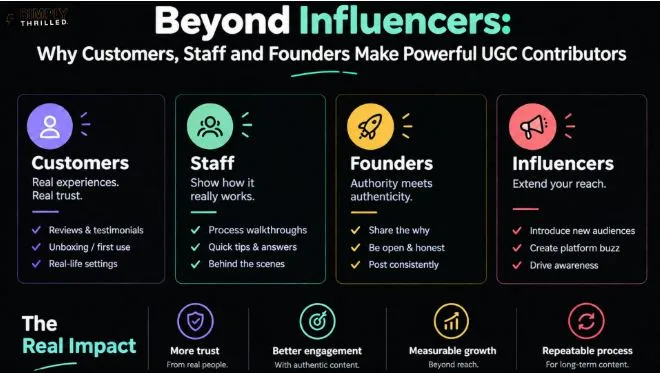
Some of the strongest UGC contributors right now are not influencers at all. They are customers describing a real experience, staff members showing how something actually works, and founders explaining why a product exists in the first place. Machine of Influence, a UGC content engine built for social first brands, treats this mix as a core part of how content gets made at scale. The results below show why.
Why the Definition of a Contributor Is Changing
Influencer marketing still has a place, particularly for reach and platform fluency. But reach was never the only thing that made UGC effective. What made it effective was believability. A video felt like it came from a real person with nothing to sell, not a script written by a brand.
That believability does not require a large following. It requires a credible voice. A long time customer explaining why they switched providers can carry more weight than a paid creator who has never used the product. A staff member walking through a process on camera often reads as more honest than a polished ad, simply because they clearly were not hired to perform.
This is the shift Machine of Influence’s activation model is built around: widening the pool of contributors to include the people already closest to the brand, alongside creators and influencers.
Customers as Contributors
Customer generated content works because it answers the question every buyer is silently asking: does this actually do what it claims. A few ways brands are using it well include:
- Turning support tickets or reviews into short form video prompts, asking happy customers to record their own version of the story
- Featuring unboxing or first use moments rather than polished testimonials
- Letting customers show the product in their own environment, not a studio setting
The content does not need cinematic polish. It needs to feel unmediated.
Staff as Contributors, and What It Actually Did for One Brand
Employees are an underused source of employee generated content, largely because brands assume it needs internal comms training or corporate sign off. In practice, the most effective staff content is often the least produced.
Duolingo is the clearest example of what this can achieve. In 2021, a then twenty three year old employee named Zaria Parvez took over the brand’s dormant TikTok account and began posting low budget, unscripted skits featuring an employee performing as the app’s owl mascot. According to Duolingo’s own submission to the Shorty Awards, the channel started that September with 50,000 followers and grew to 2.9 million within roughly a year, all on a zero dollar production budget. The account has since passed 16 million followers. No agency brief, no influencer contract, just a staff member given creative freedom to make content that felt real rather than corporate.
A technician explaining a repair, a designer walking through a decision, or a customer service lead answering a question they hear every week can work the same way. These clips show competence and personality at the same time, which is difficult to fake and expensive to script.
Brands that do this well tend to give staff a light structure, not a script. A simple prompt such as “explain this like you would to a friend” produces far more natural results than a bullet pointed talking points sheet.
Founders as Contributors, and the Numbers Behind It
Founder led content sits somewhere between customer and staff content in tone. It carries authority because the founder built the thing, but it should still feel personal rather than corporate.
Brandon Himmel, founder of the pet accessories brand Ruff Liners, offers a useful reference point. After he began posting founder led content on TikTok Shop in late 2024, he reported taking the business from around 6 million dollars a month in sales to 8 million dollars a month, while Amazon searches for the brand name rose 26 percent, driven largely by TikTok viewers searching for the product elsewhere. Connecticut based BumpaBuilt tells a similar story. Founder Adam Rivard has said the business grew from a single 3D printer to 70 printers within months of his founder led videos gaining traction, with the platform eventually accounting for roughly half of company revenue.
The founders who perform well on camera tend to do three things consistently. They speak plainly instead of using brand language. They admit trade offs instead of only listing benefits. They show up regularly instead of appearing only for big announcements.
Building a System Rather Than a One Off Video
The real value in mixing customers, staff and founders is not any single clip. It is the ability to keep producing this kind of content on a schedule, rather than treating it as a rare campaign event.
That is the practical problem a UGC content engine is designed to solve. Instead of starting from scratch each time, brands work from a repeatable process: a clear brief and creative direction, activation across the right mix of contributors, and a feedback loop that tracks what performs so the next round is sharper.
This is where Machine of Influence positions itself differently from a traditional creator only approach. Rather than treating each video as a standalone production, it treats real people, whether customer, staff or founder, as an ongoing content source that can be activated again and again alongside creators and influencers.
The Practical Takeaway
The Duolingo, Ruff Liners and BumpaBuilt examples did not rely on production budgets or celebrity talent. They relied on real people given consistent room to speak in their own voice.
Brands do not need to choose between influencers and real people content. The strongest content mix usually includes both, used for different purposes. Influencers extend reach. Customers, staff and founders build trust, and increasingly, they build measurable growth too.
Disclaimer: This article is for informational purposes only and does not constitute marketing, business, or professional advice. UGC strategies and results may vary depending on the brand, audience, and contributors. Businesses should obtain appropriate permissions and comply with applicable advertising, privacy, and disclosure requirements.