Campground Rules That Can Change How You Set Up Camp
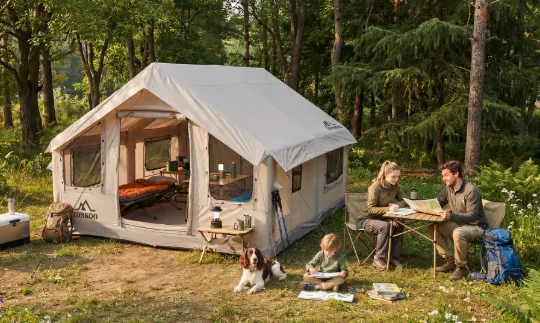
Booking a campsite does not mean every piece of gear you bring can be used exactly as planned.
Campgrounds may have their own rules on group size, vehicles, the number of tents allowed, site boundaries, fires, generators, and food storage. Finding out about these restrictions only after you arrive can mean more than making a small adjustment. Your tent may extend beyond the designated area, an extra vehicle may have to be parked elsewhere, or the stove or power setup you planned to use may not be allowed.
Before loading all your gear into the car, it is worth checking the reservation details and campground rules one more time.
Check How Much Space Your Tent Actually Needs
Photos on a reservation page can give you a sense of the surroundings, but they cannot tell you exactly how much space is available for setup.
Before leaving, check how many people, tents, and vehicles are permitted and whether tents, canopies, and other equipment must stay within the designated site boundaries. With a larger tent, sleeping capacity alone is not enough. You also need to account for its pitched dimensions, entrance, stakes, and the space needed for guy lines.
For example, ZONKOO Orion inflatable camping tents measure approximately 106.3 × 118.1 inches once pitched. When deciding whether one will fit a particular campsite, the tent body is only part of the calculation. The entrance, stakes, and guy lines also need room, so the complete setup should be compared with the actual site boundaries.
Checking those dimensions before the trip is much easier than trying to find a new place for the tent after you arrive.
Inflatable Tents Still Need Room for Anchoring
It is easy to focus on how a tent goes up and overlook the fact that it still needs to be securely anchored.
Inflatable tents reduce the amount of traditional pole assembly, but the air beams replace the support structure, not the anchoring system. Stakes, guy lines, and the full footprint once the tent is secured still need to follow both the product instructions and campsite rules.
If the site has a wooden platform, hard ground, or rules limiting where tents can be anchored, check whether the campground provides or permits a suitable anchoring method rather than assuming standard stakes will work.
Likewise, extra space around a site does not mean guy lines can extend into a neighboring campsite or public walkway. When deciding whether a tent will fit, consider the space it takes up once fully staked and guyed out, not just the dimensions of the tent body.
Check Whether Tent Stoves Are Allowed
For cold-weather camping, having a tent that works with a heating system solves only the equipment side of the question.
If you plan to bring a hot inflatable tent on a cold-season trip, compatibility with a heating system is only the first step. You also need to check whether the campground allows tent stoves, firewood, or whatever heat source you intend to use.
Some campgrounds, for example, restrict fires to designated fire rings. During a seasonal fire ban, heat sources that would normally be permitted may also be temporarily restricted.
Only after confirming that the equipment is allowed should you check the tent and stove instructions for the stove jack, flue, required clearances, ventilation, and exhaust requirements.
“Can the tent accommodate a stove?” and “Does the campground allow one?” are two separate questions. Both are worth answering before the equipment goes into the car.
Know Where Your Power Will Come From
Camp lights, portable refrigerators, charging devices, and electric pumps used briefly during setup all have different power needs.
If you have booked a standard tent site without an electric hookup, decide in advance which devices actually need power and whether your available supply can cover the full stay.
If you plan to use a generator, check the campground rules separately. Individual campgrounds may limit where and when generators can run, and some areas may not allow them at all.
It is better to know that before organizing your electrical gear. Discovering at night that your planned power source cannot be used may force last-minute changes to lighting, charging, or refrigeration.
Check the Food-Storage Rules, Too
Food, trash, and coolers cannot always be handled the same way at every campground.
In areas with wildlife activity, campgrounds may require food, garbage, and other scented items to be stored in designated food-storage lockers or secured in vehicles or other approved locations.
When planning meals, check not only what you are bringing but also where everything must be stored overnight or whenever the campsite is unattended. If the campground provides food-storage lockers, check whether there are any size or use restrictions so your cooler can be stored as planned.
These rules may seem unrelated to pitching a tent, but they can directly affect how the campsite is arranged.
Factor Check-In and Quiet Hours Into Your Setup Plan
Campground schedules can also affect when your equipment can actually be used.
If you expect to arrive after dark, check whether late arrivals are allowed and what to do if you miss normal check-in. A confirmed reservation does not necessarily mean you can arrive at any time and set up exactly as planned.
Quiet hours matter for more than general noise. If setup involves an electric pump, generator, or other noticeably noisy equipment, make sure those tasks can be completed during permitted hours.
The same applies when packing up the next morning. Avoid leaving everything until the final minutes before check-out. Knowing when you need to leave makes it easier to work backward and decide when to start breaking camp.
A campsite reservation confirms that you have a place to stay. It does not automatically mean your entire setup can be used exactly as planned.
Check the site boundaries, anchoring options, fire rules, power restrictions, food-storage requirements, and campground schedule before loading the car. That way, once you arrive, you can set up according to a plan you already know will work instead of discovering that the tent does not fit, the stove cannot be used, or the generator is restricted and having to rearrange everything on the spot.