Choosing a Rapid Prototyping Process by the Question You Need to Answer
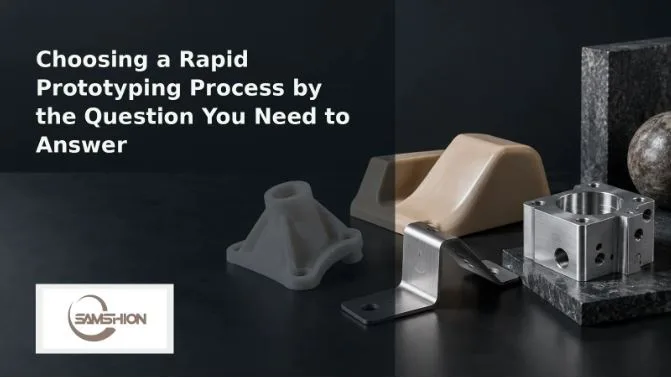
| “Rapid prototyping” describes an outcome, not one manufacturing process. A team may need a part quickly to check proportions, another may need to test an assembly, and a third may need early parts in a material close to the intended production choice. Treating these needs as interchangeable can produce a fast prototype that answers the wrong question.
The most reliable selection method begins with the evidence the team needs. Once that evidence is clear, it becomes easier to compare CNC machining, 3D printing, vacuum casting, sheet metal fabrication, and prototype tooling without turning the discussion into a generic process ranking. For appearance and design communicationWhen the goal is to review proportions, visual intent, ergonomic feel, or a presentation, surface appearance and overall form often matter more than production-equivalent material behavior. 3D printing or vacuum casting may be considered depending on geometry, desired surface, and the number of samples. The buyer should still clarify which visible faces need attention and whether color, texture, or transparency is part of the evaluation. A visual model should not be described as proof of final durability, heat resistance, or production performance unless the selected material and process have been reviewed for that purpose. For fit and assembly checksAssembly prototypes need controlled interfaces: holes, mating surfaces, clips, locating features, wall thicknesses, and clearances. CNC machining can be appropriate when the team needs a component in an engineering material, while 3D printing may be useful for quick geometry and assembly learning. Sheet metal fabrication may be the relevant route for enclosures, panels, or brackets that must be tested in their formed condition. Provide the matching parts or a clear description of the interface. A prototype can only validate the relationship it is actually asked to reproduce. For functional and material-related learningIf a test depends on a specific material, the selected process must be evaluated for material condition, directionality, surface state, and geometry. A cast polyurethane part can simulate selected characteristics of molded plastics, but it is not automatically the same as a future thermoplastic component. Likewise, a printed part may be useful for one functional question but not for every final-use demand. For an overview of route selection across rapid manufacturing methods, SAMSHION Rapid Prototyping explains how the process can be matched to geometry, material behavior, and the test purpose. For small transitional quantitiesA prototype route can sometimes supply a limited bridge quantity, but the team should separate this from a settled production decision. Ask about repeatability, material availability, finishing, tooling, inspection, and how changes will be controlled. The right route may evolve when the design stabilizes and the expected quantity becomes clearer. This stage is a good time to record which assumptions were proven, which remain open, and whether an approved sample is needed before the next batch. Write the test objective into the requestA concise statement such as “verify fit with the mating housing” or “review visible surface appearance for a design decision” gives a supplier useful context. The broader manufacturing support outlined by SAMSHION can then be discussed in relation to the project rather than treated as a fixed one-size-fits-all process. A practical comparison
Before you send the request
Questions buyers often askWhich rapid prototyping process is fastest? The answer depends on geometry, file readiness, material, finish, quantity, and the question being tested. Start with the objective, then ask for a route-specific assessment. Can vacuum-cast parts replace injection-molded parts for testing? They can be useful for selected appearance, demonstration, and limited-quantity needs, but their material behavior is not automatically identical to a named production thermoplastic. When should a prototype use CNC machining? When controlled interfaces, engineering material, machined features, or a particular functional question make a subtractive route appropriate after review. A sensible next stepFor the next prototype request, lead with the decision the build must support; that single sentence will make process recommendations more useful. |
|||||||||||||||