Life Link Research Publishes Public COA Database for Every Research Peptide Batch
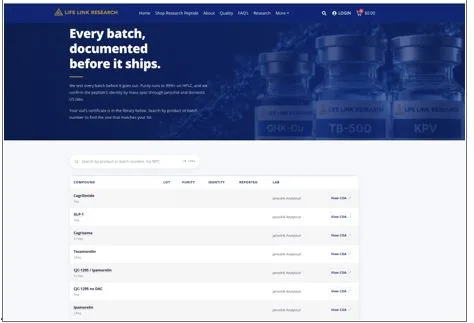
New batch-matched COA database brings full HPLC and mass-spec traceability to Life Link Research’s entire research catalog in 2026.
SHERIDAN, Wyo., September 5, 2026. Life Link Research, a US-based research-peptide supplier, today launched a public, batch-matched certificate of analysis (COA) database covering its full research catalog. Every lot the company sells now carries a published certificate showing its HPLC purity result and mass-spec identity confirmation, searchable by product or batch number at the website.
The database is live now across all compounds, with no product excluded. It gives any researcher a way to audit the exact vial they intend to buy before placing an order, a step that previously required contacting a vendor directly.
What Life Link Research Announced: A Public COA for Every Batch
The announcement centers on one concrete change. Life Link Research has moved every batch certificate into a single public library, organized as a searchable table with columns for compound, lot, purity, identity, test date, testing lab, and a link to the certificate itself. A researcher types in a product name or batch number and pulls the matching document in seconds.
The scope covers the entire catalog. More than twenty compounds are listed at launch, and each new lot is added as it clears testing. The vial label carries the same batch number printed on its certificate, so a buyer can confirm the document belongs to the vial in hand. Earlier, certificates were available only on individual product pages. The new library gathers them in one place and makes the full record browsable before purchase.
Why Batch-Matched COAs Matter for Research Peptide Purity
A batch-matched COA is the document that tells a researcher what a specific vial actually contains, and two tests carry most of the weight.
- HPLC, or high-performance liquid chromatography, measures purity by determining what fraction of the vial is the intended peptide.
- Mass spectrometry confirms identity by matching the molecule’s measured mass to its known molecular weight. Purity answers how clean the material is, and identity answers whether it is the right compound at all.
- The batch-specific part is what makes the record useful. A generic certificate that represents a product line, with no lot number tied to it, cannot tell a researcher whether the vial on the bench matches the paperwork.
- A batch-matched certificate can, because it reports results for one production run and links to the label on the vial.
- That link is what supports reproducibility. When an experiment is repeated months later, the researcher can confirm the second vial was made to the same measured standard as the first, or document exactly where it differed.
For laboratory work, where an unverified reagent quietly undermines a result, the pairing of HPLC purity and mass-spec identity on a per-lot basis is the research-grade standard. Publishing that pairing openly, for every lot, is the change Life Link Research is announcing.
Full HPLC and Mass-Spec Traceability Across the Catalog
Every lot in the catalog is tested by both methods before it is released for sale, and the results are recorded on the certificate that enters the public library. Purity runs to 99%+ by reverse-phase HPLC, and identity is confirmed by mass spectrometry. The analysis is performed by Janoshik Analytical, an independent testing laboratory, alongside domestic US labs.
The certificates report more than the headline pair. Beyond HPLC purity and mass-spec identity, the panel covers heavy metals, bacterial endotoxin, and sterility, with residual solvent screening on the compounds that call for it.
Each certificate lists the compound, its lot number, the measured results, the date reported, and the lab that ran the analysis. The database presents that information in a consistent format across the catalog, so the record for one compound reads the same way as the record for the next.
Addressing Transparency Concerns in the Research Peptide Market
The research-peptide market is known to be weak on documentation. A share of the material sold online arrives with a purity claim printed on a banner and no certificate behind it, which leaves a buyer trusting a number that nothing supports. That gap is where mislabeled or under-tested products circulate, and it is the concern a public COA database is built to answer.
Life Link Research is positioning the library as its response to that gap. By publishing a batch-matched certificate for every compound it sells, open to anyone before a purchase, the company turns a promise into a document a researcher can read and verify. The approach places verifiable evidence at the front of the buying decision and gives the reliability-minded buyer a concrete reason to choose a documented source. The company frames the database as a standard it is willing to be held to, across the full catalog and every future lot.
“Transparency only counts when it is something people can check for themselves,” said Dr Daniel Hayes, Quality Analyst at Life Link Research. “We decided the genuine version of a purity claim is the certificate that backs it, so we published all of them in one place. A researcher should never have to email us to find out what is in a vial. They should be able to open the batch record, read the HPLC and mass-spec results, and confirm the lab that signed off, before they ever add the product to a cart.”
What the COA Database Means for Researchers
For researchers, the database changes how a purchasing decision gets made.
- Sourcing confidence rises when the certificate is available up front, because the buyer can weigh the actual lot data before deciding, with a verifiable document doing the work a marketing figure once had to.
- Reproducibility improves when every vial can be traced to a batch record, since a repeated experiment can be tied back to a documented standard.
- The practical effect is reduced sourcing risk. A lab can screen a compound’s certificate for purity and identity before committing a budget, compare lot records over time, and keep a verifiable paper trail for its own protocols.
- All of this applies to laboratory research use only. The certificates report on the chemical quality of a research material, and they carry no implication about use in humans or animals, which the company keeps outside the scope of the product and the database alike.
Rebecca Lang, Lab Operations Executive at Life Link Research, said, “Our aim is to make published, per-lot testing the baseline that researchers expect from any supplier. If open batch records become the norm, the whole research-supply market gets more accountable. We would rather help set that bar than wait for it. The database is our commitment to keeping it, lot after lot, as the catalog grows.”
How to Access and Read a Life Link Research COA
The database is available at lifelinkresearch.com under the COA Library. A researcher opens the library, then searches by product name or batch number to find the certificate that matches a specific lot. The vial label prints the same batch number, so matching the two takes a moment.
Reading the certificate is simple.
- Each document reports the purity percentage from HPLC, the identity confirmation from mass spectrometry, the date the results were reported, and the name of the testing laboratory.
- The report number on the certificate lets a researcher confirm the document independently with the lab.
- Read together, those fields answer the core questions before a purchase: how pure the material is, whether it is the correct compound, when it was tested, and who tested it.
- For deeper background, the company maintains current research and quality evaluation guidance across its research library.
About Life Link Research
Life Link Research is a US-based supplier of research-grade peptides for in-vitro laboratory use. Its catalog spans repair and recovery, growth hormone, metabolic, longevity, and immune research compounds, sold as single peptides and multi-compound kits. Each lot is verified to 99%+ purity on HPLC, with mass-spec identity confirmation from independent laboratories, and every certificate is published in the company’s public COA library.
Life Link Research is built around a transparency-first standard for research-compound supply. All products are labeled for research use only. More information is available at lifelinkresearch.com.
Media Contact
Email: [email protected]
Website: lifelinkresearch.com
Disclaimer
All Life Link Research products are for research use only and are not for human or veterinary consumption. They are not approved by the FDA and have not been evaluated for safety or efficacy in humans. Nothing in this release is medical advice. Statements about future testing standards are forward-looking and subject to change. Products are sold to qualified buyers 18 or older.