Forehead Lift Surgery in South Korea: What Patients Should Compare Before Choosing a Procedure
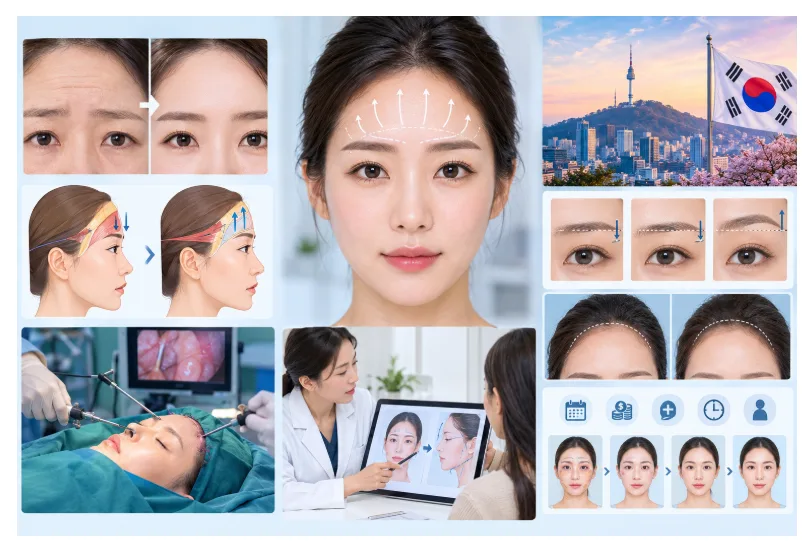
Interest in facial rejuvenation is no longer focused only on the lower face.
For many patients, the earliest visible changes appear around the forehead, eyebrows, and upper eye area.
When the brows descend or the forehead begins to sag, the entire upper face can appear heavier or more tired.
This has increased interest in forehead lift procedures, including endoscopic techniques that aim to reposition tissue through relatively small incisions.
However, forehead lifting is not simply a procedure for removing forehead wrinkles.
The position of the eyebrows, the proportions of the forehead, the upper eyelids, and the overall balance of the upper face all need to be considered.
What Does a Forehead Lift Actually Change?
A forehead lift is generally designed to reposition sagging tissue in the forehead and brow region.
For some patients, the main concern is that the eyebrows have gradually moved lower.
For others, the issue is a heavier appearance around the eyes or a tendency to use the forehead muscles excessively when opening the eyes.
This distinction matters.
A forehead lift addresses the upper facial framework.
It is therefore different from simply treating a surface wrinkle or making the eyes appear larger.
Patients should first determine whether their concern originates primarily from the forehead and brow region or from the eyelids themselves.
The Eyebrows Influence the Appearance of the Eyes
The relationship between the eyebrows and eyes is one of the most important factors in upper-face rejuvenation.
When the eyebrows descend, the space between the brow and upper eyelid can become smaller.
This can make the eyes appear heavier even when the eyelid itself has not changed significantly.
As a result, some patients initially assume they need eyelid surgery when the underlying issue may involve brow position.
The reverse can also be true.
A patient may attribute heaviness to the forehead when the primary issue is actually within the eyelid.
This is why diagnosis of the source of the problem matters before choosing a procedure.
Endoscopic Forehead Lifting Has Changed the Conversation
Endoscopic surgery has become an important part of modern forehead lifting.
Instead of relying on one large incision, endoscopic techniques may use smaller incisions placed within or near the hairline.
A small camera allows the surgeon to view internal structures while tissues are released, repositioned, and fixed.
For patients, the term “endoscopic” can sound automatically superior.
But the use of an endoscope alone does not determine the quality of the operation.
The more important questions include:
- where the incisions are located
- how much tissue is released
- how the tissue is repositioned
- how fixation is performed
- whether additional areas, such as the temporal region, are included
Patients comparing forehead lift surgery should therefore focus on the full surgical plan rather than the name of the technique alone.
More Lifting Is Not Always Better
A common assumption is that a stronger lift produces a better result.
That is not necessarily true.
The goal of forehead lifting is not simply to move the eyebrows as high as possible.
The final eyebrow position needs to remain consistent with the patient’s facial proportions.
If the eyebrows are elevated excessively, the result may look unnatural.
This is particularly important for patients who already have a relatively large forehead or a naturally greater distance between the eyebrows and eyes.
Surgical planning should therefore consider proportion rather than maximum elevation.
Hairline Position Can Matter
Forehead size and hairline position may also influence the choice of surgical approach.
A patient with a high hairline may have different priorities from someone with a shorter forehead.
Incision placement can affect how the forehead appears after surgery.
This does not mean that one technique is universally better.
It means that the relationship between the hairline, brows, eyes, and forehead should be evaluated together.
Patients should ask how the planned incision and lifting direction may influence these proportions.
Why Patients Use Their Forehead to Open Their Eyes
Some people unconsciously raise their eyebrows or contract their forehead muscles when opening their eyes.
Over time, this may contribute to visible forehead lines.
However, the behavior itself does not automatically mean that forehead lifting is the correct treatment.
There may be several reasons why a person uses the forehead muscles.
The brows may have descended.
The upper eyelids may feel heavy.
Other anatomical factors may also be involved.
Before surgery, identifying why the forehead is being used can be more important than simply treating the resulting wrinkles.
Recovery Should Be Planned, Not Assumed
Forehead lift surgery involves tissue manipulation, which means some recovery should be expected.
Common temporary experiences can include:
- swelling
- bruising
- a feeling of tightness
- temporary changes in scalp or forehead sensation
- sensitivity around incision areas
Patients should not assume that returning to work and looking fully settled are the same thing.
A person may resume many ordinary activities before swelling and subtle changes have completely resolved.
Planning around important events is therefore advisable.
How Long Does a Forehead Lift Last?
Patients often ask for a precise number of years.
In reality, surgical lifting does not operate like a temporary cosmetic treatment that simply stops working on a specific date.
Repositioned tissues may remain in their new position while the natural aging process continues.
Long-term appearance can be influenced by:
- age
- skin and soft-tissue quality
- the degree of sagging before surgery
- surgical technique
- individual aging patterns
For this reason, longevity is better understood as a combination of surgical correction and continued aging rather than a fixed expiration period.
Cost Should Be Compared With Procedure Scope
Forehead lift pricing can vary because the procedures themselves vary.
Factors can include:
- the surgical technique
- incision design
- extent of tissue release
- fixation method
- anesthesia
- whether another lifting procedure is performed at the same time
A lower quote may represent a more limited procedure.
A higher quote may include a broader surgical plan.
The useful question is not simply, “Which clinic costs less?”
It is, “What exactly is being done for that price?”
The Consultation Should Answer Specific Questions
Before choosing a surgeon, patients may benefit from preparing a short list of questions.
Where will the incisions be placed?
Why is this technique recommended?
How will the eyebrows be repositioned?
Could the procedure change the apparent size of the forehead?
Is the heaviness around the eyes caused by the brow or eyelid?
What fixation method will be used?
What recovery timeline should be expected?
These questions make it easier to compare medical recommendations rather than marketing descriptions.
The Right Procedure Depends on the Cause
Forehead lifting can be an effective option for appropriately selected patients, but it should not be treated as a universal solution for upper-face aging.
Some concerns originate primarily from the eyebrows.
Others involve the eyelids.
Some involve both.
The most useful approach is therefore to determine what has changed anatomically before deciding how to correct it.
For patients considering surgery in South Korea, understanding these distinctions before consultation can make clinic comparisons more meaningful and help set more realistic expectations about both the procedure and recovery.