Blue-Green Deployments for Databases: What Actually Needs to Stay in Sync
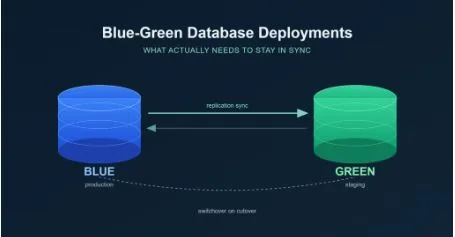
Blue-green deployment started as an application release pattern. Run two identical environments, route traffic to one, deploy to the other, then switch. For stateless services this works cleanly because there is nothing to reconcile between the two sides. Databases are a different problem entirely. The moment you introduce a stateful layer, “identical” stops being a snapshot and becomes an ongoing synchronization requirement.
Teams that treat blue-green deployments for databases the same way they treat application rollouts usually run into trouble at switchover time: stale reads, dropped writes, or a replica that looks caught up but isn’t. Understanding exactly what needs to stay synchronized, and what doesn’t, is the difference between a clean cutover and an incident.
The Core Idea for Databases
In a database blue-green setup, blue is the current production instance and green is a replica that mirrors blue’s topology, primary, read replicas, and parameter groups. Green stays synchronized through ongoing replication, typically binary log replication for MySQL and MariaDB, or logical replication for PostgreSQL. You make your risky changes on green, engine upgrades, parameter changes, schema modifications, or storage adjustments, while blue keeps serving production traffic untouched.
The switchover is the critical moment. Writes on blue are briefly paused, replication lag is checked, and once green has fully caught up, traffic is redirected to it. Application endpoints typically do not change, since the underlying instances are renamed rather than the connection strings.
What Actually Needs to Stay in Sync
| Component | Needs Sync | Why |
| Data (rows, transactions) | Yes | Any lag between blue and green means data loss risk at cutover |
| Schema (tables, indexes, constraints) | Yes | Mismatched schema breaks replication or application queries |
| Stored procedures and triggers | Yes | Application logic may depend on them executing identically |
| Parameter groups and configuration | Partially | Only the settings that affect data behavior, not instance sizing |
| Connection pools and session state | No | These are ephemeral and reset naturally on reconnect |
| Cache layers (Redis, application cache) | No, but invalidate | Stale cache entries after cutover cause subtle bugs, not sync failures |
| Monitoring and alerting rules | Yes, operationally | Alerts must point at green immediately after switchover |
Data and Replication Lag
This is the part most teams already understand: green must be a faithful, current copy of blue. Replication lag is the metric that determines whether a switchover is even safe to attempt. Most managed platforms enforce guardrails here, blocking a switchover automatically if lag exceeds a threshold rather than letting you cut over to a stale copy. If you are managing replication manually, this check needs to be explicit in your runbook, not assumed.
Schema Drift Is the Silent Killer
Schema changes made on green for testing purposes, an extra index, a modified column type, can create drift that either breaks replication outright or causes queries to behave differently once traffic moves over. Any schema change intended for the eventual production state should be applied in a way that replication can carry forward, not as a one off tweak isolated to green. If a change cannot replicate cleanly, it needs to be applied to both sides through your migration tooling instead of relying on blue-green sync to carry it.
Application Level State Does Not Need to Follow
This is where teams overcorrect. Connection pools, in flight transactions, and session caches are transient by design. They do not need to be replicated or preserved across the cutover. What does need attention is how quickly your application layer detects the switch and reconnects. A connection pool that holds stale connections to the old blue endpoint after a rename can cause a wave of errors even though the database itself switched over cleanly.
Application caches deserve a similar but distinct treatment: they are not part of the sync requirement, but they should be invalidated or given a short TTL around the cutover window so users are not served data that predates the switch.
Where a DBA Consultant Adds Real Value
Reading the guardrails is one thing. Knowing which schema changes are safe to let replicate versus which ones require an offline migration path is a different level of judgment, one built from having watched cutovers fail in production. A DBA consultant brought in for a blue-green rollout typically focuses on three things: validating that replication lag thresholds match the business’s actual tolerance for data loss, auditing planned schema changes for replication compatibility before they are applied to green, and building the switchover runbook so that connection handling, monitoring cutover, and rollback triggers are defined ahead of time rather than improvised.
A Practical Checklist Before You Switch
- Confirm replication lag is at or near zero, not just below threshold.
- Verify schema changes on green are replication safe, not isolated tweaks.
- Check that stored procedures and triggers match between blue and green.
- Update monitoring and alerting to track green before the cutover, not after.
- Confirm application connection pools will reconnect cleanly to the renamed endpoint.
- Set a short TTL or manual invalidation plan for application caches around the cutover.
Blue-green deployments reduce downtime and risk for database changes, but only when the synchronization boundary is drawn correctly. Data, schema, and stored logic must stay in lockstep. Everything ephemeral, connections, caches, in flight sessions, should be allowed to reset naturally. Getting that boundary right is largely a matter of experience with how each engine’s replication actually behaves under load, which is exactly the kind of judgment a specialized database team like Mydbops brings to a rollout.