Why Audience Engagement Is the Skill Most Presenters Underestimate
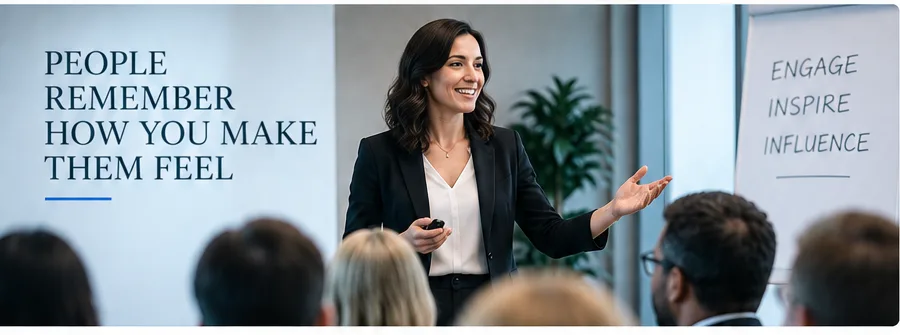
The best presentations do more than deliver information. They make people feel involved, understood and ready to respond.
Presenters often spend hours refining slides, collecting statistics and polishing the wording of every point. Those things matter, but they are not what determines whether a presentation succeeds. If the audience is only passively receiving information, even a well-researched talk can disappear from memory as soon as the meeting ends.
Audience engagement is the missing skill because it changes the role of the listener. Instead of asking people to sit through a sequence of slides, an engaging presenter helps them connect the message to a problem, decision or opportunity that matters to them. That shift can turn the same content from a one-way briefing into a conversation that influences what happens next.
What Audience Engagement Really Means
Engagement is sometimes confused with entertainment. A presentation does not need games, dramatic effects or constant audience participation to be engaging. In a business setting, engagement is better understood as sustained mental involvement. People know why the topic matters, they can follow the argument, they recognize how the message connects to their work, and they have opportunities to think or respond.
That distinction is important because it makes engagement practical. Harvard Business Review has emphasized that gaining and maintaining audience focus is central to communication success. The point is not to compete with every distraction in the room. It is to structure and deliver the message in a way that gives people a reason to keep following it.
Why Presenters Underestimate It
The most common reason is simple: presenters naturally concentrate on what they need to say. They think about the facts they must cover, the slides they need to show and the questions they hope to avoid. The audience, however, is approaching the presentation from the opposite direction. They are asking whether the information is relevant, whether it is easy to understand and whether it changes anything for them.
This mismatch explains why knowledgeable speakers can still lose a room. Expertise may give a presenter authority, but it does not automatically create connection. The audience needs a clear path through the material and a reason to stay mentally involved.
Start With the Audience, Not the Slide Deck
A useful engagement strategy begins before the first slide is designed. Ask what the audience already knows, what they care about and what decision or action the presentation should support. The answers determine what should be included, what can be removed and where more explanation is needed.
For example, a leadership team may care about risk, cost and strategic impact. A sales team may care about customer objections and practical results. A technical audience may need evidence and detail, while a mixed audience may need more context before the same evidence makes sense. The speaker who adapts to those differences is much more likely to keep attention than the speaker who delivers the same deck to every room.
Open With a Reason to Care
Engagement is easiest to build early. Long introductions, agenda slides and background information can delay the moment when the audience understands why the presentation deserves attention. A stronger opening gives the audience a problem, question, contrast or outcome to think about.
That does not mean every presentation needs a dramatic story. A simple question such as “What would change if we cut this process from five steps to three?” can be enough to create curiosity. The point is to give listeners something to mentally answer before asking them to absorb supporting details.
Build Interaction Into the Message
Questions are one of the simplest ways to convert a presentation from monologue to interaction. Stanford Graduate School of Business communication lecturer Matt Abrahams has described questions as an unusually versatile presentation tool because they can build intrigue, foster audience engagement and help create a stronger connection between speaker and listener.
The question does not always need a spoken answer. Rhetorical questions can focus attention. A show of hands can quickly reveal the room’s experience. A short poll can expose different assumptions. In a smaller meeting, inviting one or two perspectives can turn the audience into contributors without allowing the session to lose direction.
Good interaction is purposeful. If an activity does not help the audience understand the message, test an idea or connect the topic to their own experience, it can become a distraction instead of an engagement tool.
Use Stories and Examples to Create Relevance
Abstract ideas are difficult to stay connected to for long periods. Real examples give people something concrete to picture. A short customer story, a project mistake, a before-and-after comparison or a decision that produced an unexpected result can make an otherwise technical point easier to understand.
The strongest examples are selective. They are not included because the presenter has a story to tell; they are included because they clarify the point the audience needs to remember. One relevant example is usually more effective than several loosely connected anecdotes.
Keep Visuals From Competing With You
A slide can support engagement or quietly destroy it. When people are reading paragraphs, decoding a complicated chart or searching for the important number, they are no longer listening to the speaker.
Use visual material as a guide to the message rather than a storage place for everything you know. A clear headline, one meaningful chart or one strong image can direct attention. If a slide needs a long explanation before anyone can understand what they are looking at, simplify it before the presentation.
Read the Room and Adapt
Engagement is not something a presenter sets at the beginning and then assumes will continue. Watch for signs that the audience is following: eye contact, questions, note-taking, facial reactions and the quality of responses when you ask for input.
If energy drops, changing pace can be more useful than pushing through the next five slides. Summarize the key point, ask a question, move to an example or skip detail that no longer seems necessary. A presentation is a live communication event, so the ability to adapt is part of the skill.
Engagement Without Losing Control
Some presenters avoid interaction because they worry the session will run over time or move away from the objective. The solution is not to remove engagement; it is to design boundaries around it.
Tell people when questions will be taken. Ask narrow questions rather than opening every topic to debate. Use time limits for group discussion. Summarize contributions and connect them back to the main message. These techniques allow the audience to participate while the presenter still guides the direction of the session.
Treat Engagement as a Trainable Skill
Audience engagement improves with deliberate practice. Presenters need opportunities to work on openings, transitions, questions, storytelling, visual discipline and the ability to adjust when the room responds differently than expected. Structured presentation skills training can help professionals practice those behaviors in realistic situations and receive feedback on how clearly they connect with an audience.
This matters because engagement is rarely created by one clever technique. It comes from a combination of audience awareness, structure, delivery and responsiveness. The presenter who develops those habits does not need to rely on flashy slides or forced interaction to hold attention.
The Skill Behind the Slides
A strong presentation is not measured by how much information the speaker manages to deliver. It is measured by what the audience understands, remembers and is prepared to do afterward.
That is why audience engagement deserves to be treated as a core presentation skill rather than an optional extra. Start with what matters to the audience, give them a reason to care, involve them at useful moments and stay responsive to the room. When those elements are in place, the presentation becomes easier to follow, more credible and much more likely to influence action.
Editorial references
Harvard Business Review: 3 Ways to Keep Your Audience Focused During a Presentation
Stanford Graduate School of Business: A Good Question Can Be the Key to a Successful Presentation