Why brands move paid-social budget into clipping
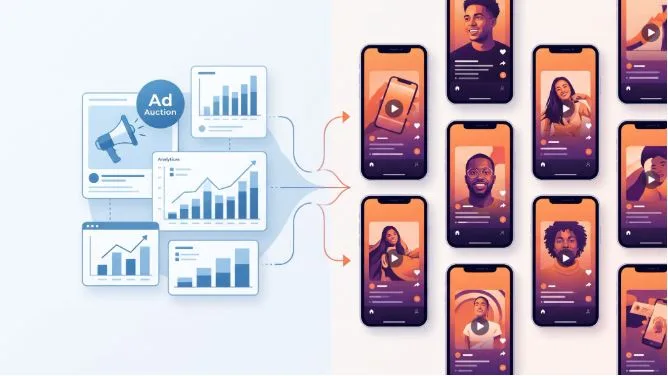
Paid social still works when you need a named audience and a sale you can track. Brands move part of that budget into clipping for brands for a simpler reason: the file already exists, and they are tired of paying the auction to show it on an account they already own. A clipping campaign cuts that file into short clips and posts them on real creator accounts. You pay for views that landed, not for a slot in the auction.
This is a split, not a funeral for ads.
Why paid-social budgets are moving
Paid ads charge first. You buy the impression, then hope someone watches.
Clipping charges after. The post has to live, the view has to count, and the ones that fail the rule do not stay on the invoice.
That timing change is why the line item moves. Skip rates and rising auctions matter too. So do limited ad accounts. The first question on the call is rarely the rate. It is whether the ad account is still allowed to spend.
If the answer is no, paid social cannot do the job this week. If the answer is yes, keep a slice on creator accounts and leave the rest in the auction for the sale. A slice is a share. It is not the whole paid-social line.
The shoot is already done. The podcast, the demo, the keynote sit on a drive. What you are buying now is reach among people who will never open that channel.
What a clipping campaign buys that ads do not
| Paid social ads | A clipping campaign | One influencer post | |
| What you pay for | An auction slot | Views on creator accounts | One post on one account |
| Whose account | Yours | Many creators | One creator |
| Looks like | An ad | A post | A post |
| If the ad account is limited | The spend stops | The posts stay up | That one post stays or dies |
| If one post fails | You buy another slot | Other clips keep running | The spend is gone |
| Who runs it | You and a media buyer | A desk, or you on a board | You and the talent |
No prices in this table. A blog rate copied into a pitch is a guess.
Ads sell impressions. A clipping agency sells a view rule.
Paid ads sell an impression. The ad rendered. That is the unit.
The desk sells a rule: what counts as a view, what gets thrown out, and what happens if the post comes down. Some desks still bill a retainer. The ones worth the move still have that rule in writing.
Mix the two units and every five times cheaper page looks clever. Ask for the rule, who checks the posts, and whether a deleted clip still bills. Slide answers mean you are buying a screenshot.
What leaves the media buyer’s plate
The media buyer keeps the auction, the pixel, and the retarget stack. That work stays.
What leaves is the job of turning one long file into dozens of posts on other people’s accounts: briefing those accounts, catching cuts that break the brand, and pulling dead posts out of the invoice.
If that work stays with the buyer, the buyer becomes the desk. Most buyers did not take the role to argue about a hook on a Tuesday night. Hand the desk work to a desk.
When the paid ads budget should stay
Keep paid social when you need a named audience today, a sale on a page you can track, or a retarget window on people who already saw the brand.
Clipping is weak at all three. It does not replace the pixel or the media buyer. Checkout this week still belongs in the auction.
Same if the only asset is a still. Creators need a long video with a moment worth cutting.
When clipping campaigns get the line item
Move a slice when the long video is already strong, you need people who do not follow you, and you want many posts instead of one lucky clip.
Restricted categories feel this first: crypto, iGaming, some finance, some health. Ads get limited. Creator posts do not run through your ad account. Posts can still come down. Write a do-not-say list, and disclose paid work the way the platform asks.
One clip is luck. Clipping campaigns are many clips across many accounts. Only the second version is worth a line item.
Keep the slice a slice. Empty the paid-social line and checkout will not move with the views. Reach moved. The sale did not, because nobody kept a retarget budget behind the people who watched.
Then close the loop. The clips that hold can take usage rights and run as ads. Creator accounts find the hook. Paid social puts spend behind the hook that already worked. That is a move, not only a split.
What does not move with the money
Attribution will not look like Ads Manager. You will not get a clean last-click from a creator’s TikTok onto checkout. Measure branded search, direct traffic, and which hooks held long enough to reuse. Do not invent a lift percentage for finance.
Forced brand placement flops. Open on a logo card and people swipe. The brand can sit inside the moment. It cannot be the first three seconds.
A farm sells a screenshot and a total. Ask what counts as a view, what gets thrown out, and whether a deleted post leaves the invoice. If those three answers are vague, keep the money in ads.
FAQ
Does a clipping agency replace paid social?
No. Use clipping to reach people who do not follow you. Use paid ads to retarget the ones who already saw you.
Are clipping campaigns cheaper than paid ads?
Often cheaper per view, because you are not buying the auction. The number depends on the video, the platforms, and the view target. Do not copy a rate from a blog.
Who owns the line item?
Finance needs one owner. If the brand runs a board, the brand owns it. If a desk runs the brief, the posts, and the view report, the desk owns it. Split ownership is how invoices drift.
What do you tell finance?
The unit changed. Ads buy a rendered impression. This channel buys a view that passed a rule. The paid-social line still exists for the sale. You are not signing a blog rate.
What if paid ads are banned in my category?
Creator accounts can still post. The brief still binds. Write the do-not-say list before the first clip goes live.
Bottom line
Move budget when the video already exists and you need reach that does not sit inside an ad account. Keep paid ads for targeting and for the sale.
A pitch that says ads are dead, or that clipping wins every time, is selling a slogan. Buy the split.
Why a full-stack clipping agency
Three ways to buy this.
Run a board yourself. You brief the editors, check the posts, and argue about the views. You become the desk. The first week is a pile of cuts and nobody owning the rejects. The board dies in two weeks.
Hire an editor shop. You get files. You still have to post them. The files sit in a folder while the week moves on.
Or hire a full-stack desk. One team writes the brief, matches creators, posts the clips, and shows the views against the rule you agreed.
Lumina Clippers runs that third model. Brief to report sits with one owner, so the brand is not the desk and the line item has one name on it.