Reducing High-Rise Inspection Risk: How Rope Access and Drones Are Changing Facade Safety in the UAE
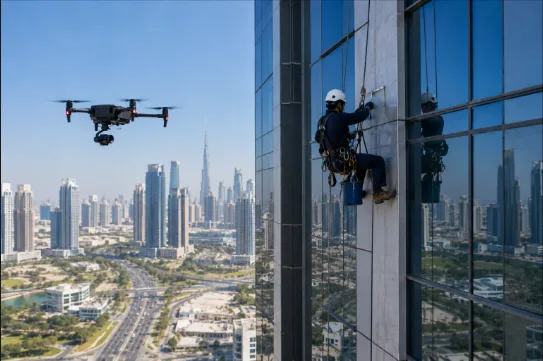
High-rise facade inspection has always been a safety problem before it’s ever a cost problem. Someone has to get close enough to a building’s exterior to spot a cracked panel or a failing seal, and for decades that has meant putting a person at height to do it. Rope access and drones have both changed what that exposure looks like, though not in the same way.
Why High-Rise Facade Inspection Is a Safety Problem First
A failed fixing or degraded sealant on a 30-storey tower isn’t just a maintenance line item, it’s a falling-object risk to people on the ground below. That risk is one reason building owners and facility teams in the UAE need structured facade inspection and maintenance programs, particularly for high-rise and aging assets.
Every inspection method that gets someone physically close to the facade also creates a working-at-height risk event that has to be assessed, permitted, and supervised before work even starts. The inspection itself is meant to reduce risk, but the access method used to perform it can introduce risk of its own.
How Rope Access Manages That Risk Today
Rope access uses trained technicians on ropes and harnesses to reach building exteriors that scaffolding or cradles can’t easily access. It remains the standard for close-up, tactile inspection where an inspector needs to physically touch a surface, not just photograph it.
IRATA Standards and Supervised Access
Many professional rope-access contractors in the UAE use IRATA’s internationally recognized framework, the Industrial Rope Access Trade Association’s standard for technician competence, supervision, and rescue planning. High-rise rope-access work typically requires appropriately certified technicians, competent supervision, and a documented rescue plan, with crew size determined by the project’s risk assessment and scope.
Professional providers such as Baseera 360 combine rope access and BMU inspection capabilities with structured facade assessment, giving building teams a way to select the appropriate access method for each inspection rather than defaulting to one method for everything.
Where Drones Reduce Risk, and Where They Don’t
Drone-based facade inspection removes the access step entirely for the survey phase, since the pilot and any reviewing engineer stay on the ground while the drone captures the elevation. That can significantly reduce exposure to working-at-height risks during the initial survey phase.
On a glazed, occupied high-rise, a drone can capture the full elevation with high-resolution and thermal imagery in a matter of hours instead of the days a full rope access survey would take. Baseera 360’s drone facade and rooftop inspection service uses this to flag cracking, spalling, and moisture ingress before deciding where closer access is actually needed.
What drones don’t remove is the need for tactile assessment once a defect is found. A hollow tile or early-stage delamination often requires a physical tap test that no camera can perform, and reflective or heavily glazed facades can still produce image quality issues in strong sunlight.
When Rope Access Still Makes More Sense
Some facade issues can only be confirmed by touch, not imagery, which keeps rope access relevant even as drone surveys expand. A tap test on a suspect tile, for example, tells an inspector whether it’s hollow underneath, something no camera resolution can determine.
- Confirming sealant condition and elasticity by hand
- Verifying loose or hollow finishes with a tap test
- Close-up assessment of localized structural cracking
- Areas where reflective glazing or shading obstructs drone imagery
- Repair and maintenance work that needs a technician on-site regardless of how the defect was first identified
This is why treating drones as a full replacement misses the point. The two methods answer different questions, one about where a problem might be, the other about exactly what’s wrong and how to fix it.
Building a Hybrid Inspection Plan
The lowest-risk approach for most high-rises isn’t choosing rope access or drones exclusively, but sequencing them: a full drone pass to map the entire elevation and flag areas of concern, followed by targeted rope access only where a closer look is warranted.
This cuts total time at height dramatically, since technicians are no longer surveying blind across an entire building, they’re descending to specific, pre-identified locations. A 40-storey tower that once needed a full rope access survey covering every elevation can instead send technicians to only the handful of zones the drone pass flagged.
Facility teams adopting this approach tend to phase it in gradually, testing the hybrid model on one building before applying it across a portfolio, which keeps inspection quality consistent while the workflow beds in.
FAQ
Does using drones eliminate the need for rope access technicians?
No. Drones reduce how often rope access is needed by narrowing down where a technician actually has to go, but tactile checks and repair work still require physical access.
What safety standard governs rope access work in the UAE?
Many contractors follow IRATA’s internationally recognized framework, which sets expectations for technician certification, supervision, and rescue planning during work at height.
How much does a drone facade survey typically save compared to a full rope access inspection?
Savings vary by building, but the largest gains come from reducing how many elevations need physical access at all, rather than from the drone survey cost itself.
Can drone inspection reports be used for regulatory compliance in the UAE?
In many cases yes, provided the flight is conducted by a properly licensed operator, though acceptance can depend on the specific authority or insurer reviewing the report.
What happens if a drone survey misses a defect that later causes a failure?
This is why a hybrid approach matters. Drone surveys are strongest at broad coverage, and pairing them with targeted rope access on flagged or high-risk zones catches what imagery alone can miss.
Reducing inspection risk on a high-rise isn’t about picking a winner between rope access and drones. It’s about using each for what it does best, so the people doing the work spend less time at height and more time solving the problems the inspection actually finds.