USDT Wallet for TRC20, ERC20, BEP20, Solana, and TON
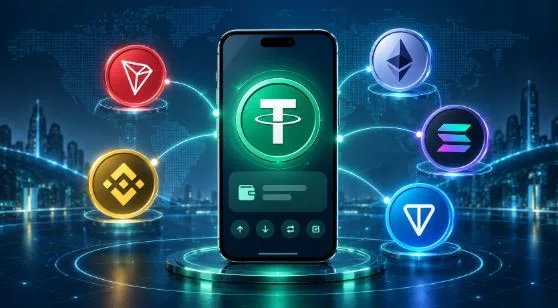
Tether (USDT) is designed to track the value of the US dollar, but it does not operate on only one blockchain. It is issued on several networks, and every network has its own rules, fees, addresses, and native coin for transaction costs. This makes choosing a capable USDT wallet particularly important.
Gem Wallet provides a self-custodial way to manage USDT on supported networks from one mobile application. Users can store, send, receive, buy, and swap supported versions of USDT without creating an account or handing control of their private keys to a centralized service.
Why the USDT Network Matters
The name USDT can make different versions of the token appear interchangeable. In practice, USDT on TRON is a TRC20 token, USDT on Ethereum follows the ERC20 standard, and USDT on BNB Chain follows the BEP20 standard. USDT is also available on networks such as Solana and TON.
Although these assets are designed to represent the same value, they exist on separate blockchains. Therefore, the network selected by the sender must match the network supported by the recipient.
A TRC20 transfer must go to a compatible TRON address, while ERC20 USDT should be transferred through Ethereum. Users should confirm both the address and the network before approving a transaction. This remains important when two networks use similar-looking address formats.
Because blockchain transfers are generally irreversible, sending a small test amount before making a large transfer can reduce the risk of an expensive mistake.
One Wallet for Major USDT Networks
The official Gem Wallet USDT page lists support for USDT on TRON, Ethereum, BNB Chain, Solana, and TON.
Instead of maintaining a separate application for every ecosystem, users can access supported USDT balances through one wallet interface. Each balance remains associated with its underlying blockchain, allowing users to see the network information needed to complete transactions correctly.
The network also determines which cryptocurrency is required to pay the transaction fee:
- TRC20 USDT transactions generally require TRX.
- ERC20 USDT transactions require ETH.
- BEP20 USDT transactions require BNB.
- USDT transactions on Solana require SOL.
- USDT transactions on TON require TON.
Keeping a small amount of the relevant native coin is essential. A wallet may contain USDT but still be unable to send it if there is not enough of the network’s native cryptocurrency to cover the transaction fee.
Sending and Receiving USDT
To receive USDT in Gem Wallet, users first select the correct asset and network. They can then open the receiving screen and share the displayed wallet address or QR code with the sender.
The sender must choose the same blockchain network. For example, if the recipient provides a TRC20 USDT address, the sender should select TRON or TRC20 as the withdrawal network.
To send USDT, the user selects the appropriate USDT balance, enters the recipient’s address and amount, reviews the network fee, and signs the transaction on the device.
Before confirming a transfer, users should:
- Verify the selected blockchain network.
- Check the beginning and ending characters of the address.
- Confirm whether a memo or tag is required.
- Review the transaction amount and network fee.
- Consider sending a small test transaction first.
Funds should never be sent based only on the USDT ticker because identically named assets can exist on different networks.
Self-Custody and Privacy
Gem Wallet is a self-custodial cryptocurrency wallet. According to its official feature documentation, users retain control of their private keys and digital assets.
The wallet does not take custody of the user’s funds, and its official website states that private keys do not leave the user’s device. This differs from depositing USDT on a centralized exchange, where the company controls the private keys and provides access through an internal account.
Self-custody gives users greater control, but it also creates additional responsibility. The recovery phrase should be recorded accurately and stored offline in a secure, private location.
Users should never:
- Share the recovery phrase with another person.
- Provide it to someone claiming to represent customer support.
- Enter it on an unknown website.
- Save it as an unprotected screenshot.
- Store it in an ordinary email or messaging application.
Anyone who obtains the recovery phrase may be able to restore the wallet and transfer its assets.
Buying and Swapping USDT
Gem Wallet includes access to cryptocurrency purchasing and swapping services. Its built-in swap experience can compare available routes from integrated decentralized exchanges, aggregators, and liquidity providers.
An on-chain swap exchanges supported assets that operate on the same blockchain. A cross-chain swap can exchange supported assets across different networks.
Cross-chain functionality is particularly relevant to USDT because users cannot move USDT from one blockchain to another through a regular transfer. For example, sending TRC20 USDT directly to an ERC20 destination is not a cross-chain transfer and could lead to lost funds. A supported cross-chain swap route should be used instead.
Swap routes are not guaranteed for every asset or network combination. Availability can depend on:
- The selected cryptocurrencies
- Supported blockchain networks
- Available liquidity
- Network and provider fees
- Current market conditions
- Live provider quotes
Users should review the expected amount, provider route, price impact, network fee, and minimum amount received before signing a swap transaction.
Fiat On-Ramp and Off-Ramp Access
Gem Wallet provides access to third-party fiat providers that can allow users to buy or sell supported cryptocurrencies.
A fiat on-ramp converts traditional currency into cryptocurrency. An off-ramp performs the opposite process by converting supported cryptocurrency into traditional currency.
Depending on the provider and location, available payment methods may include cards, bank transfers, Apple Pay, or other local options. However, payment methods, identity-verification requirements, fees, purchase limits, supported currencies, and geographic availability can vary.
Users should always review the provider’s final quote and terms before completing an order. Gem Wallet provides access to these services, while the selected third-party provider processes the fiat transaction.
An Open-Source USDT Wallet
Gem Wallet publishes its wallet code through the official Gem Wallet GitHub repository.
An open-source codebase allows developers and security researchers to inspect the implementation, report potential issues, suggest improvements, and contribute to the project. This provides greater transparency than a completely closed-source wallet.
However, open-source software does not remove every risk. Users should still download the application through official sources, secure their mobile devices, protect their recovery phrases, and carefully review transactions before signing them.
Choosing the Right USDT Wallet
A practical USDT wallet should clearly identify blockchain networks, support the chains a user needs, explain transaction-fee requirements, and keep transaction authorization under the user’s control.
Gem Wallet combines support for USDT on major networks with a simple interface, self-custody, decentralized swaps, fiat access, support for more than 100 blockchains, and an open-source codebase.
For users managing USDT across TRC20, ERC20, BEP20, Solana, or TON, the most important rule remains simple: always match the sending and receiving networks.
Users can explore the supported versions of USDT and download the application through the official Gem Wallet website.
Frequently Asked Questions
Can one USDT address receive every version of USDT?
No. USDT exists separately on each supported blockchain. The sender and recipient must select the same network. Even when two address formats look similar, the underlying networks may be different.
Why can I see USDT in my wallet but not send it?
The wallet may not contain enough of the network’s native coin to pay the transaction fee. Depending on the selected USDT network, the user may need TRX, ETH, BNB, SOL, or TON before submitting a transfer.
Does Gem Wallet hold my USDT?
No. Gem Wallet is self-custodial. The wallet manages private keys on the user’s device rather than holding USDT in a company-controlled account. The user authorizes transactions and remains responsible for protecting the recovery phrase.
Disclaimer: This article is for informational purposes only and does not constitute financial or investment advice. Always verify wallet addresses, supported networks, and transaction details before sending USDT.