From Survival to Structure: Lessons from the Crescent Star Insurance Journey
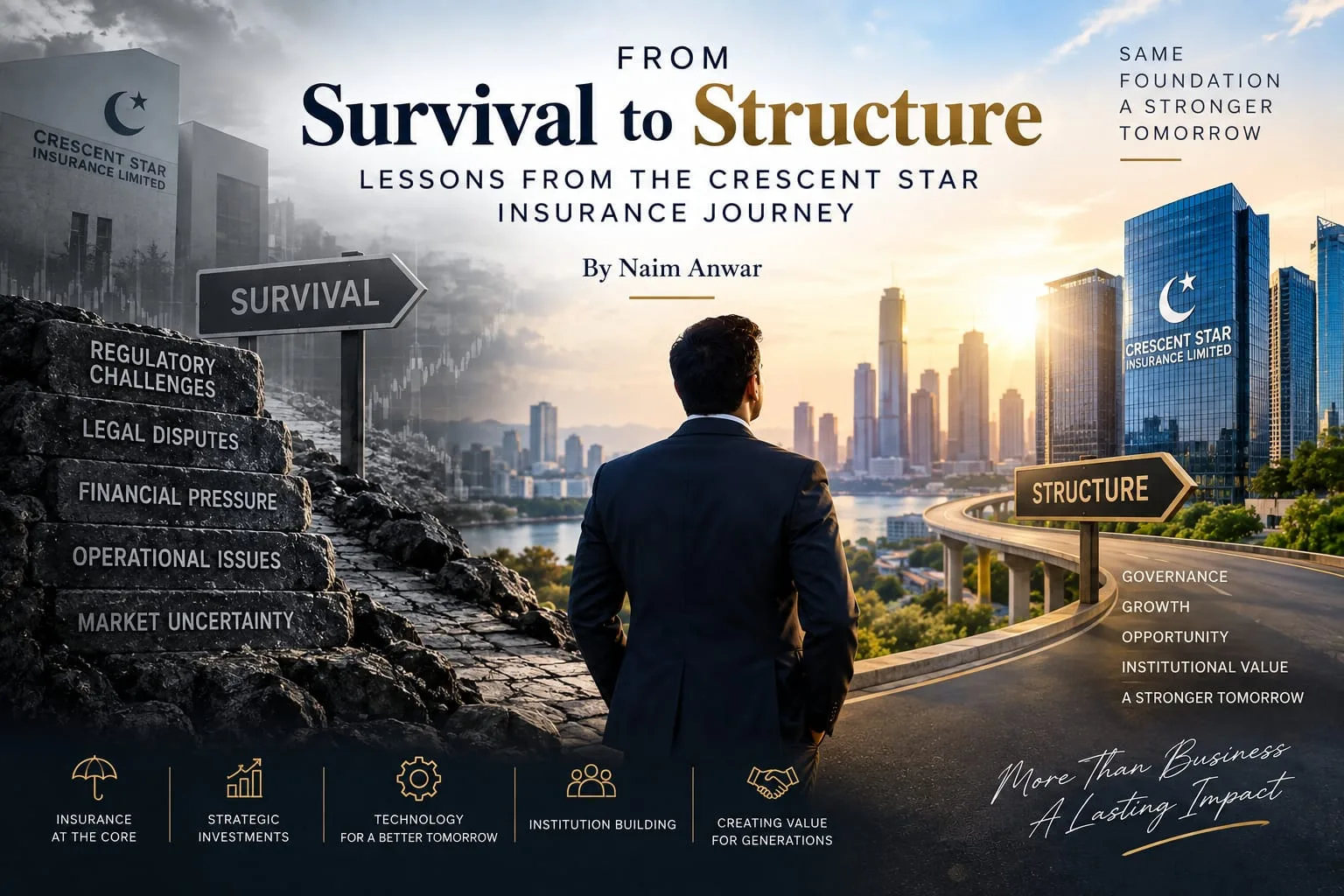
A Corporate Restructuring and Long-Term Value Perspective
Corporate restructuring is rarely a simple process. It often involves legacy liabilities, regulatory matters, operational challenges, investment decisions and long periods of uncertainty. The experience of Crescent Star Insurance Limited (CSIL) provides a useful example of how a company can move from stabilization toward a broader strategic structure. For readers interested in the full CSIL Journey, the case study documents this experience from the perspective of Naim Anwar.
Starting With Stabilization
Taking charge of a business with historical challenges requires a different approach from entering a company that is already operating from a stable base. When Naim Anwar assumed leadership of CSIL in 2013, the priority was to understand the existing position and stabilize the core insurance business. The company had legacy liabilities, receivables, regulatory matters, staffing and relationship issues, accounting concerns and investments whose book values did not necessarily represent their practical or underlying worth.
Understanding the Past Before Building the Future
The experience highlighted an important principle of corporate management: before building a new strategy, management needs to understand what already exists. Assets, liabilities, regulatory obligations, investments, relationships and operating performance all have to be considered together. Stabilization therefore became an essential part of the longer-term strategy rather than a temporary exercise.
Learning From Diversification
CSIL also explored diversification through investments and subsidiaries in areas outside its traditional insurance operations. Not every opportunity produced the intended result. That experience became part of the learning process and reinforced the importance of selective diversification, liquidity planning and professional management. A strategic investment may have potential, but it still needs to fit the wider structure of the group.
The Crescent Star Foods and PICIC Chapter
One of the most significant chapters involved Crescent Star Foods and PICIC. The merger process began in 2017 and continued for nearly nine years through objections, hearings, modifications and delays. The experience raised a fundamental question: does a long-delayed corporate opportunity lose its underlying value simply because implementation takes time? The CSIL case study records the view that delay can postpone recognition of value without necessarily eliminating it.
The 16 April 2026 Milestone
On 16 April 2026, the Sindh High Court sanctioned the Modified Scheme. The scheme contemplated approximately 7.9 billion PICIC shares for CSF shareholders. Its implementation could materially affect CSIL’s balance sheet and strategic position, subject to the completion of the relevant steps and conditions. The milestone represented the outcome of a long process in which persistence remained connected to an identifiable underlying opportunity.
Regulation and Legal Rights
Insurance is a regulated business, involving policyholders, solvency requirements, legal rights and regulatory oversight. CSIL’s experience also involved guarantee and transit-related businesses and regulatory challenges that affected operations, relationships and market perception. The broader lesson is that corporate restructuring must operate within the applicable legal and regulatory framework, while legitimate rights may need to be pursued through appropriate processes.
The Cost of Difficult Decisions
Long-running corporate matters have costs beyond direct financial expenses. Litigation, management time, regulatory uncertainty and delayed decisions can affect an organization for years. At the same time, difficult investments or disputes should not become an excuse for neglecting the core operating business. Rebuilding insurance operations remained important while longer-term strategic matters continued.
Distressed Does Not Always Mean Worthless
The experience with Dost Steels further shaped the perspective on distressed assets. A company may face serious operational or financial problems while still holding physical assets, land, plant or industrial potential. The distinction between a distressed company and a worthless asset is therefore important. The real question can be whether the underlying platform can be responsibly repositioned, recapitalized or put back into productive use.
From Insurance Executive to Corporate Restructurer
Over time, the experience moved beyond traditional insurance management into broader corporate restructuring. The questions became more structural: What does the business own? What is its capital structure? What liabilities remain? What permissions or corporate actions are required? Can the business be recapitalized? Can another operating business be introduced? Can an underused platform become productive again? These questions formed a practical education in corporate structuring.
From CSIL to a Broader Structure
The longer-term direction described in the case study is a broader group structure. CSIL remains the principal operating insurance business. PICIC may become a second listed financial platform once the merger is fully implemented and properly capitalized. Crescent Star Technologies provides a technology and digital layer, while Crescent Star Ventures is intended to institutionalize experience in restructuring, capital raising, M&A and related corporate matters. The objective is structure rather than diversification for its own sake.
Building an Institution
An entrepreneur can help rescue a company, but building an institution requires more than individual effort. Professional management, strong boards, younger leadership, technology specialists and experienced insurance and investment professionals all have roles to play. The longer-term test is whether the organization can continue creating value without every decision depending on one person.
2026 Is Not the Finish Line
The 2026 developments are presented as a new stage rather than a conclusion. Future success depends on turning strategic opportunities into sustainable economic value: strengthening the insurance base, implementing the PICIC opportunity where applicable, developing technology capabilities, building advisory and restructuring capacity, and managing capital carefully.
The Vision Ahead
The broader vision is to build a corporate platform capable of identifying value where others may see difficulty. That means using insurance as a foundation while developing investments, technology and advisory capabilities; restructuring businesses rather than automatically abandoning them; using capital markets responsibly; and building younger professional management for the future.
Conclusion
The CSIL experience demonstrates that corporate transformation is often measured in years rather than months. Survival can be the first objective, restructuring can create opportunity, and institutional structure can turn that opportunity into sustainability. The central lesson is simple: the real skill is not only understanding what an asset is worth today, but recognizing what it could become tomorrow.
The detailed case study, including the chronology and lessons from the transformation, is available here: From Survival to Structure: The CSIL Journey.