Info Calan Broadens Its Editorial Focus to History and Cultural Heritage
| Info Călan Broadens Its Editorial Focus to History and Cultural Heritage
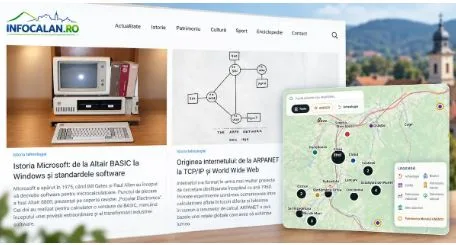
Info Calan, a Romanian online publication originally focused on the town of Calan and the Strei Valley in Hunedoara County, has gradually expanded its coverage to history, cultural heritage and documentary projects with a wider geographical scope. Local news and community subjects remain part of the publication, while a growing section of the website is devoted to historical events, archaeological sites, monuments, industrial heritage, biographies and reference materials. Several projects developed during 2026 reflect this direction, including an interactive heritage atlas and a series of thematic A–Z indexes. The expansion can already be seen in the publication’s coverage of Hunedoara County. Articles initially concentrated on places closely connected with Calan and the Strei Valley, including the medieval churches of Strei and Streisângeorgiu, archaeological remains, historic buildings and the industrial history of Calan. Coverage later extended to Țara Hațegului, the Orăștie area and other parts of Transylvania. An interactive atlas of historic placesOne of the projects developed by Info Calan is the Interactive Heritage Atlas, a digital map bringing together archaeological sites, medieval monuments, UNESCO World Heritage sites, industrial heritage and other places connected with the history of Transylvania. The first stage focused mainly on Hunedoara County. Locations included in the project range from Sarmizegetusa Regia and other Dacian sites to medieval churches, archaeological remains and industrial heritage. Among the places documented are the churches of Densus, Strei and Streisangeorgiu, sites around Calan and remains connected with the former industrial complex of the town. The atlas later expanded beyond Hunedoara County to include Sighișoara, Biertan, Viscri, Prejmer, Calnic, Saschiz, Valea Viilor, Darjiu and Roșia Montană. Each location can be connected with an individual article providing historical information and context. The project is being expanded gradually, with Transylvania forming its wider geographical area. The map includes different types of heritage, from archaeological sites and medieval churches to historic settlements and industrial buildings. Some are well known internationally, while others receive relatively little attention outside their local or regional context. Reference projects on Romanian historyAlongside the atlas, Info Calan is developing several thematic sections designed to organize historical information in an accessible form. The website includes A–Z indexes devoted to historical events, political prisoners and former collaborators of the Securitate documented through court decisions and archival material. Other sections deal with twentieth-century Romanian history, biographies and the history of journalism. The articles can be read independently, but they are also grouped into broader reference collections. This format makes it possible to bring together information that would otherwise remain dispersed across historical studies, archival documents, court decisions and older publications. Historical articles published on the website cover subjects including the Grivița strike of 1933, the royal strike of 1945–1946, the abdication of King Michael I on December 30, 1947, the proclamation of the Romanian People’s Republic and the nationalization of June 11, 1948. The publication has also expanded its coverage of journalism and media history, with profiles of journalists, newspapers and international news agencies. From local history to a wider regional contextCalan and the Strei Valley remain an important part of the publication’s historical coverage. The area brings together archaeological remains, medieval monuments and industrial heritage within a relatively small geographical space. Local subjects often provide a starting point for broader articles. The medieval monuments of the Strei Valley are connected with the history of Țara Hațegului and Transylvania, while the industrial history of Calan can be placed within the wider development of mining and metallurgy in Hunedoara County. The same approach is used for articles about place names, old maps, historic buildings and changes in local communities. Info Calan has also developed sections devoted to the Romanian language, names and historical curiosities, alongside its longer documentary projects. Local reporting continues alongside these projects, while the history and heritage sections increasingly include subjects from Hunedoara County, Transylvania and Romanian history more broadly. |