Platinum vs Gold: Why They Stopped Moving Together
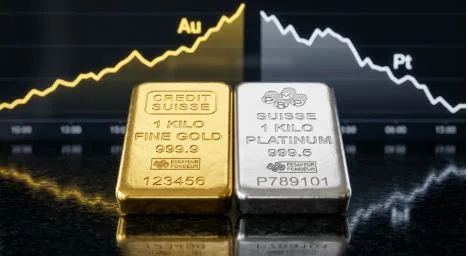
For a long stretch of modern market history, platinum traded at a premium to gold. It was rarer, harder to extract, and carried a luxury association that jewellery marketing reinforced.
That relationship inverted and then persisted in its inverted form for long enough that a generation of traders has never seen the old one. The interesting question is not when it will revert. It is whether the assumption that it should revert was ever sound.
Why the ratio is a poor starting point
The ratio between the two metals became a widely watched indicator, with wide deviations read as a sign that one was mispriced relative to the other.
The flaw is that the similarities between them are mostly superficial. Any platinum price prediction resting primarily on the gap to gold has substituted a chart relationship for an analysis of what actually sets each price — and those two things have almost nothing in common.
Understanding why requires looking at what drives demand for each metal separately.
Gold demand is largely about belief
Gold’s principal demand drivers are monetary and psychological.
Central banks hold it as a reserve asset. Investors buy it as a hedge against currency debasement, inflation and geopolitical disruption. Its price responds to real interest rates, because holding a non-yielding asset costs more when yields are high. It responds to confidence in institutions, because that is what it is insurance against.
Industrial use exists but is a small share of the total. Gold’s price is not meaningfully set by how much of it gets consumed.
This is why gold can rally when economies weaken. Fear is a demand driver.
Platinum demand is largely about output
Platinum’s principal demand drivers are industrial.
Emissions control in vehicles is the largest single use, tying demand to vehicle production volumes, powertrain mix and the stringency of emissions regulation. Chemical, glass, petroleum and electronics applications add further industrial demand. Jewellery is significant and price-sensitive. Investment demand exists but is the smaller part of the picture.
The consequence is straightforward: platinum tends to weaken when industrial activity slows, because less of it gets consumed.
So the two metals face opposite pressures in the same conditions. An environment of economic anxiety and slowing output supports gold and undermines platinum. Expecting a stable ratio across such an environment is expecting two different businesses to report the same earnings.
What actually changed
Several structural shifts contributed, and their combination matters more than any one of them.
Changes in the diesel share of vehicle production altered the demand base for a metal particularly associated with diesel emissions control. Substitution between platinum group metals gave manufacturers a lever that did not previously exist at scale. The growth of electrified powertrains raised questions about the long-run size of the autocatalyst market. Meanwhile gold’s monetary role was reinforced by a long period of unconventional monetary policy and elevated central bank buying.
None of these is a temporary dislocation. They are changes to what each metal is for.
Why mean reversion arguments are weak here
The standard case for trading the ratio is that it has historically returned to a long-run average.
Mean reversion is a reasonable expectation when the mechanism producing the mean is still operating. It is a poor expectation when the underlying drivers have changed. A ratio built on platinum’s role in diesel emissions control carries limited information once that role has shifted.
This does not make the ratio useless. It remains a clean way to express a relative view — that industrial demand will outperform monetary demand, or the reverse. But that is a view about economies and policy, stated in metals. It is not a statistical edge, and treating a historical average as gravity is how people hold losing positions for years.
Where the two genuinely overlap
Two areas connect them.
Jewellery demand shifts between the metals on relative price, which creates a mild stabilising force at extremes.
Investment demand is the more direct link. When investors treat platinum as a precious metal rather than an industrial input, flows can push it in gold’s direction regardless of fundamentals. This tends to be episodic rather than persistent, which is precisely why it makes the relationship unstable rather than reliable.
How to use the comparison
The ratio is a useful framing device and a poor forecasting tool.
A sensible approach builds a view on each metal separately, from its own drivers, and then looks at the ratio to see what that combined view implies.
Platinum should be assessed on vehicle production, emissions policy, substitution economics, mine supply and recycling. Gold should be assessed on real rates, central bank behaviour and institutional confidence.
They may converge again. If they do, it will be because something changed in one of those lists — not because a line on a chart got tired of being far from its average.