Tall boys and traffic jams: Why Bangalore loves the Wagon R
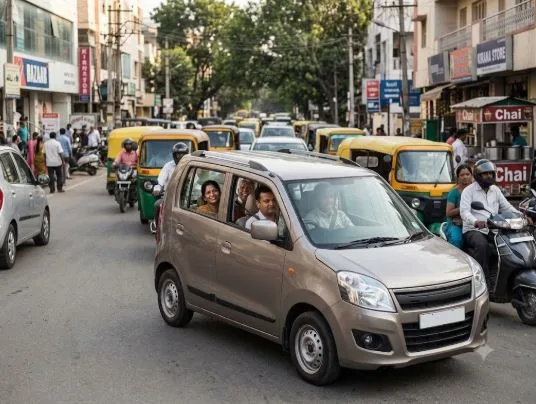
Sit at a signal on Old Airport Road during the evening crawl and start counting Wagon Rs. You’ll run out of fingers before the light turns green. Bangalore has a strange relationship with this boxy little hatchback. It’s not fast, it’s not pretty, and nobody buys one to impress anyone. Yet it keeps selling, keeps getting resold, and keeps holding value in a city where cars spend more time stationary than moving.
The reason has less to do with the badge and more to do with the shape.
Why the boxy shape wins in a choked city
That tall boy design gives the Wagon R a high seating position. One detail. Changes everything.
Sitting upright means you can see over the bonnet of the car ahead, spot the gap opening in the next lane, and read a potholed stretch of Sarjapur Road before the front wheel drops into it, which, if you’ve driven that road after the first monsoon shower, you know isn’t a small thing. Any Bangalore driver will tell you visibility matters more than power when average speeds sit in single digits for half the commute. Nobody’s flooring it through Silk Board. You’re just trying to see what’s happening three cars ahead before it becomes your problem.
The narrow body helps too. Filtering through the lanes behind Commercial Street or squeezing past a parked tempo in Jayanagar is far less stressful in a car this slim.
Browse listings for used cars in Bangalore and the Wagon R surfaces again and again, usually with high kilometre readings and clean service records. That combination tells its own story. These cars get driven hard, but not fast, because the city rarely lets them be.
Ground clearance is the other quiet advantage. Bangalore’s speed breakers range from polite ripples to concrete walls, and the Wagon R clears most without the scraping noise that makes sedan owners wince. Every. Single. Time.
Understanding the engines
Two petrol engines dominate the used market. The 1.0 litre is the older, simpler unit, happy to rev and light on fuel, though it runs out of breath on flyovers when the car’s fully loaded. The 1.2 litre K12-series engine, introduced with the 2019 generation, feel noticeably stronger in third gear, which is where Bangalore commutes mostly live anyway.
The factory CNG option adds another layer. Cleaner, cheaper to run, but the boot loses most of its usable space to the cylinder, and pickup drops noticeably when the petrol tank’s bypassed.
What to actually inspect before buying
A city car this common attracts a wide spread of conditions. The inspection matters more than the price tag. Full stop.
Suspension is the first checkpoint. Bangalore roads chew through front strut mounts and control arm bushes faster than the service schedule suggests they should, and a knocking sound over a rough patch usually means both need replacing at once. Anyone shortlisting Wagon R second hand cars should insist on taking the test drive through a genuinely bad road rather than a smooth one, because every car handles fine on smooth tarmac. That’s not useful information.
Water damage is the second concern, and it’s specific to certain pockets.
Lift the boot mat and the rear seat base. A musty smell that air freshener can’t quite hide is a walk-away signal, not a negotiating point.
For AMT variants, check whether the actuator has been serviced and whether the clutch has already been replaced. For CNG cars, confirm the kit is endorsed on the registration certificate. An unendorsed retrofit creates real problems at fitness renewal, and correction doesn’t move quickly.
Ownership costs and the resale reality
Running costs are where the car quietly justifies itself. Service intervals are long, consumables are cheap, and almost every neighbourhood workshop from Rajajinagar to Marathahalli knows this platform cold. Parts availability is rarely a waiting game.
Bangalore’s used market stays firm because demand comes from three directions at once: first-time buyers, cab operators, and families wanting a second car. A well-kept Bangalore example often looks noticeably better on paper than a comparable car from a more humid coastal city, where underbody rust becomes a meaningful pricing factor, even across the same year and variant.
The trade-offs are honest. Highway stability at speed is average. Road noise builds past eighty. Interior plastics are strictly functional, and nobody’s pretending otherwise. But none of that matters much when the commute is fifteen kilometres of stop-and-start through Electronics City or Whitefield. That’s the Wagon R’s argument. Bangalore keeps agreeing with it, one signal at a time.