Reverse phone lookup social media: How to Research Public Social Profiles
A phone number can be an important piece of information when trying to understand someone’s online presence. In many cases, people know a contact’s phone number but have no idea which username they use on social platforms. Searching by name can also produce too many unrelated results, especially when the person has a common name or uses a different identity online.
A reverse phone lookup social media search offers another way to approach this problem. Instead of beginning with a username, the search starts with a phone number and investigates whether publicly available social information may be associated with it.
This approach can be useful for reconnecting with contacts, checking your own digital footprint, or investigating an unfamiliar number. However, it is important to understand the limitations of phone-based searches and respect the privacy choices made by social-media users.
What Is Reverse Phone Lookup Social Media?
A reverse phone lookup normally begins with a phone number and attempts to identify information connected with that number. When the process focuses on social platforms, the objective is to determine whether the number may be associated with publicly discoverable social accounts.
The term does not mean that a private social-media account can automatically be opened or that a person’s private phone number will become visible.
Social networks have their own privacy and discoverability settings. A person may have a phone number associated with an account while preventing others from discovering the account through that number.
This makes phone-based social discovery a process of finding possible connections rather than obtaining guaranteed identification.
Why Use a Phone Number for Social Discovery?
There are several situations where a phone number can be a useful starting point.
Someone may have an old contact saved on their phone but no longer remember the person’s social username. Searching by name may return numerous profiles, while a phone number can provide a more specific starting point.
Another reason is personal privacy. People can search their own number to understand what information may be associated with it online and whether old accounts or profiles remain publicly discoverable.
Phone-based searches may also provide context when dealing with an unfamiliar number. A publicly available social profile may sometimes help explain who is behind a number, although it should never be considered definitive proof of identity.
How Social-Media Discoverability Works
Social networks use phone numbers for different purposes, including account recovery, security, and contact discovery.
For example, X allows users to control whether people who have their phone number or email address can discover their account. The platform also explains that enabling discoverability does not publicly display the phone number on the profile. (X Help Center)
Other platforms have their own approaches to contact discovery and privacy.
This means a reverse phone lookup social media search can produce different results depending on the platform, the account owner’s settings, and the availability of public information.
A missing result should therefore not automatically be interpreted as evidence that a person does not have a social account.
How Socialprofiler Can Help
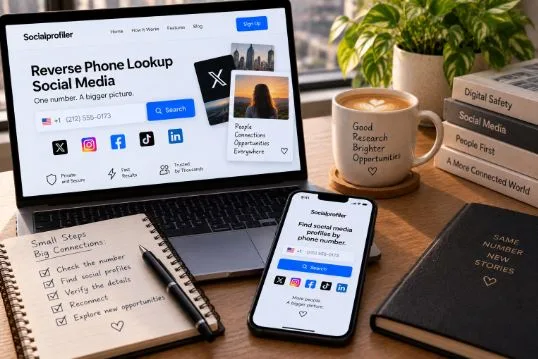
When you have a phone number but do not know which usernames or social platforms to search, Socialprofiler provides a number-first way to begin. You can start with a complete 10-digit U.S. phone number without needing the person’s name, email address, social-media username, profile URL, password, or contact upload.
After signing up, Socialprofiler can provide a Free Preview when a potential match is available. The profile photo remains visible, while identifying details such as the account name and direct profile link are blurred. This lets you assess whether the result appears relevant before accessing the full information.
With the full result, you can review the matched account details and separately check for possible profiles across Facebook, Instagram, TikTok, and X.
For a reverse phone lookup social media search, this creates a more direct starting point than guessing usernames across multiple platforms. Any result should still be treated as a possible match and independently verified.
What Else Can Socialprofiler Show?
Depending on the information available for a potential match, Socialprofiler reports may also include Top Interests, followed accounts, connections such as friends or mutual followers, possible Red Flags, Unusual Aspects, an Executive Summary, and AI-assisted analysis.
These details can provide additional context around a possible match, but they should not be treated as automatic proof of identity.
How to Verify a Possible Social Account
Finding a possible account is only the first stage. Verification is important because phone numbers and online profiles can change over time.
Compare the name
Check whether the profile’s display name matches information you already have. A common name alone is not enough to establish a connection.
Review the username
Some people use similar usernames across multiple services. A matching username can provide useful context, although it should still be treated as supporting evidence.
Check public profile details
Review information such as the biography, location, occupation, website, or interests. Several matching details can provide stronger context than one isolated match.
Examine public activity
Posts and other public activity may reveal information that is consistent with what you already know.
Look at profile images
A profile photo can help distinguish accounts, but photographs can be reused or copied. It should therefore never be treated as conclusive proof.
Why Search Results Can Be Incomplete
There are several reasons why a phone-based social search may not produce useful results.
The account owner may have disabled discoverability through their phone number. The number may have been removed from the account, or the person may have changed numbers.
Phone numbers can also be reassigned. A number that once belonged to one person may eventually be given to someone else.
In addition, some people maintain very limited public profiles. They may use privacy settings that restrict what other users can discover.
These limitations are why responsible verification is essential.
Reverse Phone Lookup and Personal Privacy
Phone numbers are personal information, so searches should be conducted with care.
A legitimate lookup should focus on information that is publicly available or otherwise appropriately accessible. It should not involve bypassing account security, obtaining passwords, reading private messages, or circumventing privacy settings.
If a person has deliberately chosen to make their social profile difficult to discover through a phone number, that decision should be respected.
There is also a risk of mistaken identity. Two people may have similar names, photographs, or other information, and a recycled phone number can make an apparently convincing result misleading.
Checking Your Own Online Footprint
One of the most practical uses of a reverse phone lookup social media search is checking your own information.
Search your own number through legitimate services and review what types of public information may be associated with it.
You may discover an old social account you no longer use, an outdated profile, or information you forgot was publicly accessible.
If you find unnecessary information, review the relevant account’s privacy settings. Removing old accounts and limiting unnecessary public contact information can reduce your digital footprint.
This is especially useful when you have changed phone numbers or stopped using older social platforms.
Using Reverse Lookup for Unknown Numbers
A reverse lookup can also provide context when an unfamiliar number contacts you.
For example, a number may appear in a text message, missed call, or business communication. Public information associated with the number may help you decide whether further investigation is appropriate.
However, a social-media profile should not be treated as proof that a caller is trustworthy.
The Federal Trade Commission warns that scammers may impersonate trusted organizations and use phone calls or messages to obtain money or sensitive information. The FTC recommends caution when dealing with unexpected requests and encourages consumers to verify information independently.
Never provide passwords, one-time codes, financial information, or other sensitive details simply because someone knows your phone number.
What to Do When No Match Appears
A failed search is not necessarily a negative result.
The number may not be connected to a social account, the account owner may have restricted discoverability, or the number may be outdated.
You can use other legitimate information that you already possess, such as a known username, public website, professional profile, or previously shared social link.
What you should not do is attempt to circumvent privacy settings simply because the normal search did not produce a result.
Final Thoughts
A reverse phone lookup social media search can provide a useful starting point when a phone number is the strongest piece of information available. It may help reconnect people, investigate unfamiliar numbers, or review your own online presence.
Socialprofiler provides a dedicated reverse phone lookup service that can help users investigate potential social-media connections associated with a phone number.
Still, phone-based searches have limitations. Privacy settings, changed numbers, recycled numbers, and incomplete public information can all affect the results.
The best approach is to treat every result as a potential lead, verify it through multiple public details, and respect the privacy choices of other users. Used responsibly, reverse phone lookup can be a useful research method without becoming an attempt to access information that someone has chosen to keep private.