AI Development: Building Scalable Solutions for Enterprise Transformation
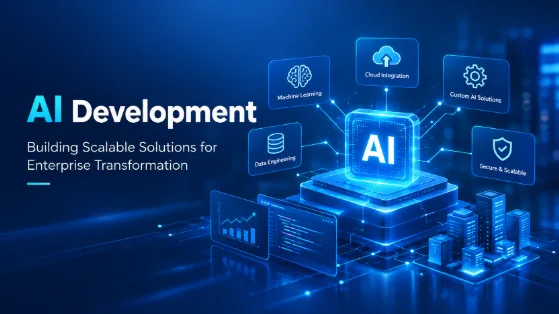
Artificial intelligence is moving from experimentation to a core business capability. Organizations are investing in intelligent applications to automate processes, improve decisions, enhance customer experiences, and create new operating models. Successful AI development requires more than selecting an AI model. It involves strategy, data, architecture, integration, implementation, governance, and continuous performance improvement.
What Is AI Development?
AI development is the process of designing, building, integrating, and optimizing artificial intelligence capabilities for specific business requirements. It can include machine learning, generative AI, predictive analytics, intelligent automation, natural language processing, and AI agents designed to address defined operational or strategic challenges.
Building Business-Focused AI Applications
Effective AI applications begin with clearly defined business objectives. Organizations can identify specific problems, users, workflows, and measurable outcomes before selecting technologies. This approach ensures AI capabilities address genuine business needs while creating a practical foundation for scalable implementation and long-term value.
From Artificial Intelligence Development to Enterprise Value
Modern artificial intelligence development combines data, models, applications, and enterprise workflows to create intelligent capabilities. Organizations can use this approach to improve forecasting, automate repetitive activities, generate insights, and support complex decisions while keeping AI aligned with broader operational and strategic priorities.
Key Approaches to AI Solution Development
Successful AI solution development requires an architecture that balances business requirements, data availability, security, scalability, and user experience. Organizations should determine whether to build, customize, or integrate existing capabilities based on their use case, technical environment, resources, and expected business value.
AI Product Development
AI product development focuses on creating intelligent products or capabilities that deliver value to internal users or customers. From AI-powered applications to intelligent assistants, organizations can embed AI into products to enhance functionality, personalize experiences, automate tasks, and create differentiated digital services.
Enterprise AI Development Solutions
Modern AI development solutions can combine large language models, machine learning, analytics, automation, APIs, and enterprise data. A modular approach enables organizations to develop capabilities that can integrate with existing systems, adapt to evolving requirements, and scale across multiple business functions.
AI Development Services for Enterprise Transformation
Organizations often require specialized expertise to move from an initial concept to a production-ready solution. AI development services can support use-case discovery, architecture design, model selection, application development, testing, deployment, integration, and optimization while ensuring solutions remain aligned with business objectives.
Designing for AI Integration
Successful AI integration connects intelligent capabilities with existing applications, data platforms, workflows, and enterprise systems. Integration specialists can design secure connections between AI applications and business technologies, allowing employees to access intelligent capabilities within familiar processes instead of operating disconnected AI tools.
Supporting AI Implementation
AI implementation services help organizations translate designs and strategies into operational capabilities. This can include infrastructure preparation, data integration, application configuration, testing, deployment, user enablement, and monitoring. A structured implementation approach reduces operational disruption and creates a stronger foundation for scalable enterprise adoption.
Building an AI Strategy for Development
Technology decisions should follow a clear business direction. AI strategy consulting helps organizations prioritize use cases, evaluate readiness, define target capabilities, establish governance, and create implementation roadmaps. This strategic foundation ensures development investments support measurable business priorities rather than isolated experimentation.
Connecting AI Consulting With Business Priorities
AI consulting helps organizations evaluate where intelligent technologies can address operational challenges and create new opportunities. Specialists can assess processes, data, technology environments, and organizational capabilities to identify practical initiatives and establish a development roadmap aligned with strategic business objectives.
Scaling With AI Consulting Services
AI consulting services can provide support across the AI lifecycle, from opportunity assessment and architecture planning to implementation and performance measurement. External expertise can help organizations navigate technology choices, manage complexity, establish governance, and accelerate development while building internal capabilities for long-term sustainability.
Driving AI Adoption Across the Organization
Successful solutions must be adopted by the people and processes they are designed to support. AI adoption depends on usability, employee readiness, training, process redesign, leadership alignment, and appropriate governance. Organizations should treat adoption as an ongoing transformation initiative rather than a one-time deployment activity.
Enabling Employees With Intelligent Tools
AI can augment employees by reducing repetitive work, providing faster access to information, and supporting complex analysis. Organizations can redesign workflows around these capabilities while maintaining appropriate human oversight, enabling teams to spend more time on strategic activities, customer needs, and higher-value decisions.
Establishing Responsible AI Governance
AI development should incorporate governance from the beginning. Organizations can establish controls covering data access, security, privacy, model evaluation, transparency, compliance, and human oversight. Embedding governance into development processes helps organizations scale AI while managing operational, regulatory, and business risks.
Measuring AI Performance and AI ROI
AI initiatives require measurable outcomes to justify continued investment. Organizations should define success metrics before deployment and track operational improvements, financial benefits, adoption levels, quality, productivity, and risk reduction. This enables leaders to evaluate AI ROI and determine where additional investment can create value.
Monitoring AI Performance
AI performance should be monitored continuously after deployment. Organizations can evaluate model outputs, process efficiency, accuracy, user engagement, system reliability, and business outcomes to identify improvement opportunities. Ongoing monitoring helps ensure AI capabilities remain effective as data, processes, and business conditions evolve.
Demonstrating AI ROI
Measuring AI ROI requires connecting technology investments to tangible business outcomes. Organizations can evaluate savings, productivity improvements, revenue opportunities, service improvements, and risk reduction against implementation and operating costs, creating a clear framework for prioritizing future AI investments and scaling successful initiatives.
Accelerate Enterprise AI Development With The Hackett Group®
Turning AI concepts into scalable enterprise capabilities requires a combination of business strategy, technology expertise, data capabilities, and implementation discipline. The Hackett Group® helps organizations identify high-value opportunities, design practical AI roadmaps, develop intelligent solutions, integrate them into enterprise environments, and establish frameworks for measuring business impact.
From AI solution development and product innovation to implementation, integration, adoption, and performance management, organizations can build AI capabilities around clearly defined business outcomes. A structured approach can help reduce development complexity, accelerate time to value, and create a foundation for continuous innovation.
Ready to move from AI ideas to production-ready solutions? Partner with experienced specialists to identify the right opportunities, define your development roadmap, and build scalable AI capabilities that deliver measurable business value.