Thermos Food Jar 101: What It Is, How It Works, & Who It’s Actually For
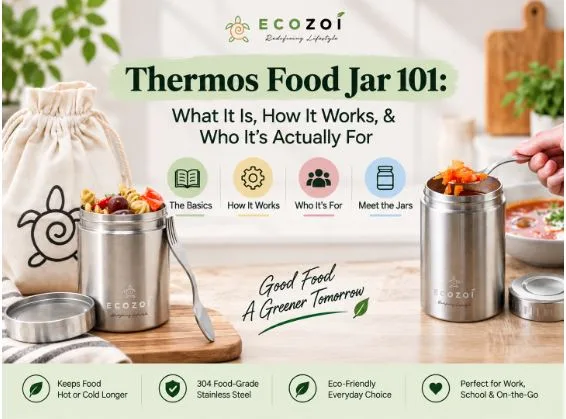
A thermos food jar is a double-wall, vacuum-insulated container built to keep one meal hot or cold for hours. A sealed vacuum gap between two stainless steel walls slows conduction, convection, and radiation, the three ways heat travels. A full, preheated jar holds food hot up to 12 hours and cold up to 24 hours.
Key Takeaways
- Preheating the jar with boiling water for 5 to 10 minutes before filling helps it hold heat longer.
- A food jar suits single dishes, such as soup, chili, pasta, or porridge, better than mixed lunches.
- The 304 food-grade stainless steel liner resists reacting with acidic foods and holding onto odors.
- Commuters, school-lunch families, office workers, and outdoor or on-site workers get the most use from it.
- Stainless steel jars are unsafe in a microwave, so reheat food separately before adding it to the jar.
What a Thermos Food Jar Is
A thermos food jar has an inner wall, an outer wall, and a sealed space between them. The inner wall touches the food. The outer wall is the part you hold. Most of the air is removed from the space in between before the jar is sealed.
That space is what gives the jar its insulating properties. In a regular lunch container, heat can move through the material around the food. In a vacuum-insulated food jar, there is very little in the gap for heat to move through. It does not stop temperature change completely, but it slows it down considerably.
The rest of the design is fairly straightforward. There is an outer shell, a food-contact liner, the sealed vacuum gap, and a lid with a seal of its own. The opening is usually wide enough to make filling easy. You can also eat directly from the jar, which means one less container to bring along.
Ecozoi food jars come with a matching spork and a carry bag. The range includes a 12 oz jar for a smaller meal or snack and a 17 oz version for a more substantial lunch.
A lunch box is usually the better choice when you want to keep several foods separate. A jar works better for one meal, such as soup, chili, pasta, or porridge. It is handy at an office without a microwave, during a long work shift, or at an outdoor job where there is no kitchen nearby.
The inside is made from 304 food-grade stainless steel. Stainless steel is not very reactive with acidic foods, and it does not tend to hold onto smells as much as plastic can.
How a Thermos Food Jar Works
There are three ways heat usually travels: conduction, convection, and radiation. The jar is built to slow all three.
- Conduction is heat moving through a material, such as metal. The vacuum between the steel walls removes most of the material that heat would otherwise travel through.
- Convection needs moving air or liquid. Since the space between the walls has been sealed after the air was removed, there is no normal air current carrying heat around inside that gap.
- Radiation does not need contact. It travels as energy waves. The shiny inner surface reflects some of that energy toward the food instead of allowing it to pass outward as easily.
The lid is easy to overlook, but it matters. The vacuum wall stops below the opening, so the lid and its seal have to prevent heat from escaping through the top. If the lid fits poorly, the jar will not perform as well, even if the vacuum insulation is good.
The steel protects that insulation too. A serious dent can squeeze the gap between the walls and damage it. Stainless steel is used partly because it resists dents and corrosion better than softer materials.
A few terms are worth knowing:
- Double wall: Two stainless steel walls, one inside the other, with a gap between them.
- Vacuum seal: The closed gap from which most of the air has been removed.
- Heat retention: How long hot food stays above room temperature.
- Cold retention: How long chilled food stays below room temperature.
The Ecozoi’s 17 oz & 12 oz thermos insulated food jar will keep food hot for up to 12 hours and cold for up to 24 hours. That means soup packed at seven in the morning may still be hot after lunch.
The word “up to” matters here. Results depend on how full the jar is, how hot or cold the food was to begin with, how often the lid is opened, and the temperature around the jar. A full jar generally does better than a half-full one. Cold winter air can cool hot food faster, while a hot commute can warm a cold lunch.
Preheating is an easy way to give the jar a better start. Fill it with boiling water, leave the water there for five to ten minutes, and then empty it. Add the hot food immediately afterwards. The warmed steel will take less heat from the meal.
Who a Thermos Food Jar Is Actually For
This kind of jar is most useful when lunch has to wait several hours before it can be eaten. It may be a good fit for:
- Commuters who pack lunch well before they eat it.
- Parents whose children cannot reheat food at school.
- Office workers who do not have a microwave, or do not want to use the shared one.
- Outdoor and on-site workers who spend the day away from a kitchen.
Ecozoi Thermos Food Jars: Sizes and What’s Included
Ecozoi makes vacuum-insulated food jars in two sizes: a 12 oz jar for smaller meals and a 17 oz jar for a full lunch.
Each jar uses a 304 food-grade stainless steel liner and comes with a matching spork and carry bag. The 12 oz and 17 oz jars are rated for up to 12 hours of heat retention and up to 24 hours of cold retention.
FAQs
1. How does a vacuum insulated food jar keep food hot?
The air is removed from the space between the two steel walls. That makes it harder for heat to travel through the sides of the jar. The inner wall reflects some radiant heat toward the food, and the lid closes the opening at the top. Together, these features slow the cooling process.
2. How do thermos food jars work?
Food sits inside a steel liner. Around that liner is a sealed vacuum gap, followed by the outer wall. A lid seals the top. Since there is little material between the inner and outer walls, and the opening is covered, heat leaves more slowly than it would from an ordinary container.
3. How long does the Thermos food jar keep food hot?
It depends on the jar and the conditions. The Ecozoi 17 oz & 12 oz vacuum insulated food jar is rated for up to 12 hours of heat retention and up to 24 hours of cold retention. Filling the jar fully and preheating it first can help, but the result will still vary with the food and the surrounding temperature.
4. Who needs a food jar?
A food jar is useful for anyone who packs a meal well before eating it. Commuters, school-lunch families, office workers, and people working outdoors are common examples.
5. Can you put a thermos in the microwave?
No. Stainless steel is not suitable for microwave use. A sealed container may also build up pressure as its contents heat. Heat the food in a saucepan or a separate microwave-safe container, then transfer it to the jar.