How Businesses Can Improve Employee Productivity With Better Workforce Visibility
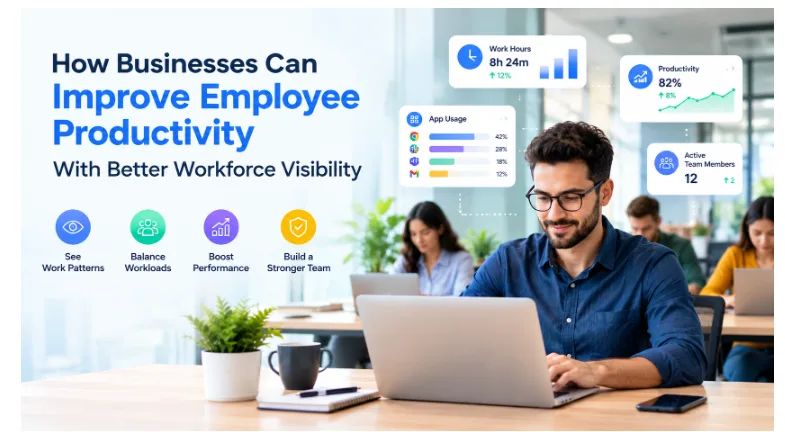
Employee productivity is not always easy to understand from the outside.
A team may be very busy on a day and not be able to finish the projects in time. Staff can join in meetings, reply to messages, update tasks and work in various applications, but vital work is still undeleted.
Many times the issue is not that they aren’t trying hard enough. Managers might not be able to see what’s happening regarding work.
Increased workforce visibility can provide companies with insight into where time is being spent, workload distribution and potential project bottlenecks. But more significantly it can assist managers to look at these problems in advance of they begin to impact delivery.
What Does Workforce Visibility Actually Mean?
Workforce visibility is the presence of helpful information on workforce progress throughout a team.
This can include working hours, attendance, project progress, task completion, workloads, overtime, and resource allocation.
It is not meant to be an exhaustive list of employee actions.
If a project is behind schedule, for instance, workforce visibility can give managers insights into whether the problem is a worker who’s overworked, unreasonable deadlines, unforeseen work, or an inefficient process.
In the absence of this context, managers could reach incorrect conclusions regarding productivity and fail to uncover the true cause of the issue.
How Can Businesses Identify Where Time Is Being Lost?
Businesses cannot increase productivity without knowing how working time is being used.
Of course, the working pattern varies according to the role. Sometimes a developer can take several hours to resolve one technical issue and a salesperson can spend a lot of his or her day talking to prospects.
It’s not all about making every minute count.
Rather, managers can search for trends in the data. For instance, do some of your projects keep taking longer than expected? Is there too much time spent on administration work? Are regular meetings impacting focused work?
That’s where employee productivity tracking can be helpful. Data on time, tasks, projects and work patterns can give firms clues as to areas which could require attention.
It is important to look at patterns, rather than individual days of activity to evaluate employees.
How Can Workforce Visibility Help Balance Workloads?
Unbalanced work loads may directly impact productivity.
One staff member could have multiple critical projects and another could have spare capacity. If managers don’t notice, this situation may continue until the employee becomes overworked and deadline or quality is affected.
Such imbalances can be identified with regular workload reviews.
For example, if there’s a team member who has more high priority work than anyone else, some can be redistributed. This can help relieve unnecessary pressure and maximize capacity utilization.
It’s especially helpful for agencies, consulting firms, IT companies, and all types of service businesses that have workers working on a number of different projects.
Why Should Businesses Compare Planned and Actual Work?
The project budget is not always the same as the actual cost.
An expected 5-hour task takes 8 hours. A project that is supposed to take 100 hours could potentially end up taking 130 hours.
Rather than see this difference as a productivity problem, it should be explored to find out what caused it.
The extra time could have been due to the changing needs, technical challenges, further revisions, unclear responsibilities, or the original estimate was too optimistic.
These patterns can be identified by comparing planned and actual work and can be used to help businesses improve their estimates for future work.
This can lead to better resource planning over time and increased predictability of project delivery.
How Can Businesses Measure Productivity Beyond Activity?
A potentially common mistake is to think that if people are busy, they are productive.
If a businessperson is at multiple meetings, it looks busy; if an employee is working with a client on something tricky for three hours, it doesn’t look busy.
Neither situation tells the complete story.
Effective productivity management should consider outcomes alongside activity.
Depending on the business, useful measures can include:
- Project completion
- Task progress
- Billable hours
- Resource utilization
- Overtime
- Project costs
- Client delivery
- Workload distribution
The right metrics will vary between roles. A customer support team, for example, may need different measures from a software development team.
How Can Businesses Improve Productivity Without Micromanaging?
Workforce visibility is more useful when employees understand its purpose.
Businesses should clearly communicate what information is collected, why it is needed, and how it will be used.
For example, if data shows that a team is regularly working overtime, managers can investigate whether deadlines are unrealistic or whether additional resources are needed.
Similarly, if a particular process consistently takes too long, the business can look at improving the process instead of immediately blaming employees.
This approach makes workforce information a way to improve working conditions and business processes rather than simply a method of checking employee activity.
How Can Workforce Data Improve Project Planning?
Historical workforce data can provide useful information for future projects.
If a company repeatedly discovers that a certain type of task takes longer than expected, those actual figures can be considered when planning similar work.
This can help managers:
- Create more realistic project estimates
- Allocate resources more effectively
- Identify potential bottlenecks
- Plan workloads earlier
- Reduce unnecessary overtime
- Set clearer delivery expectations
The basic process is simple:
Track actual work → identify patterns → improve planning → review the results.
Over time, this can help businesses make decisions based on real working patterns rather than assumptions.
How Can Businesses Turn Workforce Visibility Into Action?
Collecting workforce information is only the first step.
Businesses need a simple process for turning that information into improvements.
Review: Look at relevant working hours, workloads, and project data.
Identify: Find recurring patterns instead of focusing on isolated incidents.
Investigate: Understand whether the cause is workload, process, resources, or planning.
Act: Make a practical change, such as redistributing work or improving a process.
Review again: Check whether the change actually improved the situation.
This keeps workforce visibility focused on continuous improvement rather than creating another reporting exercise.
Final Thoughts
Improving productivity does not always mean asking employees to work harder.
Often, businesses need a clearer understanding of what is happening across their teams and projects. Better workforce visibility can reveal workload imbalances, unexpected time requirements, recurring delays, and processes that need improvement.
When businesses use this information responsibly, they can make better decisions about workloads, project planning, resources, and processes.
The goal is simple: understand how work is happening, identify what is getting in the way, and make practical changes that help both employees and the business perform better.
FAQs
What is workforce visibility?
Workforce visibility is the ability to understand how employees spend working time, how workloads are distributed, and how work progresses across projects and tasks using relevant workforce data.
How does workforce visibility improve employee productivity?
It helps managers identify workload imbalances, time-consuming processes, project bottlenecks, and recurring productivity gaps so they can take targeted action.
Is employee productivity tracking the same as employee monitoring?
Not necessarily. Productivity tracking can focus on work patterns, project progress, time allocation, and outcomes. Employee monitoring may involve broader activity or device-level information. Businesses should define what they need to measure and use data proportionately.
How can businesses improve productivity without micromanaging employees?
Set clear expectations, measure meaningful outcomes, use workforce data to identify process problems, and focus management conversations on support and results rather than constant activity checks.
Can workforce visibility help remote and hybrid teams?
Yes. It can give managers a consistent view of working hours, workloads, attendance, and project progress when teams operate across different locations.