How solarisblack.com Defines Multi-Asset Trading Today
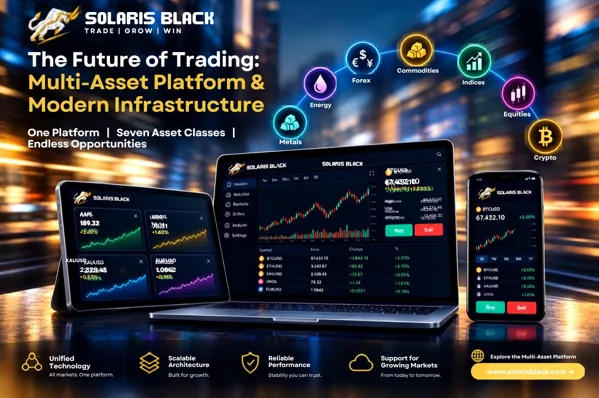
The trading technology landscape is changing fast. Across retail and institutional markets alike, the demand for smarter, faster, and more unified trading infrastructure has never been stronger. Traders no longer want to juggle five different platforms for five different asset classes. They want one powerful system — built from the ground up for the markets of today and tomorrow.
That is exactly what solarisblack.com is designed to deliver.
In this article, we explore the broader shift happening across the trading platform industry, why legacy architecture is falling behind, and how platforms like Solaris Black are setting a new benchmark for modern, scalable, multi-asset trading infrastructure.
The Problem With Legacy Trading Architecture
For years, the foundation of most trading platforms was built on legacy technology. These systems worked well enough for earlier generations of market activity — but as trading environments have grown more complex, their limitations have become harder to ignore.
The core issue with legacy architecture is not that it stops working overnight. It is that expanding it becomes increasingly difficult over time. When a platform is built in layers — different components developed at different stages of a company’s growth — adding new asset classes, integrating new technologies, or improving the user experience requires working around an increasingly complicated technical foundation.
The result is what developers call technical debt: a growing backlog of outdated code and workarounds that slows innovation, increases the risk of errors, and makes the platform more expensive to maintain with every passing year.
For trading businesses, this technical debt has real consequences. It limits their ability to respond to market changes quickly. It makes it harder to meet the rising expectations of modern traders. And it puts them at a competitive disadvantage against newer platforms that have been built with a clean, modern architecture from day one.
The Industry Shift Toward Multi-Asset Trading Infrastructure
Alongside the move away from legacy systems, a second major trend is reshaping the trading platform industry: the rise of multi-asset infrastructure.
Traditionally, different asset classes required entirely separate systems. A trader dealing in forex would use one platform. Equities required another. Crypto another. Commodities and indices yet another. For active traders working across multiple markets, this fragmented approach created serious inefficiencies — multiple logins, multiple interfaces, multiple sets of data feeds, and no unified view of their overall positions.
Modern traders and financial businesses are demanding something better: a single, unified platform that brings all major asset classes together under one technology framework.
This is not simply about displaying multiple markets on the same screen. True multi-asset infrastructure means the underlying architecture is capable of handling different asset classes through a shared, scalable system — delivering consistent performance, consistent data, and a consistent user experience across every market.
Introducing solarisblack.com: Multi-Asset Infrastructure for Modern Markets
Solaris Black, accessible at www.solarisblack.com, has been developed around a single core idea: that modern trading technology should not be constrained by the limitations of legacy architecture.
Where older platforms add layers on top of existing systems, solarisblack.com has been built with scalability and flexibility as foundational principles — designed from the start to support the complexity and pace of today’s digital markets.
The platform currently supports seven asset classes within a single technology environment, including:
- Forex — major, minor, and exotic currency pairs
- Commodities — including metals, energy, and agricultural products
- Indices — global equity indices
- Equities — individual stocks across major markets
- Crypto — leading cryptocurrencies and digital assets
- And additional asset categories within its expanding infrastructure
For traders and financial businesses, what makes solarisblack.com genuinely different is not the number of markets available — it is the quality of the infrastructure connecting them. All seven asset classes are accessible through one unified platform, with a consistent interface, scalable architecture, and a technology foundation built for growth.
Why Scalability Is the Most Important Feature Nobody Talks About
When traders evaluate platforms, they often focus on the most visible features: the interface, the charting tools, the available instruments. What gets far less attention — but matters just as much — is the underlying infrastructure.
Scalability is the ability of a platform’s architecture to grow alongside the business and the markets it serves — without becoming slower, more fragile, or harder to maintain as it expands.
For solarisblack.com, scalability was built into the platform’s DNA from the beginning. As market coverage grows, as user bases expand, and as new technologies emerge, the platform’s architecture is designed to absorb that growth without requiring a fundamental rebuild every few years.
This matters enormously for the financial businesses and institutional participants who rely on the platform. Infrastructure downtime, performance degradation during high-volume periods, or technical failures during critical market moments are not just inconveniences — they are commercial risks. A platform built on a scalable, modern architecture is inherently more reliable than one stretched across layers of legacy components.
As Marcus Reid, CEO of Solaris Black, puts it:
“Traders don’t want five platforms stitched together — they want one platform built for where the market is actually heading.”
One Platform, Seven Asset Classes: A New Standard for Trading Technology
The practical benefit of what solarisblack.com has built is straightforward: traders and financial businesses no longer have to choose between breadth and quality.
With older, fragmented approaches, covering more markets often meant accepting lower quality in each — because resources were spread across multiple disconnected systems. With a unified multi-asset infrastructure, all asset classes benefit from the same foundational technology, the same performance standards, and the same ongoing development investment.
For retail traders, this means a simpler, more powerful trading experience — with access to a wide range of markets through a single login and a single interface.
For financial businesses and institutional participants, it means a more efficient operational foundation. Managing risk, accessing data, executing strategies across multiple markets — all through one unified technology environment rather than several separate systems with separate workflows, data feeds, and support requirements.
This is the direction the industry is heading, and solarisblack.com is already there.
The Broader Industry Direction: Integration, Flexibility, and Future-Ready Infrastructure
The trends driving platforms like Solaris Black are not isolated to one corner of the market. Across fintech broadly, the movement is toward greater integration, greater flexibility, and infrastructure designed to adapt rather than simply expand.
Forex and crypto trading technology are developing at a rapid pace. User expectations — shaped by the best digital experiences across every industry — are rising constantly. Regulatory environments are evolving. New instruments and market structures continue to emerge.
In this environment, the platforms that will define the next decade of trading technology are not the ones with the most features today. They are the ones with the most capable, most adaptable, and most future-ready infrastructure.
solarisblack.com has been built with exactly that future in mind.
Why solarisblack.com Stands Out in a Crowded Market
There is no shortage of trading platforms competing for attention. What genuinely distinguishes solarisblack.com from the field comes down to three things:
- Architecture-First Design Rather than adding features to an existing legacy foundation, Solaris Black was designed from the ground up around the requirements of modern digital markets. This produces a more coherent, more reliable, and more scalable technology environment.
- True Multi-Asset Coverage Seven asset classes. One platform. One unified experience. This is not a marketing claim — it is the architectural reality of what solarisblack.com has built.
- A Vision Aligned With Market Direction The CEO’s vision for Solaris Black is not about chasing today’s trends. It is about building infrastructure that is positioned for where trading technology is going — toward greater integration, smarter data environments, and platforms that serve traders across the full complexity of modern markets.
Also Read About: Delta Executor
Final Thoughts: The Next Generation of Trading Infrastructure Is Already Here
The trading platform industry is in the middle of a genuine transformation. Legacy architecture is giving way to modern, scalable systems. Fragmented multi-platform workflows are being replaced by unified infrastructure. And traders at every level are demanding more from the technology they use every day.
solarisblack.com represents a concrete, fully realized example of what that next generation looks like in practice — a multi-asset trading platform built without the compromises of legacy architecture, designed for the complexity of modern markets, and ready to grow alongside the traders and businesses that use it.
Whether you are an active retail trader looking for a better way to manage positions across multiple markets, or a financial business evaluating modern platform infrastructure, Solaris Black is worth serious consideration.
To explore the platform and learn more about its multi-asset infrastructure and technology approach, visit www.solarisblack.com.
FAQ Section
Q: What is solarisblack.com? A: solarisblack.com is the official website of Solaris Black, a modern multi-asset trading platform that supports seven asset classes — including forex, crypto, equities, commodities, and indices — through a single, unified technology infrastructure.
Q: How many asset classes does Solaris Black support? A: Solaris Black currently supports seven asset classes, including forex, commodities, indices, equities, and cryptocurrencies, all accessible through one platform.
Q: Why is Solaris Black different from other trading platforms? A: Unlike platforms built on legacy architecture, solarisblack.com was designed from the ground up with scalability and multi-asset support as core architectural principles — not afterthoughts.
Q: Who is the CEO of Solaris Black? A: Marcus Reid is the CEO of Solaris Black. He has been central to the platform’s development philosophy of building infrastructure aligned with the future direction of trading technology.
Q: Where can I learn more about Solaris Black? A: You can explore the full platform and its infrastructure at www.solarisblack.com.
— Marcus Reid, C.E.O., Solaris Black
Visit www.solarisblack.com to learn more.