Test 400 vs Test E vs Sustanon: How Blends Differ and Who They Suit
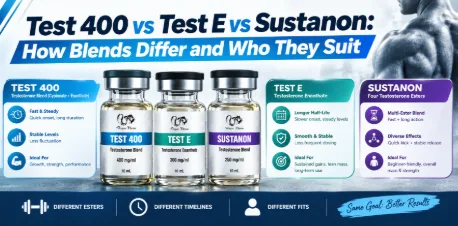
Guest contribution. The author writes about anabolic steroid pharmacology. This article is editorial commentary, not medical advice, and it contains no dosing guidance.
Few questions in this market get asked more often, and few are answered worse. “What is the difference between Test 400, Test E and Sustanon” sounds like a question about three different drugs. It is not. It is a question about three different ways of delivering the same hormone, and understanding that distinction is what makes the answer simple instead of tribal.
The short version is that the active molecule is identical in all three cases. What differs is the ester attached to it, the number of esters involved, and the concentration of the oil — and those three variables determine how the product behaves, how often it is administered, and how much discomfort it causes. They do not determine what the hormone does.
The ester is the whole story
Testosterone on its own is poorly suited to injection. It is absorbed and cleared quickly, which makes for a short and unstable window. Attaching a fatty acid chain — an ester — to the molecule solves this, because the body has to cleave the ester off before the testosterone becomes active. The longer the chain, the slower the release from the injection site.
That single principle explains every product in this category. The ester does not change the hormone. It changes the rate at which the hormone becomes available, and rate is what the entire conversation is actually about.
| Ester | Typical release profile |
|---|---|
| Propionate | Short — days |
| Phenylpropionate | Short-to-medium |
| Isocaproate | Medium |
| Enanthate / cypionate | Long — roughly a week |
| Decanoate | Long |
| Undecanoate | Weeks |
Two esters in that table, enanthate and cypionate, are the ones most people mean when they say “Test E” and “Test C”. They are close enough in behaviour that the distinction between them is largely a matter of which one a given market supplies. Both are single-ester products, which is the important structural point: one molecule, one ester, one predictable release curve.
What Sustanon actually is
Sustanon is not a different drug, and it is not a stronger one. It is a blend of four testosterone esters in a single oil, and the standard 250 mg formulation distributes them in a deliberate ratio: a small amount of fast-acting propionate for an early rise, two medium esters for the middle, and a larger amount of decanoate to carry the tail.
The design intent is a release curve that starts quickly and finishes slowly — effectively a self-contained blend that behaves like several esters administered at once. Higher-concentration versions marketed as 270 follow the same four-ester concept with the total adjusted upward, which changes the amount per millilitre rather than the idea.
The practical consequence is stability. A multi-ester blend produces a flatter overall curve than a single short ester, which is the argument usually made for it. The counter-argument is that the ratios are fixed by the manufacturer: you get the release profile they chose, and you cannot adjust one component without moving the others.
Where Test 400 fits, and why the name confuses people
Test 400 is not an ester, and it is not a compound. The number refers to concentration — 400 milligrams per millilitre of oil, as opposed to the more usual 250 or 300.
The reason such products exist is arithmetic: at a higher concentration, a smaller volume of oil delivers the same quantity of hormone. If volume is the constraint — and in an oil-based injectable it usually is, because the injection site has a limited tolerance for fluid — then concentration is the lever.
The trade-off is tolerability at the injection site. High-concentration oil preparations are consistently associated with more post-injection discomfort, because the depot has to disperse a greater amount of drug from the same tissue. This is not a matter of product quality; it is a consequence of the concentration itself, and it is the most common reason people who try a 400 go back to a 250.
Blend composition at that concentration varies between manufacturers in a way that single-ester products do not. One 400 may be predominantly cypionate and enanthate; another may include propionate for an early rise. The label tells you the total. It rarely tells you the ratio, and the ratio is what determines the curve. A buy test 400 product page that states its ester composition is therefore more informative than one that does not — and where composition is unstated, the release behaviour is a guess.
The three side by side
| Aspect | Test E / Test C | Sustanon | Test 400 |
|---|---|---|---|
| What the name means | An ester | A branded four-ester blend | A concentration |
| Esters per product | One | Four | Varies by manufacturer |
| Onset | Slow | Faster, because of the propionate component | Depends on the blend |
| Curve shape | Predictable, gradual | Flatter, with a longer tail | Unpredictable if the ratio is unstated |
| Typical concentration | Around 250 mg/ml | Around 250 mg/ml, higher in 270 variants | 400 mg/ml |
| The main trade-off | Slower onset | Ratio fixed by the manufacturer | More injection-site discomfort |
Read down that table and the pattern is obvious: one row describes chemistry, one describes formulation, and one describes arithmetic. None of them describes a difference in the hormone.
What genuinely differs between the three
Stripping away the marketing, four things differ, and only four.
Frequency of administration. The shorter the esters involved, the more often the product has to be injected to keep levels stable. Propionate alone is the extreme case; enanthate and cypionate sit at the comfortable end; blends sit in between depending on their composition.
Stability of the curve. Single long esters give a slow rise and a slow decline. Blends give a faster onset with a longer tail. Neither is superior in the abstract — they suit different preferences about consistency versus onset.
Injection volume and discomfort. This is where concentration matters, and it is the difference most people actually notice in practice. A 400 delivers the same amount of hormone in less oil, at the cost of more local reaction.
Predictability. A single-ester product behaves the way its half-life says it will. A blend behaves the way its ratio says it will, and if the ratio is not on the label, it behaves unpredictably. That is a genuine argument for single esters, and it is not the one usually made.
What does not differ
The active hormone is testosterone in every case. Once the ester is cleaved — and it is cleaved, completely, before the molecule becomes active — the body sees testosterone, and nothing about which ester carried it changes what testosterone does.
This is the point that the entire debate obscures. Test 400 is not a stronger hormone than Test E. Sustanon is not a different hormone from either. A higher number on the vial is a higher concentration of the same thing, and “blend” describes a release profile rather than a distinct pharmacological entity.
Two consequences follow. First, comparisons of the type “which one gives better results” have no meaningful answer, because the variable that would differ is timing rather than effect. Second, any claim that one of these formats is fundamentally more potent than another is a claim about concentration, which is arithmetic, or about esters, which is timing.
It is worth being precise about the cleavage step, because it is where the confusion originates. Esterases in the body hydrolyse the ester bond, and the fatty acid chain is removed entirely — it is not partially retained, and it does not confer any effect of its own. What remains is testosterone, identical to the testosterone that every other format in this article delivers.
That is why the “different ester, different drug” framing collapses under scrutiny. The ester is a delivery mechanism with a release rate attached, and once it has done its job it is gone. Two products with different esters are not two different drugs any more than two envelopes are two different letters.
The one place the difference does register is in detection. Ester identity affects which metabolite markers appear and for how long, which is a sporting question rather than a pharmacological one, and it has no bearing on what the hormone does in the body.
Reading the label properly
The most common error in this category is not pharmacological. It is arithmetic, and it happens at the point of purchase.
Two numbers appear on an injectable listing and they are routinely confused. The first is concentration in milligrams per millilitre. The second is total content, which is concentration multiplied by the volume of the vial. A 10 ml vial at 400 mg/ml contains 4,000 mg. A 1 ml ampoule at the same concentration contains 400 mg. Both are labelled “400”, and they are not remotely the same purchase.
The same confusion applies to blends in a second way. A blend’s total milligram figure tells you how much hormone is in the vial, not how it is distributed across esters — and distribution is what determines the release curve. Two products both labelled 400 can have materially different behaviour, which is why the composition matters more than the headline number.
That is the practical case for buying from a source that publishes its composition and its batch documentation rather than one that advertises a concentration. Dragon Pharma Store’s testosterone range lists the formats side by side, which at least makes the comparison possible on the numbers rather than on the marketing.
Two other formats are worth knowing because they come up in the same searches. buy sustanon 270 is the higher-concentration variant of the four-ester concept described above — same idea, larger total. And buy test enanthate is the single-ester benchmark: one molecule, one ester, one predictable curve, and the format against which the blends are usually being compared.
How to think about choosing between them
There is no dosing advice in this article, and the choice between formats is a clinical question rather than a product one. What can be said is what the trade-offs actually are, so that the question can be asked properly.
Single long esters trade onset speed for stability and predictability. Blends trade predictability for a faster start and a longer tail. High concentrations trade injection volume for local tolerability. Every one of those is a genuine trade with a real cost on both sides, and none of them is about potency, because all three products contain the same hormone.
The other variable is documentation. A single-ester product from a source with batch-specific analysis and a stated concentration is a known quantity. A blend with an unstated ratio and no analytical data is not, regardless of what number is printed on the vial.
The short version
Test 400, Test E and Sustanon contain the same active hormone. The differences are the ester, the number of esters, and the concentration — which is to say, release speed, curve shape and injection volume.
That is genuinely all that separates them, and it is a shorter list than the arguments suggest. The relevant questions are about timing and tolerability, not about strength, and the most valuable piece of information on any of these listings is not the number on the front but the ester composition and the batch documentation behind it.
Disclaimer: This article is for informational purposes only and does not constitute medical advice or a recommendation to use testosterone products. Testosterone preparations may carry significant health risks and should only be used under qualified medical supervision.