Crypto VPS: Why developers and traders pay for servers in Bitcoin, USDT and Monero
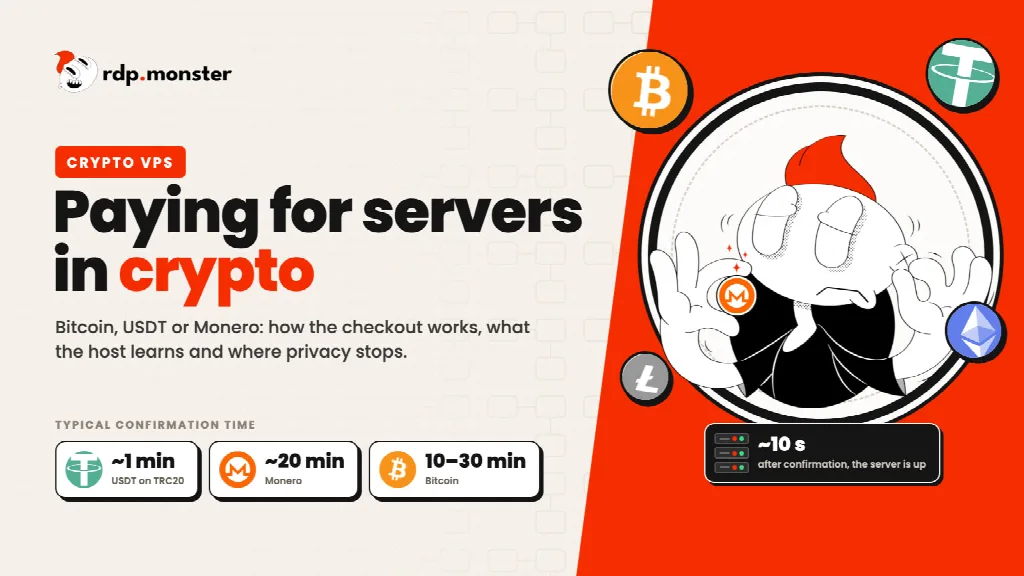
Paying for a server by bank card is still the norm, yet a growing number of developers, algorithmic traders and remote workers now settle their hosting bills in cryptocurrency. What they buy is usually called a crypto VPS, and the reasons range from the practical (cards declined by foreign merchants) to the principled (not wanting a card number stored by yet another company). Taking rdp.monster, which sells Windows RDP and Linux VPS plans, as the case study, this article explains how buying works, what the seller learns and where privacy ends.
A crypto VPS is a rented virtual server that the customer orders and renews with digital currency, such as Bitcoin, the USDT stablecoin or Monero, rather than a card or bank transfer. The provider switches it on once the blockchain confirms the payment.
Why developers and traders pay for servers in crypto
For many buyers, crypto is simply the money they already use. A trader who keeps working capital in USDT, or a developer paid in Bitcoin for freelance work, sees little point in moving coins back to a bank only to pay a hosting invoice. For others, the card is the obstacle: in a number of countries, locally issued cards are routinely declined by foreign subscription services. Paying in crypto also leaves no card details with the host.
rdp.monster is among the hosts that accept coins at checkout. It rents Windows RDP and Linux VPS servers located in Europe and the USA. Each server runs on KVM, with dedicated CPU cores and RAM and full admin or root access. The entry-level Basic plan is $8.99 monthly for two cores, 6 GB of ECC DDR4, a 40 GB NVMe drive and a 1 Gbps port, while a High Performance line built around the AMD Ryzen 9 7950X with DDR5 memory starts at $13.99. Crypto payments cost the same as card, PayPal or SBP, with no surcharge. The company also said on 17 September 2026 that current prices will hold through 31 December 2027.
How to buy a VPS with crypto, step by step
At rdp.monster, whose crypto VPS plans accept at least ten cryptocurrencies, including Bitcoin (BTC), Tether (USDT on TRC20 or ERC20), Monero (XMR), Litecoin (LTC) and Ether (ETH), the steps are:
- Choose a plan, a region (Europe or the USA), an operating system and a billing cycle: monthly, quarterly (11% off) or yearly (two months free), with no setup fee.
- Create an account with an email address. No identity documents are requested.
- Select the coin and, for USDT, the network. The checkout then shows the amount due and the address to send it to.
- Send the payment, then wait while the network confirms it.
- About ten seconds after on-chain confirmation, the server is ready.
Two habits prevent most problems: send the exact amount shown, allowing for any exchange withdrawal fee, and use the same network in the wallet as at checkout, since funds sent on the wrong one can be hard or impossible to recover. Crypto transfers are also final, with no card-style chargeback. If a payment gets stuck, rdp.monster runs 24/7 human support, backed by an AI tech bot.
Confirmation times: why the coin matters
The ten-second clock starts only after confirmation, and that part depends on the blockchain, not the hosting company.
- Bitcoin: a block arrives roughly every ten minutes, so a payment typically clears within 10–30 minutes, with the fee and the required confirmations deciding where it lands.
- Monero: blocks come about every two minutes, but payments are usually treated as settled after around ten blocks, or roughly 20 minutes.
- USDT on TRC20: the TRON network usually confirms within about a minute, which is why many traders default to it. ERC20 works too, though Ethereum fees tend to be higher.
What the provider knows, and what it does not
A no-KYC VPS is one sold without “know your customer” identity checks. At rdp.monster, opening an account takes an email address and nothing else. On a crypto payment the host sees what any merchant receiving coins sees: the amount, the coin, the network and the transaction record. It does not receive a name, a card number or a bank account.
That is a narrower data footprint than a card purchase, but not invisibility. If the coins were bought on a regulated exchange, that exchange holds the buyer’s identity and a record of the withdrawal. No-KYC hosting also does not suspend the law: tax rules and the host’s terms of service still apply.
Stablecoin or volatile coin: the USDT VPS question
Plans are priced in dollars, so a volatile coin is converted at the rate on the day of payment. Bitcoin’s price can move while a transaction waits for confirmation, and in some jurisdictions spending crypto counts as a taxable disposal. Those who pay for a VPS with Bitcoin usually do so because they already hold it and accept the exposure.
A USDT VPS avoids that arithmetic: an $8.99 plan costs roughly 8.99 USDT plus the network fee, month after month. The trade-off is that USDT is issued by a single company, Tether, which can freeze tokens at specific addresses. Many traders accept that, as stablecoins already anchor their workflow.
Privacy limits of a crypto VPS
On Bitcoin and USDT, every payment sits on a public ledger. Anyone holding the transaction ID or the receiving address can read the amount and timestamp, and chain-analysis companies make a business of connecting addresses. Monero was built the other way round: its ledger conceals who paid, who was paid and how much, by default. That is why privacy-minded buyers often prefer paying with Monero over Bitcoin.
Even Monero protects only the transaction. It does not mask the IP address a buyer connects from, nor the email on the account. Those need separate care, such as a dedicated email address for infrastructure accounts and a trusted VPN.
Who a crypto VPS suits
- Traders who hold USDT and need a machine online around the clock for trading terminals or automated strategies.
- Bot developers running trading or Telegram bots on Linux with root access, who fund infrastructure from the project wallet.
- People in card-decline regions whose domestic cards fail at foreign merchants but who can legally obtain stablecoins.
It suits buyers less well if they want the option of disputing a payment through their bank, or have never sent crypto before. For them, rdp.monster also accepts card, PayPal and SBP payments at identical prices.
Frequently asked questions
Is a crypto VPS more expensive than paying by card?
Not at rdp.monster, where crypto carries no surcharge. The buyer pays only the blockchain network fee.
Can you pay for a VPS with Bitcoin without identity checks?
Yes. rdp.monster asks for nothing beyond an email address and requests no ID documents. The exchange where the Bitcoin was bought may still hold identity data.
How long does a crypto payment take to confirm?
USDT on TRC20 usually confirms within about a minute, Monero in roughly 20 minutes and Bitcoin in 10–30 minutes. Provisioning then takes about ten seconds.
Does paying with Monero make a buyer anonymous?
It keeps the payment private on-chain but does not hide the buyer’s IP address or email, which need separate protection.