Why South Lebanon’s Deadliest Areas Got Less News Coverage
Most fatal attacks documented during Lebanon’s March 2026 escalation occurred in the south. But those same attacks were substantially less likely to appear in international English-language news coverage.
A computational study by researcher Mohamed Soufan examined 229 fatal location-days reported by Lebanon’s National News Agency between March 2 and March 31. South Lebanon and Nabatieh accounted for 83.4 percent of the documented cases, yet only 44.9 percent of resolved cases there received international coverage, compared with 72.7 percent elsewhere in the country.
The finding raises a question that goes beyond how many stories were published. If the area experiencing most of the documented fatal violence was less likely to enter the international news cycle, what shaped that imbalance—and what does it mean for how the conflict was understood outside Lebanon?
Rather than identifying a cause, the study provides evidence of a measurable geographic disparity in international news attention.
The Geography of the Coverage Gap
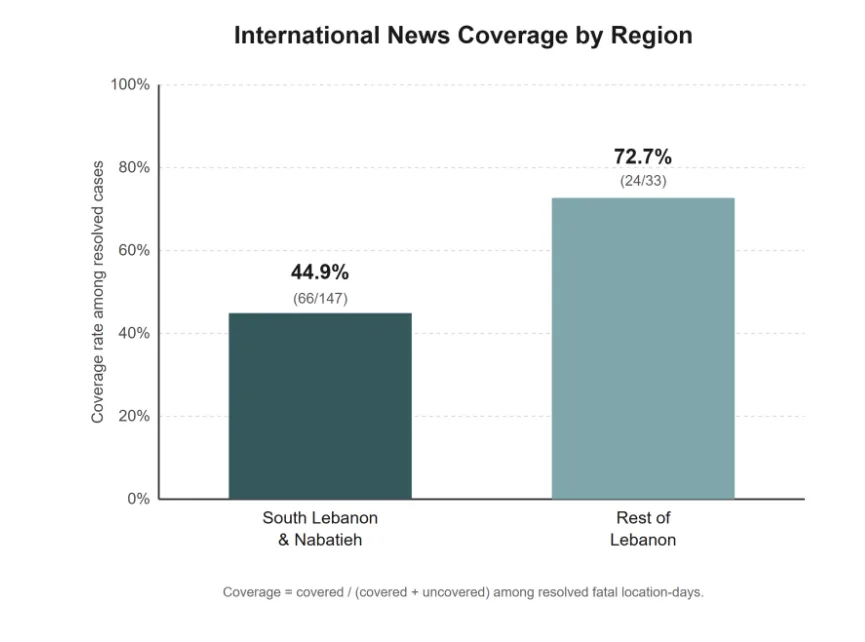
The disparity was not simply a matter of some attacks receiving more attention than others. It followed a clear geographic pattern.
Of the 229 fatal location-days identified by the study, coverage status could be resolved for 180. Half of those cases—90 in total—received no qualifying coverage from the non-Lebanese English-language news sources examined.
The association remained statistically significant, although the observational study cannot determine what caused it. In an analysis adjusting for death toll and calendar week, fatal location-days in South Lebanon and Nabatieh had approximately 65 percent lower odds of receiving international coverage than cases elsewhere in Lebanon.
That result is important because it suggests the difference was not explained simply by attacks elsewhere involving more deaths or occurring during particularly news-intensive weeks. The geographic disparity remained statistically significant, although the observational study cannot determine what caused it.
Why Some Fatal Attacks Become More Visible Than Others
International coverage is shaped by more than the severity of an event. Journalists also work within practical constraints: where correspondents are based, how quickly information can be verified, whether reliable sources are available, and whether an incident is picked up by major wire services.
Those factors can matter especially during conflict, when newsrooms are processing multiple developments at once. An attack that can be independently confirmed, photographed or reported by journalists on the ground may be easier to cover than one occurring in an area with limited access or fewer established reporting networks.
International outlets also frequently rely on a relatively small number of agencies, correspondents and local sources for breaking information. Once an incident enters that reporting chain, it can spread across multiple publications. Events that do not enter it may remain largely local, regardless of their significance.
The study does not determine whether any of these mechanisms produced the gap in Lebanon. But the findings point toward a broader question: what happens between an attack occurring on the ground and that event becoming visible to an international audience?
When Repeated Violence Becomes Routine
Another possibility is that repeated violence gradually becomes less newsworthy in editorial terms, even when its human cost remains severe.
News organizations tend to give greater attention to events that appear new, unusual or politically consequential. When attacks occur repeatedly in the same region, individual incidents may be treated as part of an ongoing pattern rather than as distinct developments requiring separate coverage.
South Lebanon has long been associated with cross-border conflict, which may shape how new attacks are perceived by editors and audiences. Violence there can risk being understood as expected, while a fatal attack in a less frequently targeted area may appear more exceptional and therefore attract greater attention.
This does not mean newsrooms deliberately discount deaths in familiar conflict zones. But repetition can influence editorial judgment. Over time, what is extraordinary for the people experiencing it may begin to look routine from outside.
What Unequal Visibility Means for South Lebanon
The measured disparity has consequences for how the conflict can be understood beyond Lebanon. If fatal attacks in the region bearing most of the documented violence are less likely to reach international audiences, the news record may give readers an incomplete sense of where the conflict’s human cost is concentrated.
That matters beyond immediate public attention. International reporting feeds into subsequent coverage, policy discussions, humanitarian assessments and research. Incidents that remain outside that reporting ecosystem have fewer opportunities to shape the broader account of what happened and where.
The effect can accumulate. When individual attacks from the same region repeatedly fail to enter international coverage, the issue is no longer simply whether one event received a headline. The cumulative record itself can become geographically uneven.
For South Lebanon, the study therefore raises a larger question about visibility in conflict: when the place experiencing the greatest concentration of documented fatal attacks is proportionally less represented in international reporting, how complete is the picture that reaches the rest of the world?