Understanding NPK Ratios and What They Mean for a Healthy Lawn
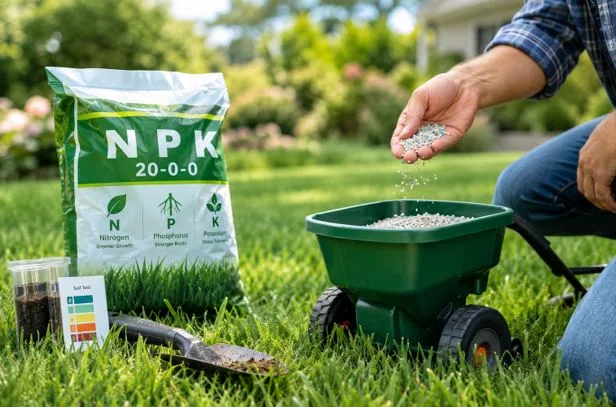
Ever stood in a garden aisle, staring at a fertilizer bag, and wondered what those three numbers are trying to tell you? You’re not alone.
Numbers like 10-10-10 or 20-0-0 can look like some strange lawn-care code, but they’re actually giving you useful information about the nutrients inside the bag. Get familiar with nitrogen, phosphorus, and potassium, and choosing fertilizer becomes a lot less guesswork.
Here’s how to read those numbers and figure out what your grass actually needs.
What Those Three Numbers Actually Mean
That N-P-K trio is just percentages by weight.
A 50-pound bag of 16-4-8 holds 8 pounds of nitrogen, 2 pounds of phosphorus, and 4 pounds of potassium. The rest? Filler and micronutrients. So the bag’s total weight matters less than how much of each nutrient your grass actually gets. That distinction trips up a lot of people.
N Is About Growth and Green Color
Nitrogen fuels blade growth and that deep green everyone craves. Push too much, and you get weak, sappy growth that invites disease and demands constant mowing.
Quick-release nitrogen spikes fast but fades in weeks. Slow-release options stretch feeding over 8 to 12 weeks, with less burn risk and better uptake—research shows slow-release nitrogen can push absorption above 70%, versus roughly 40% for untreated urea.
P and K Play Different Roles
Phosphorus handles root development and energy transfer.
The problem is, most established lawns already have enough of it. Minnesota actually restricts phosphorus fertilizer statewide unless a soil test proves a deficiency.
Potassium is the quiet workhorse—it strengthens cell walls and improves drought tolerance. You won’t see it greening anything, but when heat hits, low-potassium grass folds first.
How NPK Ratios Change Your Fertilizer Choice
Once you understand what the numbers represent, comparing fertilizer products gets much easier. A lawn product with 20-0-0 isn’t trying to do the same thing as one labeled 10-10-10.
Gordon’s fertilizer range illustrates that nicely, with products carrying different combinations such as 15-0-0, 20-0-0, 27-0-2, and 10-10-10. You can view these lawn fertilizer products to see how formulations vary depending on their intended use.
Here’s a simple way to think about a few common ratios:
| NPK Ratio | Nutrient Emphasis | Potential Use |
| 10-10-10 | Nitrogen, phosphate, and potash | General fertilizer applications |
| 20-0-0 | Nitrogen | Situations where nitrogen is needed |
| 27-0-2 | Nitrogen with some potassium | Supporting vigorous turf growth |
| 15-0-0 | Nitrogen | Products formulated around nitrogen supply |
Gordon’s 20-0-0 liquid fertilizer, for example, is listed as containing micronutrients and covering up to 6,000 square feet per gallon. Its 2.5-gallon size covers up to 15,000 square feet.
Those coverage figures matter, too. Fertilizer isn’t something to splash around until the lawn looks shiny. The application rate is part of the equation.
Read the Soil Before You Read the Bag
Here’s the part most people skip.
Penn State’s turf guidelines indicate that when soil tests show high phosphorus levels, phosphate can be omitted from the fertilizer program and nitrogen used instead.
You’re just wasting money and risking runoff at that point. A soil test costs less than a season of guessing and tells you exactly what’s missing.
If you won’t test, Kansas State suggests sticking with a turfgrass formulation like 3-1-2 and applying when grass is actively growing. Timing matters almost as much as the ratio itself.
A Healthier Lawn Starts With the Right Numbers
Nitrogen pushes growth. Phosphorus roots it. Potassium hardens it against whatever the season throws. Your soil might not match your neighbor’s, and that’s fine.
Test when you can. Pick a ratio that fills the actual gaps. Apply it when the grass can use it. The bag tells you what’s inside—your soil tells you what’s needed.
Listen to the dirt, not the shelf.