ACH Payment Fees for Small Business: Look Beyond One Transaction Price
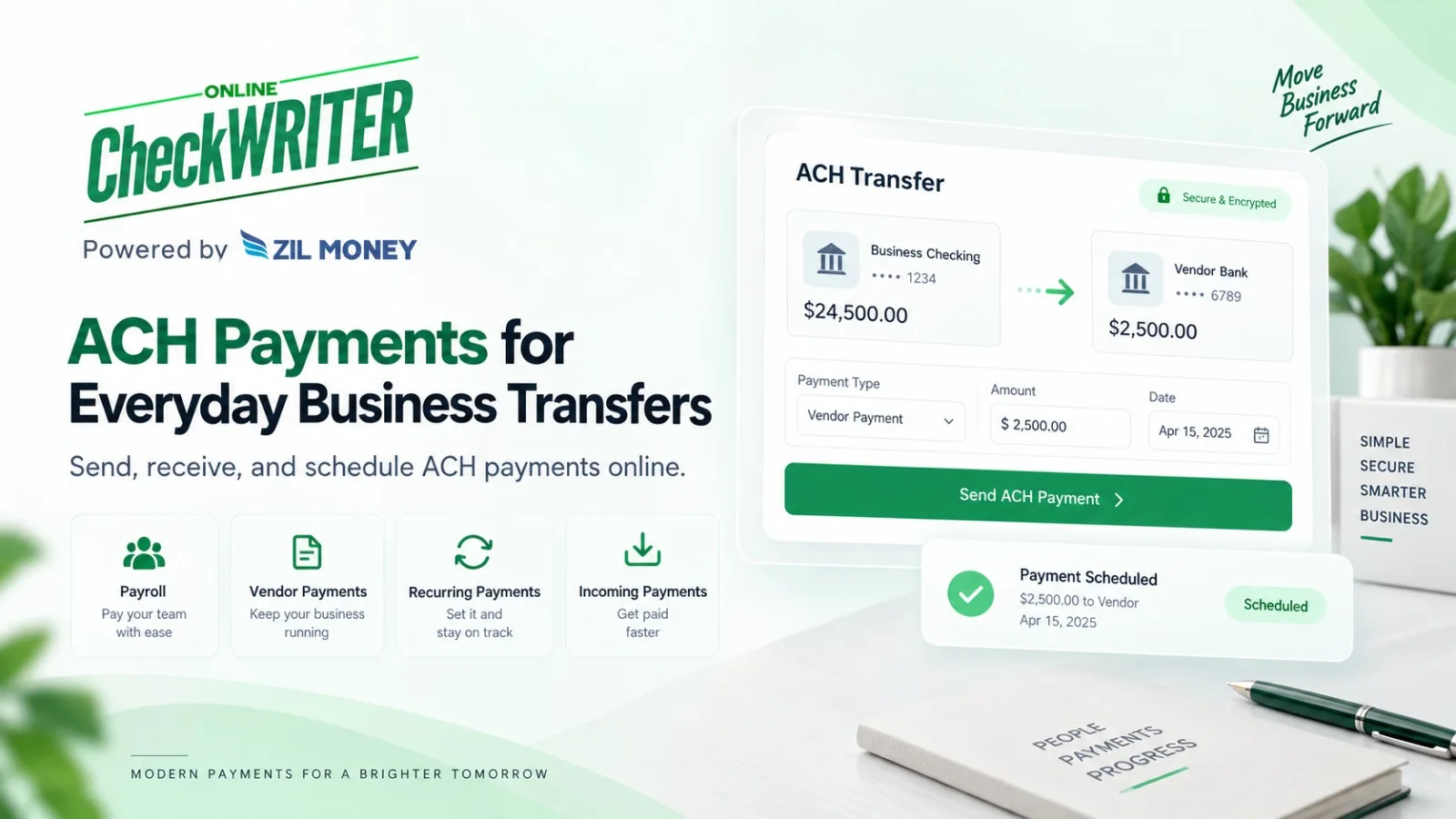
Disclosure: This article was published as part of a paid partnership with OnlineCheckWriter.com, a Zil Money platform. The author is an independent contributor.
Small businesses researching ACH payment fees for small business often expect one standard price for every ACH transfer.
There is no universal customer fee.
ACH is the payment network. The bank, fintech platform, payroll provider, accounting system, or payment processor that gives a business access to that network decides how it charges its customers.
That distinction matters when comparing providers.
ACH Network Costs Are Not the Same as Your Provider Fee
The Federal Reserve’s FedACH service has its own interbank service fees, but those are not automatically the price a small business pays to send an ACH transaction.
For example, the Federal Reserve’s 2026 FedACH fee schedule lists per-item charges assessed within its service structure. A bank or payment platform can then use its own pricing model for business customers.
A small business therefore should not search for one “official ACH fee” and assume it applies everywhere.
Instead, check the provider’s current customer pricing.
Providers Can Charge in Different Ways
An ACH provider might use a flat transaction charge, a percentage with a cap, monthly subscription pricing, included transaction credits, or volume-based pricing.
The total cost can also differ between standard ACH and faster ACH services.
That means two platforms advertising ACH may produce different costs for the same business.
A company sending five payments a month should evaluate pricing differently from one sending hundreds of vendor payments.
Same Day ACH Can Have Different Pricing
Same Day ACH uses the same ACH Network but moves eligible transactions on an accelerated schedule.
Nacha currently states that Same Day ACH supports eligible payments of up to $1 million per payment. That limit is scheduled to increase to $10 million on September 17, 2027.
A provider may charge differently for Same Day ACH than for standard ACH.
Businesses should therefore compare both the timing and the current provider fee rather than assuming “ACH” has only one price.
Be Careful With OnlineCheckWriter.com Fee Numbers
OnlineCheckWriter.com’s current documentation confirms support for standard ACH and Same Day ACH. However, its support center currently shows several different ACH pricing references across separate articles.
For that reason, businesses should check the live pricing page or the fee displayed for the transaction before submitting a payment.
Add Other Costs to the Comparison
The transaction fee is not always the only relevant cost.
Ask whether the platform also has a subscription, minimum monthly spend, funding charge, expedited-payment fee, integration cost, or another applicable charge.
Then consider internal work.
If one platform requires staff to manually enter every payment and another allows supported batch or accounting workflows, the difference in staff time may matter even when the transaction fee appears similar.
Do not invent a dollar value for that staff time. Measure your own process.
Compare Cost With the Payment Requirement
ACH is particularly useful for scheduled and recurring business payments. Nacha lists B2B transactions, payroll, bill payments, and account transfers among common ACH uses.
For routine vendor payments, standard ACH may provide the timing the company needs.
For an eligible payment that must move during the same banking day, Same Day ACH may be worth considering.
The business should match the service level to the deadline instead of automatically paying for the fastest option.
Build the Calculation Around Real Volume
To compare ACH payment fees for small business, estimate the number of monthly ACH payments, average payment value, percentage needing faster processing, subscription requirements, and any related payment-platform costs.
Then check each provider’s current terms.
OnlineCheckWriter.com supports ACH within its broader payment platform, but businesses should use the current transaction pricing shown by the platform rather than relying on an old fee quoted in an external article.
That gives finance teams a more accurate answer than treating ACH as though every provider charges the same amount.
OnlineCheckWriter.com – powered by Zil Money, is a financial technology company, not a bank. Banking and money movement services are provided through partner financial institutions and licensed service providers. FDIC insurance coverage applies only to eligible deposit products and accounts, and is subject to applicable terms, conditions, limitations, and requirements. Additional information regarding partner institutions, products, and services is available in the applicable terms and agreements.