Is It Legal to Print Your Own Checks? What Check 21 Does and Does Not Say
Disclosure: This article was published as part of a paid partnership with OnlineCheckWriter.com, a Zil Money platform. The author is an independent contributor.
Is it legal to print your own checks? For a legitimate payment drawn on an account you are authorized to use, businesses and account holders can create their own original check documents instead of buying only bank-issued pre-printed checkbooks.
But a common explanation for this practice is wrong:
Check 21 did not create a general right to print checks at home or in the office.
Understanding that distinction helps businesses avoid misleading claims.
What Is a Check Legally?
Under Uniform Commercial Code Article 3, a check is generally a draft payable on demand and drawn on a bank. The legal definition focuses on the payment instrument and obligation, not on whether the physical check came from a particular commercial check printer.
State law, account agreements, fraud laws, bank rules, and check-processing standards can still matter.
Printing a legitimate check drawn on your own authorized account is very different from creating a check on an account you do not control or altering someone else’s payment.
The latter can involve fraud and other legal violations.
What Did Check 21 Actually Do?
The Check Clearing for the 21st Century Act became effective in 2004.
The Federal Reserve explains that its main purpose was to reduce legal barriers to electronic check processing.
The law allowed banks to truncate original paper checks, exchange check information electronically, and create a new paper instrument called a substitute check when paper was still needed.
A qualifying substitute check can be the legal equivalent of the original.
That is what Check 21 addresses.
Check 21 Is Not a Home-Printing Permission Rule
A common marketing claim says, “The Check 21 Act makes it legal to print your own checks.”
That is an oversimplification.
The Federal Reserve’s own Check 21 FAQ discusses people printing checks at home, but it does so while explaining MICR requirements.
It also specifically states that the magnetic-ink requirement for original MICR lines is not the result of the Check 21 Act.
Therefore, the better explanation is that Check 21 modernized bank check processing. It did not create the underlying ability of an account holder to issue an original check.
The MICR Line Still Matters
If you print the entire check, including the MICR line, Federal Reserve guidance says the MICR line should be printed in magnetic ink.
If the check stock already has a pre-printed MICR line, other information such as the payee, date, and amount can be printed using normal ink.
This technical requirement should not be hidden behind a broad statement that any printer or paper will work in every situation.
Will Every Bank Accept Every Self-Printed Check?
That is a separate question.
A check can be legitimate without every financial institution or deposit method treating every format identically.
Bank processing systems, mobile-deposit policies, merchant policies, print quality, MICR setup, and account agreements can affect acceptance.
OnlineCheckWriter.com’s current Blank Checks page recommends printing using a setup that meets the bank’s check-printing requirements and checking with the bank if uncertain.
That is the safer advice.
How Does OnlineCheckWriter.com Fit?
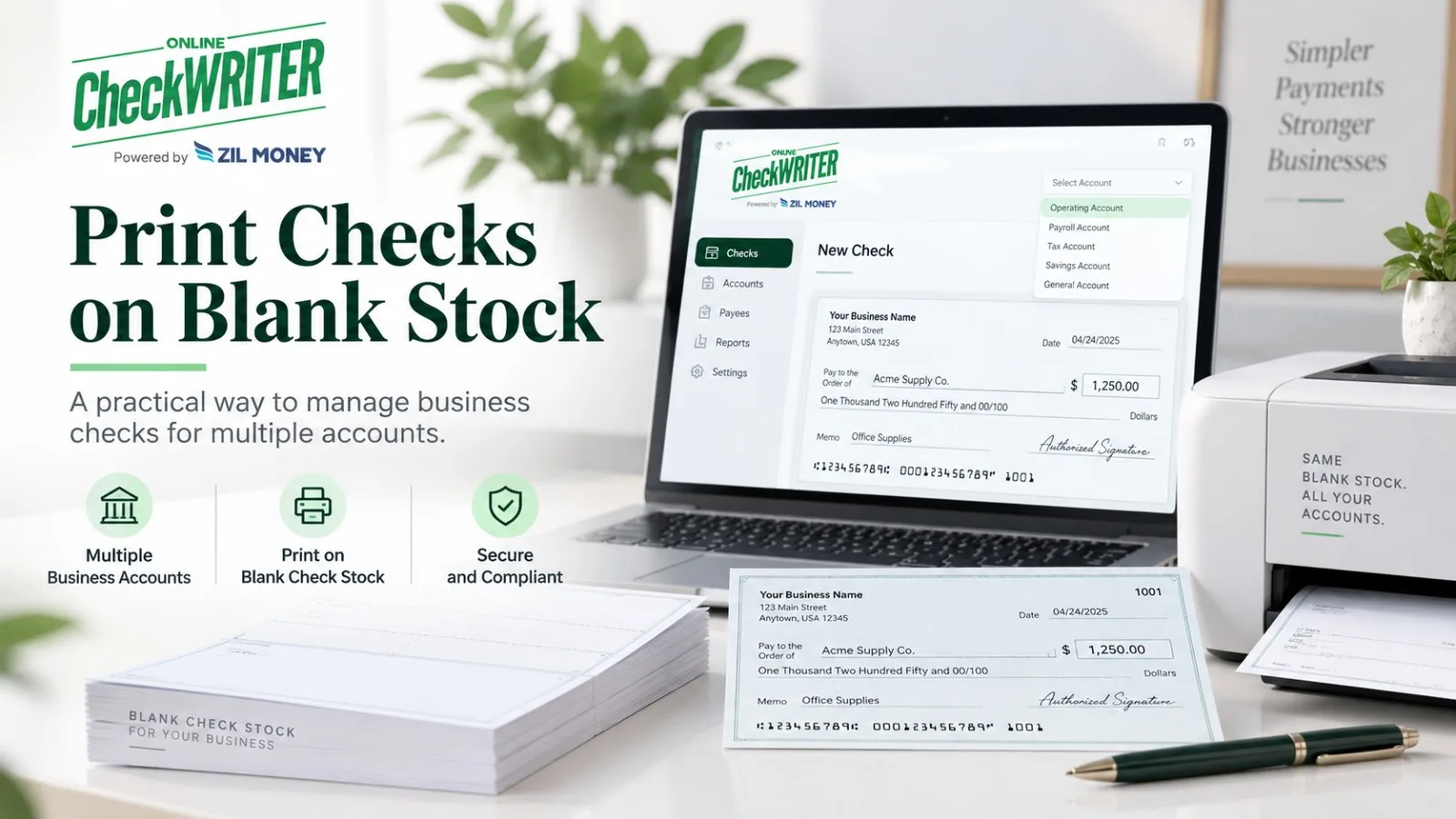
OnlineCheckWriter.com allows authorized users to create and print checks from existing bank accounts on blank stock.
The software handles check layout and account information based on the account selected by the user.
It should not be described as a bank, and using check-printing software does not override a financial institution’s requirements.
The Practical Answer
So, is it legal to print your own checks?
For legitimate checks drawn on an account you are authorized to use, self-printing is a recognized check-issuance practice.
But do not use Check 21 as a blanket legal justification, do not assume universal acceptance, and do not ignore MICR and bank requirements.
This article provides general information about check printing and is not legal advice.
OnlineCheckWriter.com – powered by Zil Money, is a financial technology company, not a bank. Banking and money movement services are provided through partner financial institutions and licensed service providers. FDIC insurance coverage applies only to eligible deposit products and accounts, and is subject to applicable terms, conditions, limitations, and requirements. Additional information regarding partner institutions, products, and services is available in the applicable terms and agreements.